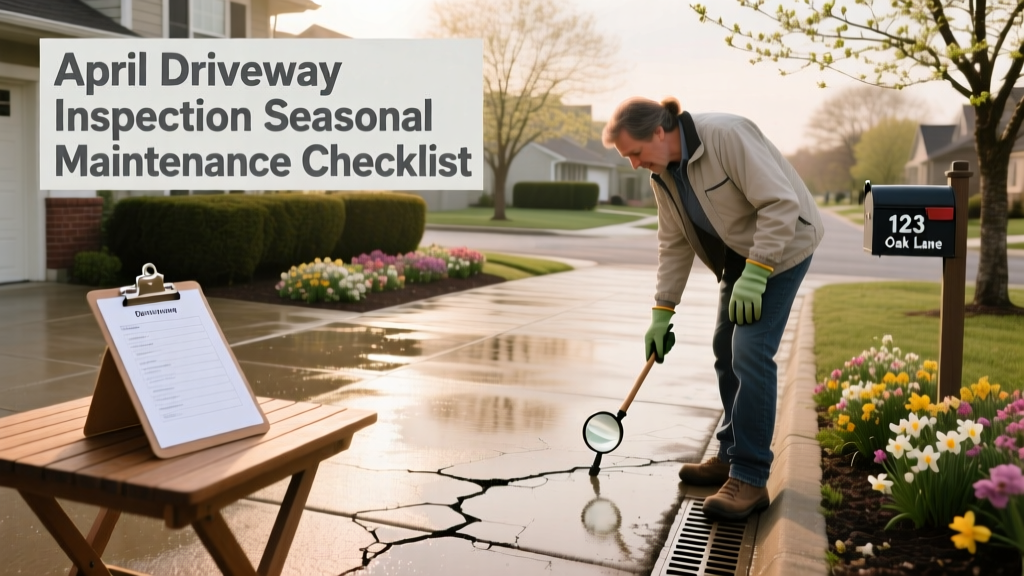
April is the sweet spot for driveway inspection: winter’s freeze-thaw cycles have done their work, but spring rains haven’t yet masked surface flaws or washed away telltale signs of deterioration. This month gives you clear visibility into damage before it worsens — and before summer heat makes asphalt repairs messy or concrete sealing ineffective.
Priority Tasks
| Task | Time Required | Difficulty | Tools Needed |
|---|---|---|---|
| Walk-and-inspect full surface | 15–20 min | Easy | Notepad, phone camera |
| Fill hairline cracks (≤¼") | 45–60 min | Moderate | Crack filler, caulking gun, stiff brush |
| Assess and mark larger cracks or spalling | 20–30 min | Easy | Chalk, measuring tape, flashlight |
| Check slope and drainage paths | 25–35 min | Moderate | Level, garden hose, bucket of water |
| Clean oil stains and organic growth | 30–50 min | Moderate | Baking soda/vinegar or commercial degreaser, stiff broom, pressure washer (≤1,500 PSI) |
Detailed Task Breakdown
Walk-and-inspect full surface
Start at the garage or house entrance and walk the entire driveway slowly — don’t rush. Look down, not ahead. Pause every 6 feet to crouch and examine texture. Note locations where water pooled after recent rain (use chalk to mark). Pay special attention to transitions: where concrete meets asphalt, near garage doors, and along curb edges. Take photos from multiple angles — especially of discoloration, flaking, or soft spots that indent under light foot pressure.
Fill hairline cracks (≤¼")
Sweep debris from cracks using a stiff nylon brush — never metal, which can widen fissures. Dampen the crack lightly (not soaked) to help filler adhere. Load flexible, cold-pour asphalt crack filler into a caulking gun; apply steadily while moving backward to avoid stepping in fresh material. Smooth with a putty knife angled at 30°, then let cure 24 hours before driving. Pro tip: Don’t overfill — material should sit just below surface level to allow for thermal expansion.
Assess and mark larger cracks or spalling
Measure crack width with calipers or a ruler. If ≥¼" wide or deeper than ½", it needs professional evaluation or routing before filling. For spalling (chipped, pitted areas), probe gently with a screwdriver — if material crumbles or lifts, it’s structural. Mark these zones with fluorescent chalk and note depth, length, and proximity to joints. According to the American Concrete Institute’s Concrete Repair Guide (2022), untreated spalls wider than 2 inches often indicate sub-base erosion and require excavation.
Common Seasonal Problems
April reveals three signature driveway issues: frost heave-induced buckling (especially on clay-heavy soil), efflorescence on concrete (white powdery residue signaling moisture migration), and algae/moss mats forming in shaded, low-slope zones. These aren’t just cosmetic — efflorescence means water is wicking upward through capillaries, accelerating rebar corrosion in reinforced slabs. Moss holds moisture against surfaces, softening binders in asphalt and promoting freeze-thaw spalling.
- Frost heave: Look for raised sections >⅛" above adjacent surface, often near property lines or tree roots
- Efflorescence: Wipe with dry cloth — if white dust remains, test pH with litmus paper (≥10 = high alkalinity = active moisture movement)
- Moss/algae: Grows fastest where runoff from gutters pools — check downspout extensions and grading near foundation
Tools & Supplies
Keep these on hand before April begins — many items double as prep tools for May gutter cleaning or June deck inspection:
- Stiff-bristle push broom (non-metal)
- 1-gallon sprayer for degreasers or moss inhibitors
- Asphalt crack filler (e.g., Road Rescue or Crack-Stix)
- Concrete patch compound (for spalls >1" deep)
- 12" spirit level + 8' straightedge (to verify slope)
- Work gloves rated for chemical resistance (ASTM D6319-21)
How soon after rain should I inspect?
Wait until the surface is dry to the touch but still shows subtle sheen — usually 24–36 hours after light rain, 48+ hours after heavy rain. Wet surfaces hide fine cracks but exaggerate drainage flaws. A damp-but-dry window lets you spot both seepage paths and micro-fractures.
Can I seal my driveway in April?
Only if air and surface temps stay above 50°F for 48 hours before and after application — and no rain is forecast. Most acrylic sealers need 72 hours to fully cure. Asphalt sealcoating too early risks blistering; concrete sealers applied in cool, humid conditions may cloud or peel. Check your product’s data sheet — SealMaster’s 2023 Application Handbook notes that 62–75°F is the optimal range for adhesion and film formation.
What’s the difference between cracking and crazing?
Crazing is a network of fine, shallow (≤1/16" deep), non-structural cracks — like dried mud — caused by rapid surface drying during curing or winter salt exposure. It rarely requires repair unless moisture intrusion is visible beneath. True cracking runs deeper, follows straight or angular paths, and often widens over time. Crazing covers < 5% of surface area in most cases; structural cracks typically start at joints or load points.
Is pressure washing safe for older driveways?
Yes — but only at ≤1,500 PSI and with a 25° or 40° fan tip, held 12–18 inches from surface. Older concrete (pre-1990) and deteriorated asphalt can delaminate under higher pressure. Test first in an inconspicuous corner. Never use a zero-degree tip — it removes aggregate and accelerates erosion. The U.S. Department of Transportation’s Pavement Preservation Manual (2021) warns that improper pressure washing accounts for 22% of premature residential driveway failures.
Do I need to re-grade my driveway if water pools?
Not always. First try redirecting runoff with a French drain or extending downspouts 5–6 feet away. If pooling persists in the same spot for >2 hours after rain, measure slope with your level and straightedge: ideal grade is 1/8" per foot (1% slope). If deviation exceeds ¼" over 10 feet, consult a contractor — DIY re-grading risks undermining base layers or violating local stormwater ordinances.
"April inspections catch 70% of driveway issues before they cost more than $1,000 to fix — but only if you document findings and act within two weeks." — Home Maintenance Alliance, 2023 Residential Infrastructure Report
Don’t let April slip by with a cursory glance. That small crack near your mailbox? It’ll triple in width by July. That slight dip near the garage? It’ll hold standing water all summer, inviting weeds and accelerating decay. Your driveway isn’t just pavement — it’s your home’s first line of defense against weather, wear, and water. Tackle these steps now, and you’ll add 3–5 years to its service life — without needing a full replacement. Pair this with our April garden bed prep guide to wrap up seasonal readiness top to bottom.