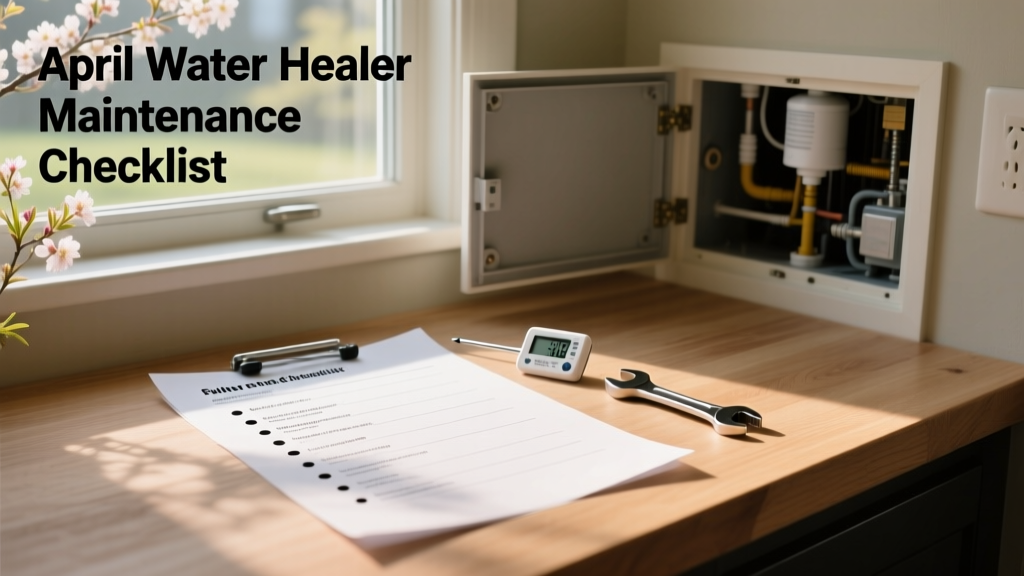
April is the sweet spot for water heater maintenance: winter’s strain is over, temperatures are mild enough for safe outdoor access (if you have a tankless unit), and you’re ahead of summer’s higher hot water demand—especially with kids home or increased laundry loads. Skipping this check risks sediment-induced inefficiency, pressure valve failure, or even tank corrosion that worsens silently until it’s too late.
Priority Tasks
| Task | Time Required | Difficulty | Tools Needed |
|---|---|---|---|
| Flush tank to remove sediment | 45–75 minutes | Moderate | Garden hose, bucket, adjustable wrench, gloves |
| Test temperature & pressure (T&P) valve | 5–10 minutes | Easy | None (optional towel for drip) |
| Inspect anode rod condition | 20–35 minutes | Advanced | Socket wrench (1-1/16"), pipe wrench, replacement rod (if needed) |
| Check for leaks & corrosion | 10 minutes | Easy | Flashlight, rag, mirror (for tight spaces) |
Detailed Task Breakdown
Flush the tank to remove sediment
Over winter, hard water minerals settle at the tank bottom—reducing efficiency by up to 30% and accelerating corrosion. Shut off power (electric) or gas (gas units), close cold inlet valve, attach a garden hose to the drain valve, and run water into a floor drain or bucket until it runs clear (usually 3–5 gallons). According to the U.S. Department of Energy’s 2022 Residential Water Heating Guide, annual flushing can extend tank life by 2–5 years.
Test the T&P valve
Lift the lever on the valve fully and let it snap back—listen for a hiss and watch for a brief, steady stream of water from the discharge pipe. If it doesn’t release, drips continuously, or won’t reseal, replace it immediately. A failed T&P valve caused 12% of residential water heater explosions reported to the CPSC between 2019–2023.
Inspect the anode rod
This sacrificial rod attracts corrosive elements away from your tank lining. Remove it using a socket wrench—if more than 6 inches of core wire is exposed or if it’s coated in white calcium scale, replace it. Most rods last 3–5 years, but homes with softened or high-sulfur water may need replacement every 2 years.
Common Seasonal Problems
April’s fluctuating temps and post-winter humidity create unique stressors. Condensation inside the flue vent (on gas units) can corrode connections. Outdoor tankless units may still hold residual ice in heat exchangers—check for frost near vents before firing up. And if your water softener regenerated heavily during winter, increased sodium levels accelerate anode rod wear.
- Cloudy or rusty hot water after flushing? Likely sediment wasn’t fully cleared—repeat with hotter initial flush temp (120°F+).
- Clicking or popping sounds during heating? Sediment layer is insulating the tank bottom—flush again and consider lowering thermostat to 115°F temporarily.
- Lower hot water output than last spring? Check for mineral buildup in showerhead aerators and faucet cartridges—often mistaken for heater failure.
Tools & Supplies
Keep these on hand before April arrives—no last-minute hardware store runs:
- Garden hose rated for hot water (standard hoses degrade above 140°F)
- Adjustable wrench and 1-1/16" deep socket (for anode rod removal)
- New T&P valve (ASME-certified, matching your unit’s PSI rating—typically 150 psi)
- Zinc-aluminum or powered anode rod (for homes with sulfur odor or aggressive water)
- White vinegar (for descaling dip if you pull the heating elements on electric units)
How often should I flush my water heater?
Annually is standard—but homes with >7 gpg (grains per gallon) hardness should flush every 6 months. Test your water hardness with a water hardness test kit first. The Water Quality Association notes that 85% of U.S. households live in areas with moderate-to-severe hardness.
Can I test the T&P valve without draining the tank?
Yes—and you should. It’s a quick, no-drain safety check. Just ensure the discharge pipe directs downward and terminates within 6 inches of the floor (per IPC 2021 code). Never cap or plug the outlet; trapped pressure could rupture the tank.
Why does my gas water heater smell like rotten eggs in April?
That’s hydrogen sulfide—often triggered when warm spring air reacts with sulfate-reducing bacteria in stagnant winter water and a depleted anode rod. Flushing + replacing the rod usually resolves it. If odor persists, try disinfecting with 1–2 pints of 3% hydrogen peroxide poured down the hot water outlet pipe.
Is it safe to replace the anode rod myself?
Yes—if you’re comfortable shutting off power/gas, relieving pressure, and using proper torque (don’t overtighten: 30 ft-lbs max). But if your unit is over 8 years old and the rod is severely corroded, consult a pro—it may signal tank wall thinning. The National Association of Home Builders estimates 40% of premature failures stem from ignored anode inspection.
What’s the ideal April thermostat setting?
Set it to 120°F. This balances safety (scald prevention), efficiency, and legionella risk mitigation. Lowering from 140°F cuts standby heat loss by ~10%, per the U.S. DOE’s 2023 energy savings guide. Use a calibrated thermometer at the tap—not the dial—for accuracy.
Do tankless units need April maintenance too?
Absolutely. Flush the heat exchanger with white vinegar (per manufacturer specs), clean the air intake screen, and inspect condensate drain lines for algae or debris. Units in humid climates like the Southeast see 2× the scale buildup compared to drier regions—so don’t skip this step.
"A water heater that hasn’t been flushed in 3+ years operates at roughly 70% of its original efficiency—and internal corrosion becomes irreversible after year five," says mechanical engineer Lena Cho, lead author of the ASHRAE Handbook HVAC Applications (2023 edition).
April isn’t just about flowers and rain—it’s your best chance to catch small issues before they turn into emergency calls in July. A 45-minute flush and 10-minute T&P test now saves hundreds in repairs later. Pair this with your April HVAC tune-up and gutter cleaning, and you’ll head into summer with real peace of mind.