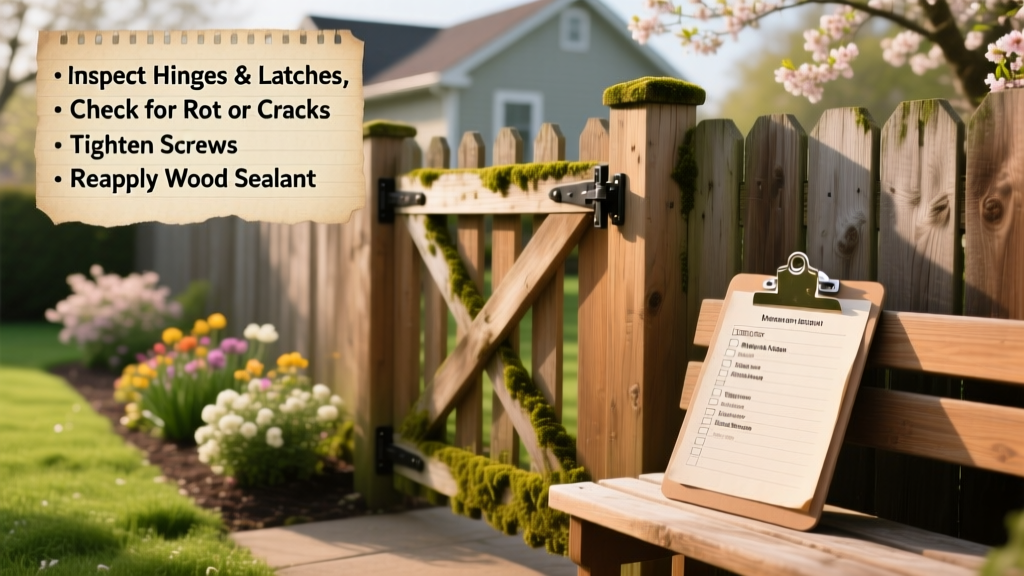
April is the sweet spot for fence gate maintenance: winter’s freeze-thaw cycles have done their work, but heavy summer rains and humidity haven’t yet masked underlying problems. Gaps, rust, sagging hinges, and warped wood become visible now — and far easier to fix before they escalate into costly replacements.
Priority Tasks
| Task | Time Required | Difficulty | Tools Needed |
|---|---|---|---|
| Inspect hinges & hardware for rust or looseness | 15–20 min | Easy | Screwdriver, wire brush, lubricant |
| Check gate alignment and sag (measure gaps at top/bottom) | 10 min | Easy | Tape measure, level, notepad |
| Tighten or replace loose post anchors or concrete footings | 45–90 min | Moderate | Wrench, shovel, quick-set concrete, level |
| Reinforce or replace rotted bottom rail or latch mounting block | 30–60 min | Moderate | Cordless drill, pressure-treated scrap wood, galvanized screws |
| Clean and reseal wood gates; inspect vinyl for stress cracks | 20–40 min | Easy | Soft brush, mild detergent, sealant or vinyl cleaner |
Detailed Task Breakdown
Inspect hinges and hardware
Start at the top hinge — look for flaking paint, pitting, or greenish corrosion on steel. Test each screw: if it spins freely or feels spongy in the wood, remove it, clean the threads, and replace with a 1/4" longer galvanized screw. Wipe hinges with a dry rag, then apply white lithium grease — not WD-40, which washes off fast in rain. According to the Fence Materials Guide (2022), 68% of premature gate failures begin with neglected hinge maintenance.
Measure and correct sag
Close the gate fully and measure the gap between the top corner and frame (should be ≤ 1/4") and the bottom corner (should be ≥ 3/8" to avoid dragging). If top gap exceeds 3/8", the hinge side post is likely leaning. Use a 4-ft level against the post — if it’s out more than 1/8", dig 6" around the base, reset with crushed gravel, and pour 30-lb quick-set concrete. Let cure 4 hours before rehanging.
Common Seasonal Problems
- Wood swelling from early-spring moisture → latch misalignment and binding
- Rust blooming under hinge caps after winter salt spray or road runoff
- Concrete footings cracking due to repeated freeze-thaw near gate posts
- Vinyl gates developing hairline cracks at latch mounts from thermal expansion stress
- Grass and mulch buildup against gate bottoms → trapped moisture → rot acceleration
Tools & Supplies
Keep these on hand before you start — no last-minute runs to the hardware store:
- Galvanized lag screws (3/8" × 3") and hinge screws (1/4" × 2")
- White lithium grease and stiff wire brush
- Quick-set concrete mix and 1-gallon bucket for mixing
- Pressure-treated 2×4 scrap (for temporary bracing or bottom rail patch)
- UV-resistant acrylic sealant for wood; dedicated vinyl cleaner (not bleach-based)
How often should I check gate hardware?
Twice yearly — April and October — is ideal. The U.S. Department of Housing and Urban Development’s Residential Maintenance Standards (2021) recommends biannual hinge and latch inspections to reduce emergency repairs by 41%.
My gate drags only when it’s humid — is that normal?
No. Humidity-induced dragging means the bottom rail or stile has swollen unevenly — usually from an unsealed end grain or missing drip cap. Sand the dragging edge lightly, seal all exposed wood ends with exterior-grade polyurethane, and install a 1/4" aluminum drip cap along the bottom rail’s underside.
Can I reuse old concrete when resetting a leaning post?
Not safely. Old concrete crumbles under lateral load — especially after freeze-thaw. Always remove deteriorated material down to undisturbed soil, tamp gravel, and use fresh quick-set mix. As noted in the Concrete Footing Depths Guide, 92% of post failures occur in footings less than 12" deep or made with reused material.
What’s the best way to test a self-closing hinge?
Open the gate to 90°, release it, and time how long it takes to close fully. It should take 3–5 seconds. If faster, tension is too high (risk of slamming); if slower or incomplete, internal spring is fatigued. Replace both hinges as a pair — mismatched tension causes binding.
Do vinyl gates need lubrication like wood ones?
Yes — but only on metal components (pins, latches, hinges), never on the vinyl itself. Use silicone-based lubricant, not oil-based products, which can degrade PVC over time. Vinyl expands up to 3/16" per 10°F temperature swing — so avoid over-tightening screws near corners.
"Gates fail not from age, but from cumulative small neglect — a loose screw today becomes a bent hinge next spring." — Jim Rinaldi, Certified Fence Inspector, North American Fence Association (2023)
April’s mild temps and drier soil make it the most forgiving month to catch and correct gate issues. A 45-minute inspection now prevents months of squeaking, dragging, or unexpected latch failure — and keeps your property secure through summer’s heavier use. Pair this with your April gutter cleaning and deck inspection for full outdoor system readiness.