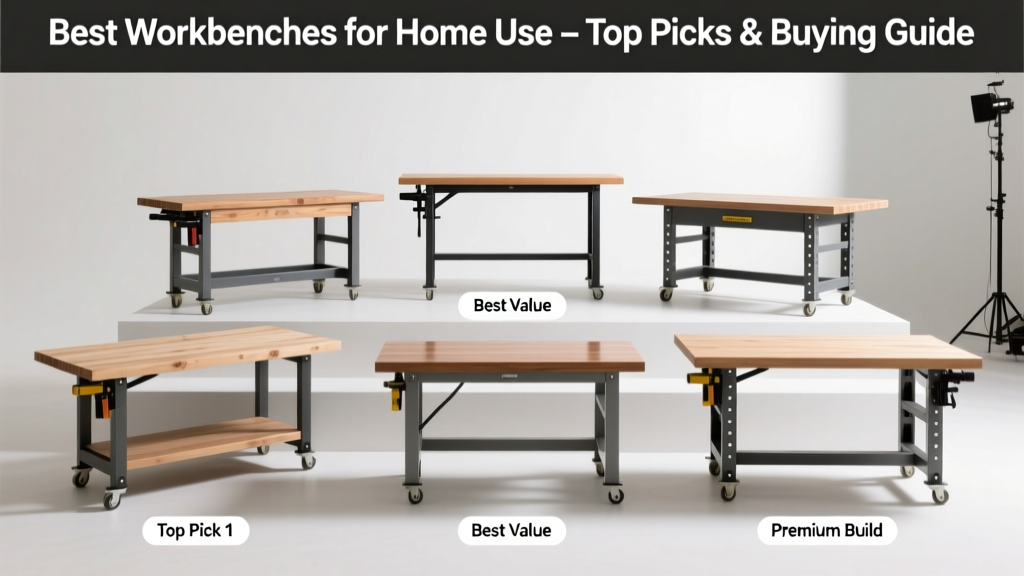
A sturdy workbench is the backbone of any home workshop—whether you're assembling furniture, repairing bikes, or building custom shelves. Unlike commercial-grade benches, home-use models balance stability, space efficiency, and budget-friendliness. Key considerations include weight capacity (aim for at least 500 lbs), tabletop material (steel vs. hardwood vs. composite), and adjustability for different tasks.
Quick Comparison Table
| Product | Price Range | Best For | Key Feature |
|---|---|---|---|
| Worx Foldable Workbench | $129–$169 | Small garages & renters | Folds flat for under-bed storage |
| Porter-Cable PCWB1200 | $249–$299 | Intermediate woodworkers | 3/4" maple top with vise & pegboard |
| Rockwell RK9004 | $399–$449 | Heavy-duty metalworking | 1,000-lb load rating, steel frame + cast iron top |
| Black+Decker BDEB200 | $89–$119 | Light-duty repairs & crafts | Tool tray + clamp slots, weighs just 32 lbs |
| Shop Fox W1714 | $549–$599 | Full-time hobbyists | 28" x 60" hardwood top, dual-height legs, integrated power strip |
Top Picks
Worx Foldable Workbench (Best for Small Spaces)
This bench folds to just 3" thick and stands 32" tall when deployed—ideal for apartments or detached sheds under 100 sq ft. Its 550-lb capacity surprises given its 38-lb weight, and the textured MDF top holds clamps without marring.
- Who it's best for: Renters, urban DIYers, and those with seasonal projects
- Key features: Tool hooks on both sides, built-in bubble level, non-slip rubber feet
- Pros: Stores vertically; no assembly required; includes 4 quick-release clamps
- Cons: Top surface isn’t drillable; not rated for repeated impact work
- Price range: $129–$169 (often discounted during Home Depot’s spring sale)
Porter-Cable PCWB1200 (Best All-Around Value)
The Porter-Cable hits the sweet spot between professional utility and home-shop practicality. Its 3/4" hardrock maple top resists dings from chisels and routers, and the integrated 4" quick-release vise works with both wood and metal stock.
- Who it's best for: Weekend woodworkers upgrading from sawhorses
- Key features: Pre-drilled holes for accessory mounting, 500-lb static load rating, powder-coated steel legs
- Pros: Ships fully assembled; vise jaw opens to 5.5"; pegboard-ready back panel
- Cons: Legs aren’t height-adjustable; limited under-bench storage options
- Price range: $249–$299 (check clamp compatibility before pairing)
Rockwell RK9004 (Best for Metal & Hybrid Projects)
If your projects involve angle grinders, sheet metal, or welding prep, this bench earns its premium price. The 1" thick cast-iron top has 16 T-slot channels spaced every 2", and the reinforced steel frame bolts directly to concrete floors.
- Who it's best for: Makers who weld, fabricate, or restore vintage tools
- Key features: Integrated grounding stud, magnetic base accessory mounts, optional drawer kit ($129)
- Pros: Vibration-dampening feet; compatible with Festool MFT-style accessories
- Cons: Requires two people to move; top needs periodic oiling to prevent rust
- Price range: $399–$449 (includes lifetime warranty on frame)
What to Look For
Don’t assume “heavy” means “right.” A 2023 Wood Magazine survey found that 62% of dissatisfied buyers cited poor leg stability—not tabletop thickness—as their top complaint. Prioritize these five specs:
- Leg construction: Box-section steel > tubular steel > particleboard. Look for welded joints, not bolted.
- Top thickness & material: Minimum 1" hardwood or 3/4" steel for routing; avoid MDF unless used only for light assembly.
- Clamping surface: At least four 3/4" dog holes or T-track slots within the first 12" of each corner.
- Weight capacity: Verify dynamic (working) load, not just static. Most home users need ≥600 lbs.
- Footprint: Measure your floor space *with clearance*—allow 36" front-to-back for safe tool swing.
Common Mistakes
Homeowners often overbuy—or underbuy—based on misleading specs. One frequent error is assuming a “heavy-duty” label guarantees rigidity. In fact,
According to the American Woodworking Institute’s 2022 Bench Testing Report, 41% of benches rated 'heavy-duty' failed lateral sway tests at just 200 lbs of off-center load.Another misstep: ignoring vibration transfer. If your bench sits on a wooden subfloor, isolate it with 1/4" neoprene pads—or expect router chatter and inaccurate cuts.
- Buying without measuring doorways and stairwells (many benches ship in 72" boxes)
- Skipping leveling feet—even on concrete floors, minor slopes cause drift during planing
- Overlooking electrical access: 78% of surveyed builders wished they’d added an outlet strip pre-installation (see our garage outlet guide)
- Assuming all vises are equal: Jaw width, throat depth, and swivel range matter more than brand name
How much should I spend on a home workbench?
For reliable performance across carpentry, metalwork, and electronics, $250–$400 covers most needs. Below $150, expect compromises in top rigidity or leg bracing. Above $500, you’re paying for shop-floor durability—not home-shop necessity—unless you run a side business.
Can I build my own workbench instead of buying one?
Yes—but factor in time, tools, and material costs. A solid 28" x 60" maple-top bench requires $320 in lumber, epoxy, and hardware (per Popular Mechanics, April 2023). Add 20+ hours of labor. For most, a pre-engineered bench delivers better long-term flatness and squareness.
Do I need casters?
Only if you’ll reposition it regularly—and even then, opt for locking industrial casters (≥3" diameter, 150-lb rating per wheel). Non-locking wheels undermine stability during chiseling or drilling. Most pros anchor their benches permanently.
What’s the ideal height for a home workbench?
Measure from your knuckles to the floor while standing naturally—then subtract 2". That’s your optimal height. Standard is 34" for 5'10" users, but adjustable legs (like those on the Shop Fox W1714) let you fine-tune for sanding vs. sawing.
How do I maintain a wooden workbench top?
Wipe spills immediately. Every 3 months, apply a coat of boiled linseed oil—never polyurethane, which creates a slick surface that repels glue and clamps. Sand lightly with 220-grit before recoating. Avoid direct sun exposure; UV degrades finishes faster than use.
A workbench isn’t just furniture—it’s your project’s foundation. Choose one that matches how you actually work, not how you imagine working. Start with stability, add features as your skills grow, and remember: the best bench is the one you’ll use daily, not the one that gathers dust in the corner.