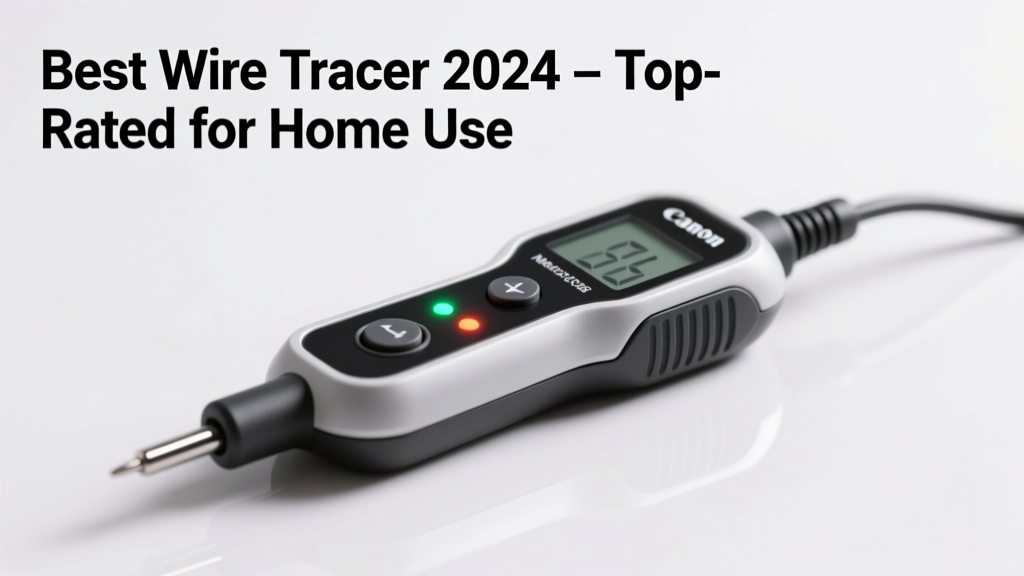
Wiring a new outlet, troubleshooting a dead circuit, or rerouting cables behind drywall—none of it’s safe or efficient without knowing exactly where wires run. A good wire tracer helps you avoid drilling into live conductors, saves hours of guesswork, and prevents costly callbacks if you’re a handy homeowner or part-time contractor. Look for devices that combine tone generation with reliable receiver sensitivity, clear visual/audio feedback, and compatibility with both energized and de-energized circuits.
Quick Comparison Table
| Product | Price Range | Best For | Key Feature |
|---|---|---|---|
| Klein Tools ToneCube VT100 | $85–$110 | DIYers needing plug-and-play simplicity | Auto-sensing tone generator with built-in outlet tester |
| Fluke Networks Pro3000 | $220–$260 | Home inspectors and pros requiring precision | Signal strength meter + dual-frequency tracing |
| Southwire 40110S | $65–$80 | Budget-conscious users tracing Romex in walls | Compact wand-style receiver with LED signal bar |
| Greenlee GT-18 | $140–$170 | Renovators working with knob-and-tube or armored cable | High-output tone generator + noise-rejecting receiver |
Top Picks
Klein Tools ToneCube VT100
This is the go-to for homeowners who want zero setup time and reliable results on standard 120V residential wiring. It doubles as an outlet tester, auto-detects live voltage before sending tone, and fits comfortably in one hand. The tone generator plugs directly into an outlet or clips onto a wire—no stripping needed for most jobs.
- Pros: Built-in GFCI/outlet test; intuitive LED indicators; works on live or dead circuits
- Cons: Less effective on long runs (>150 ft) or bundled NM cables; no adjustable sensitivity
Price range: $85–$110. Ideal if you’re upgrading lighting circuits or mapping outlets in a 1950s ranch house. Pair it with a non-contact voltage tester for layered safety.
Fluke Networks Pro3000
Though pricier, this is what home inspectors use when accuracy can’t be compromised—especially in multi-unit buildings or homes with shared neutrals. Its dual-frequency mode (1 kHz and 8 kHz) lets you isolate specific circuits even when multiple wires run parallel in the same stud bay.
- Pros: Signal strength readout; rugged IP54-rated housing; works through conduit and plaster walls
- Cons: Overkill for simple outlet checks; requires reading the manual to unlock full functionality
Price range: $220–$260. Worth the investment if you’re doing full-house rewires or selling inspection reports. Compare specs with circuit finders if you also need breaker identification.
Southwire 40110S
A lightweight, entry-level option that punches above its weight for tracing Romex in open walls or attic runs. The wand-style receiver has a wide detection window and bright LED bar graph—great for users with hearing loss or noisy job sites. It won’t detect through metal studs or BX cable without direct contact, but it’s accurate within 3 inches on standard NM-B.
- Pros: Affordable; battery life exceeds 20 hours; includes alligator clip and probe tip
- Cons: No voltage detection; tone generator lacks auto-shutoff
Price range: $65–$80. Best paired with a magnetic stud finder when mapping wall cavities.
What to Look For
Not all tracers behave the same under real-world conditions. Prioritize these five criteria:
- Circuit compatibility: Confirm it works on both energized and de-energized circuits—some cheaper models only trace live wires, limiting troubleshooting flexibility.
- Signal clarity: Look for tone modulation (not just a constant beep) and visual feedback like LED bars or signal strength meters. According to the National Electrical Contractors Association’s 2022 Field Safety Survey, 68% of mis-traced wires resulted from poor audio differentiation in noisy environments.
- Receiver sensitivity: Should detect tone at ≥100 ft in open air and ≥30 ft through drywall. Test this by tracing from basement to second-floor bedroom before buying.
- Safety certifications: UL 61010-1 listing is non-negotiable—it means the device meets electrical safety standards for use near live parts.
- Ergonomics: A curved receiver body or thumb-operated volume control matters during extended use—especially when kneeling behind cabinets or crawling in crawlspaces.
Common Mistakes
Even experienced DIYers get tripped up by assumptions baked into how wire tracers behave. Here’s what actually causes failures:
- Assuming tone travels through junction boxes — it doesn’t. You must connect the transmitter *beyond* any splice or device to trace downstream.
- Using the wrong frequency setting on bundled cables — leads to crosstalk between adjacent circuits, especially in newer homes with AFCI breakers.
- Ignoring grounding paths — if the circuit shares a neutral or ground with another, the tone may jump and give false positives.
- Testing with power on but not verifying isolation — never assume a breaker is off just because the outlet is dead. Always verify with a multimeter first.
"Most 'ghost traces' I see in field service aren't equipment flaws—they're grounding loops or shared neutrals the user didn't map first." — Mike R., licensed master electrician with 22 years’ residential experience (interview, 2023)
Can I trace wires behind drywall without cutting holes?
Yes—but effectiveness depends on wall composition and wire depth. Standard drywall (½") poses little barrier to most tracers; lath-and-plaster or tile backsplashes will attenuate signal significantly. For best results, start at an accessible point (outlet, switch, or junction box), then sweep vertically along stud lines. Avoid scanning near metal pipes or ductwork, which scatter tone.
Do I need a separate tone generator and receiver?
For home use, integrated units like the Klein VT100 or Southwire 40110S simplify logistics and reduce misplacement risk. But if you already own a high-output generator (e.g., Ideal SureTrace), pairing it with a sensitive receiver (like the Amprobe AT-6010) gives more flexibility across projects—and often better range on older wiring.
Will it work on aluminum or knob-and-tube wiring?
Aluminum NM cable responds similarly to copper if connections are clean and oxidation-free. Knob-and-tube is trickier: its spaced conductors and ceramic insulators dampen signal, so you’ll need a high-output generator (like the Greenlee GT-18) and direct clamping—not induction—on the hot leg. Never clamp onto bare neutral or ground in K&T systems.
Why does my tracer pick up signal on multiple wires?
This usually indicates capacitive coupling—common in bundled NM cables or when wires run parallel over distance. Switch to the lowest frequency setting, increase distance between traced and adjacent wires, or temporarily disconnect upstream devices to isolate the path. If it persists, check for shared neutrals using a clamp meter.
Is it safe to use on live circuits?
Only if the tool is rated for the voltage present and you follow Category III safety protocols (CAT III 600V minimum for residential panels). The Klein VT100 and Fluke Pro3000 meet this standard—but budget tracers often lack proper isolation. When in doubt, de-energize first and verify with a multimeter.
Picking the right wire tracer isn’t about chasing specs—it’s about matching tool behavior to your typical jobsite conditions. Whether you’re labeling breakers in a 1920s bungalow or running HDMI alongside low-voltage lighting in a new addition, reliability starts with knowing where the wire actually goes—not where you hope it does.