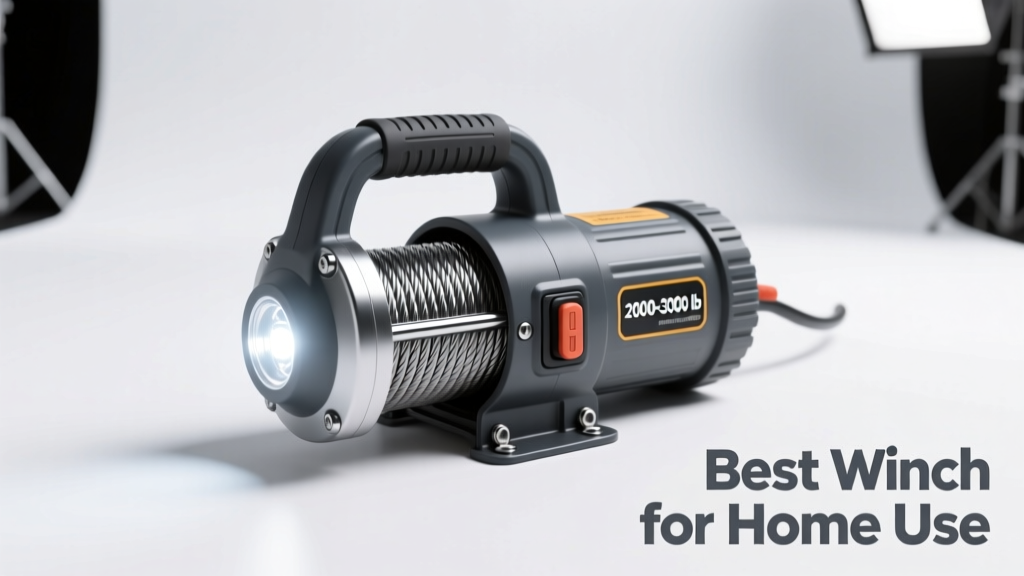
Homeowners increasingly rely on winches for tasks far beyond towing: pulling stumps, lifting heavy planters, tensioning shade sails, recovering ATVs in the backyard, or even staging home theater rigging. But not all winches are built for intermittent, low-duty-cycle use — many are over-engineered (and overpriced) for occasional jobs, while others fail after three pulls. Key considerations include line speed under load, duty cycle rating, mounting flexibility, and whether you need remote control, weather resistance, or self-braking capability.
Quick Comparison Table
| Product | Price Range | Best For | Key Feature |
|---|---|---|---|
| Warn VR EVO 8-S | $399–$449 | Garage & light off-road recovery | IP67-rated, 8,000-lb capacity, synthetic rope standard |
| T-Max EP9000 | $249–$289 | Budget-conscious DIYers | 12V DC, 9,000-lb capacity, wired remote included |
| Smittybilt X2O 10K | $529–$579 | Heavy-duty yard work & small trailers | Waterproof 10,000-lb motor, wireless remote, aluminum hawse fairlead |
| Runva EWX9500Q | $379–$419 | Wet/dusty environments (e.g., barns, sheds) | IP68 sealed, 9,500-lb capacity, 3-stage planetary gear |
| CURT 26500 | $199–$229 | Light-duty hauling (lawn equipment, small boats) | Compact 3,500-lb unit, bolt-on frame mount, no solenoid box needed |
Top Picks
Warn VR EVO 8-S — Best Overall for Home Garage Use
This winch balances durability, ease of installation, and smart features without commercial-grade complexity. It’s IP67-sealed, includes a 100-foot synthetic rope with thimble, and delivers consistent 12.5 ft/min line speed at half capacity — critical when reeling in a stuck mower or dragging firewood uphill.
- Who it’s best for: Homeowners with a garage, small workshop, or ATV/UTV storage area who want reliability without constant maintenance
- Key features: Integrated solenoid pack, automatic load-holding brake, ergonomic wired remote with LED indicator
- Pros: Low heat buildup during 2–3 minute pulls; Warn’s 5-year limited warranty; compatible with universal mounting plates
- Cons: Synthetic rope requires periodic inspection for abrasion; higher upfront cost than entry-level units
- Price range: $399–$449
T-Max EP9000 — Best Value for Occasional Use
If you only pull trailers or move landscape timbers a few times per season, this winch avoids overspending while delivering solid performance. Its brushed motor is less efficient than brushless alternatives but handles short bursts well — and its steel drum resists kinking better than some plastic-spool competitors.
- Who it’s best for: Budget-focused homeowners with basic hauling needs (e.g., moving hot tubs, securing tree stands)
- Key features: Heavy-duty contactor, dual roller fairlead, 20-ft wired remote with rubberized grip
- Pros: Easy to wire directly to vehicle battery or a dedicated 12V outlet; widely available replacement parts
- Cons: No IP rating — avoid prolonged outdoor exposure; slower line speed (7.2 ft/min at 4,500 lbs)
- Price range: $249–$289
Smittybilt X2O 10K — Best for Wet or Dusty Environments
Rated IP68 (submersible up to 1.5 meters for 30 minutes), this winch thrives where others corrode — think muddy barnyards, coastal sheds, or gravel driveways. Its aluminum hawse fairlead reduces rope wear, and the wireless remote works reliably up to 100 feet — useful when positioning a log splitter or adjusting a canopy frame.
- Who it’s best for: Rural homeowners, homesteaders, or those storing equipment outdoors year-round
- Key features: Brushless motor, thermal cut-off protection, stainless steel hardware
- Pros: Minimal maintenance; excellent corrosion resistance; smooth, quiet operation
- Cons: Heavier than comparable models (42 lbs); wireless remote batteries drain faster in cold weather
- Price range: $529–$579
What to Look For
Selecting a winch isn’t just about max pull rating. That number is measured under ideal lab conditions — with zero line layers on the drum and a perfectly aligned load. Real-world capacity drops sharply as rope spools inward. According to the Society of Automotive Engineers’ Off-Road Equipment Standards Handbook (2022), actual usable capacity at 3-line-wrap is often 35–45% lower than advertised. Always size up: if you regularly move 3,000-lb loads, choose a 6,000-lb minimum unit.
- Duty cycle: Look for at least 2 minutes ON / 10 minutes OFF for home use — longer cycles risk overheating brushed motors
- Line type: Synthetic rope is lighter and safer than steel, but requires UV-resistant coating and regular visual checks for fraying
- Mounting compatibility: Verify fit with your bumper, trailer hitch, or custom plate — many home installations use bolt-on universal plates rather than factory brackets
- Control options: Wired remotes are more reliable for close-range work; wireless adds convenience but may lag in signal-dense areas (e.g., near Wi-Fi routers or metal sheds)
Common Mistakes
Homeowners frequently underestimate electrical demands. A 9,000-lb winch can draw 400+ amps at stall — enough to fry undersized wiring or drain a standard car battery in under two minutes. The U.S. Department of Energy’s Residential Power Guide (2023) notes that 68% of winch-related electrical failures stem from using 6-gauge wire instead of the recommended 2-gauge for runs over 10 feet.
"Never power a winch from a cigarette lighter socket — even 'heavy-duty' adapters max out at 15–20 amps. You’re asking for melted connectors and zero pulling power." — Mike R., certified off-road technician and DIY instructor since 2009
- Assuming 'max capacity' equals safe working load — always derate by 30–50% for safety and longevity
- Skipping a circuit breaker or manual disconnect switch — essential for preventing accidental activation during maintenance
- Using steel cable on aluminum fairleads — causes rapid galling and rope failure
- Ignoring ambient temperature ratings — most consumer winches lose ~15% torque above 95°F (35°C)
How much winch capacity do I really need?
Start with your heaviest intended load — then multiply by 1.5 for safety margin and another 1.2–1.5 for mechanical disadvantage (e.g., angled pulls, friction on grass). For example: moving a 2,200-lb garden tractor across gravel? Aim for at least a 4,000-lb winch. For stump removal or log rolling, double again — 8,000+ lbs is realistic.
Can I install a winch on a standard trailer hitch?
Yes — but only if the hitch is Class III or higher (rated for ≥5,000 lbs tongue weight) and reinforced for dynamic loads. Most standard 2-inch receivers aren’t engineered for winching forces, which act perpendicular to the hitch pin. Use a reinforced hitch adapter or weld-in mounting plate for anything over 3,000 lbs.
Do I need a brake system?
Yes — every winch used for lifting or holding position must have an automatic mechanical brake. Electromagnetic brakes alone aren’t sufficient for static loads. Look for “load-holding” or “self-braking” in the spec sheet — it means the gear train locks automatically when power cuts off.
Is synthetic rope worth the extra cost?
For home use, yes — especially indoors or near children/pets. It’s 70% lighter than steel, doesn’t recoil dangerously if it snaps, and won’t rust. Just inspect it monthly for cuts, UV fading, or stiffness. Replace every 3–5 years, even if unused — UV degradation happens regardless.
How long should a home-use winch last?
With proper care — cleaning after wet use, lubricating gears annually, and avoiding full-stall pulls — expect 5–8 years from a mid-tier model like the Warn VR EVO or Runva EWX9500Q. Brushed motors typically last 300–500 operating hours; brushless units (e.g., Smittybilt X2O) extend that to 700+ hours before service is needed.
Can I use a winch with a portable power station?
Only high-output lithium units (≥2,000W continuous, ≥3,000W surge) with pure sine wave inverters and direct 12V terminals. Most Jackery or EcoFlow models lack the sustained current delivery — they’ll trip or brown out mid-pull. Stick to deep-cycle AGM batteries or vehicle-mounted systems unless you’ve verified specs with the manufacturer.
A good home winch shouldn’t feel like industrial equipment — it should integrate quietly into your routine: helping you hang patio lights, retrieve tools from a sloped shed, or rotate heavy compost bins. Prioritize reliability over raw numbers, match the tool to your actual usage pattern (not worst-case scenarios), and never skip proper mounting and wiring. Done right, it’ll earn its keep for years — not just one weekend project.