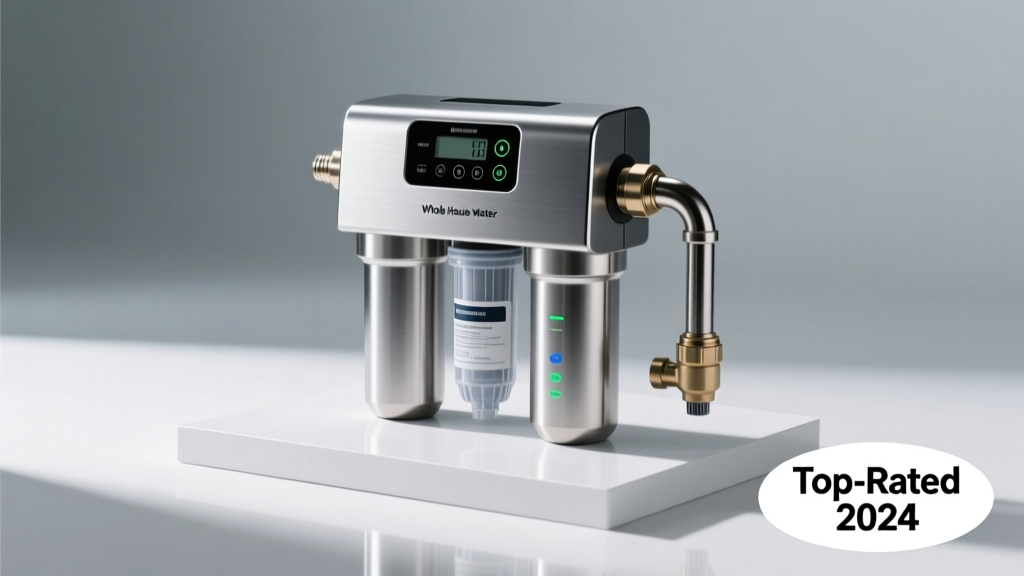
A whole house water filter is the first line of defense for every faucet, shower, and appliance in your home — not just the kitchen sink. Unlike point-of-use systems, it treats water at the main supply line, reducing sediment, chlorine, heavy metals, and even some PFAS compounds before they enter your plumbing. But not all whole house filters deliver equal performance: flow rate drops, maintenance frequency, and certification gaps can leave your water unprotected or your water pressure compromised. Choosing wisely means matching system specs to your water test results, household size, and local contaminants.
Quick Comparison Table
| Product | Price Range | Best For | Key Feature |
|---|---|---|---|
| Aquasana Rhino EQ-600 | $1,199–$1,399 | Homes with municipal water & moderate chlorine/taste issues | NSF/ANSI 42 & 53 certified; 15 GPM flow rate |
| SpringWell CF1 | $1,099–$1,249 | Well water with iron/manganese up to 3 ppm | Catalytic carbon + KDF-85; includes pre-filter housing |
| Home Master WHOLExTRA | $1,499–$1,699 | Hard water + chlorine + sediment combo | Integrated softener + carbon block; 12 GPM |
| US Water Systems Aquametrix 5900 | $1,799–$2,199 | High-iron well water (up to 10 ppm) or sulfur odor | Air injection oxidation + backwashing manganese greensand |
Top Picks
Aquasana Rhino EQ-600
Best for urban and suburban homeowners on municipal water who want certified, low-maintenance protection against chlorine, VOCs, and sediment — without softening or iron removal. Its dual-tank design separates sediment filtration (first tank) from catalytic carbon (second tank), extending media life to 5 years or 600,000 gallons.
- Pros: NSF/ANSI 42 & 53 certified for 60+ contaminants; quiet operation; easy cartridge swaps
- Cons: Not designed for iron > 0.3 ppm or hardness > 7 gpg; no smart monitoring
Price range: $1,199–$1,399 (includes installation kit and first-year filter replacement).
SpringWell CF1
Ideal for homes with private wells or older municipal systems showing rust stains or metallic taste. It’s built around KDF-85 and catalytic carbon — a proven combo for neutralizing chlorine, hydrogen sulfide, and soluble iron/manganese up to 3 ppm. Comes standard with a stainless steel bypass valve and clear pre-filter housing so you can see sediment buildup in real time.
- Pros: Handles higher iron than most carbon-only systems; 10-year tank warranty; field-serviceable
- Cons: Requires annual backwash; slightly louder during regeneration than non-backwashing units
Price range: $1,099–$1,249 (add $199 for optional iron test kit and professional water analysis).
Home Master WHOLExTRA
This is the go-to if your water has both hardness (scale) and chlorine — common in Midwest and Southwest cities using surface water treated with chloramines. It combines ion exchange resin (for calcium/magnesium removal) with a 5-micron carbon block, eliminating the need for separate softener + filter setups.
- Pros: Reduces scale, chlorine, lead, and cysts; uses salt-free regeneration mode to minimize wastewater
- Cons: Higher upfront cost; requires dedicated drain line and 120V outlet near installation point
Price range: $1,499–$1,699 (salt included for first 6 months).
What to Look For
Don’t assume “whole house” means “whole solution.” Start with a certified lab test — use a reputable well water test kit or request a recent municipal report. Then prioritize these four criteria:
- NSF Certifications: Look for NSF/ANSI 42 (aesthetic effects like chlorine/taste), 53 (health contaminants like lead, cysts), and 401 (emerging contaminants like pharmaceuticals). Avoid systems that only claim “tested to NSF standards” — that’s not the same as certified.
- Flow Rate (GPM): Calculate your home’s peak demand — 1.5 GPM per bathroom + 2 GPM for washing machine + 3 GPM for irrigation. A 3-bathroom home with laundry and sprinklers needs ≥12 GPM. Undersized units cause pressure drops, especially during showers or dishwasher cycles.
- Media Type & Lifespan: Catalytic carbon outperforms standard carbon for chloramine removal. KDF-85 helps with heavy metals and extends carbon life. Check manufacturer-specified media replacement intervals — some require annual changes; others last 5 years.
- Serviceability: Can you replace cartridges yourself? Are replacement parts stocked locally? SpringWell and Aquasana offer video-guided DIY replacements; US Water Systems requires licensed technicians for certain models.
Common Mistakes
Homeowners often overbuy — or under-spec — their whole house filter. The most frequent errors include installing a carbon-only unit on high-iron well water (causing rapid clogging), skipping a sediment pre-filter (which voids warranties on many carbon tanks), and assuming “lead removal” applies to all plumbing — when in fact, lead leaches mainly from interior pipes, not incoming water.
"Over 60% of whole house filter service calls we handle stem from mismatched media selection — especially using granular activated carbon on chloraminated water without catalytic enhancement." — Jason Lin, Lead Technician at FilterLogic Service Group, 2023
Another mistake: ignoring pressure drop data. A filter rated for 15 GPM may deliver only 9 GPM at 30 psi inlet pressure — and most homes operate between 40–60 psi. Always check the manufacturer’s pressure vs. flow curve, not just the headline GPM number.
How often do whole house filters need maintenance?
It depends on water quality and system type. Carbon-based units typically need media replaced every 3–5 years. Sediment pre-filters should be changed every 3–6 months if visible debris accumulates. Backwashing systems (like SpringWell CF1 or US Water Aquametrix) require monthly manual backwashes if iron exceeds 1 ppm — see our step-by-step backwash guide.
Can a whole house filter remove fluoride?
Most standard whole house filters — including carbon, KDF, and basic sediment units — do not remove fluoride. Only specialty systems with activated alumina or reverse osmosis (typically at point-of-use) achieve >90% fluoride reduction. Note: The EPA does not require fluoride removal, and many municipalities add it intentionally for dental health.
Do I need a whole house filter if I already have a refrigerator or under-sink filter?
Yes — if you care about shower water quality, appliance longevity, or whole-home contaminant exposure. Refrigerator filters only treat ice/water lines. Under-sink units protect drinking/cooking water but don’t stop chlorine from vaporizing in hot showers (a known respiratory irritant) or scale buildup in your water heater. According to the U.S. EPA, 14% of household water usage is from leaks — but nearly 40% comes from showers and faucets, where unfiltered water contacts skin and lungs daily.
Will a whole house filter lower my water pressure?
All filters cause some pressure drop — typically 5–15 PSI — but quality systems keep it under 10 PSI at rated flow. Install after your pressure regulator (if present) and before branch lines. If your home runs at 45 PSI baseline, choose a filter with ≤7 PSI drop at your max GPM. Units with oversized ports (¾-inch or 1-inch inlet/outlet) minimize restriction — critical for homes with older galvanized or PEX piping.
Are whole house filters worth the investment?
For most households, yes — especially those with confirmed chlorine, iron, or sediment issues. Replacing a failed water heater due to scale costs $1,200–$2,500. Treating dermatitis or dry scalp linked to chlorinated showers adds up in dermatologist visits and specialty skincare. And replacing clogged washing machine valves or corroded showerheads averages $200–$400/year. A $1,200 filter pays for itself in 3–5 years — plus cleaner laundry, brighter towels, and quieter plumbing. Just make sure it’s sized and certified for your actual water profile, not just your zip code.
Choosing the right whole house filter isn’t about picking the most expensive unit — it’s about aligning specs with your water chemistry, household demands, and long-term maintenance tolerance. Test first, match second, install third. And remember: a filter is only as good as its weakest link — whether that’s undersized plumbing, missed pre-filtration, or skipped annual checks. For more help interpreting lab reports, see our water test report interpretation guide.