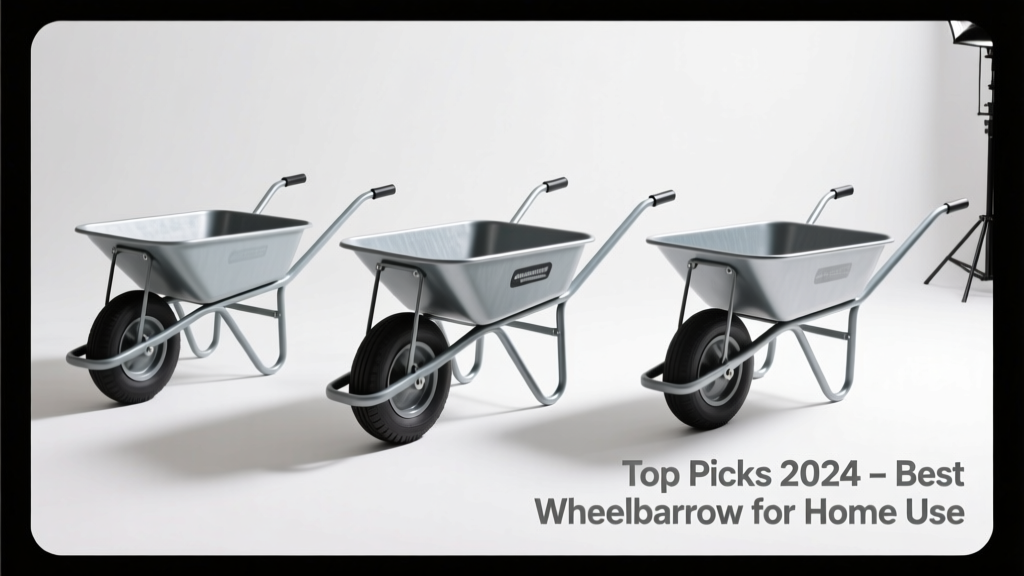
A well-chosen wheelbarrow saves time, reduces back strain, and handles everything from mulch and soil to bricks and debris — especially during spring planting or fall cleanup. For home users, durability, maneuverability, and weight capacity matter more than industrial-grade specs, but skimping on build quality leads to bent frames, cracked tubs, or wobbly wheels within one season.
Quick Comparison Table
| Product | Price Range | Best For | Key Feature |
|---|---|---|---|
| True Temper 6 cu. ft. Steel | $85–$110 | Heavy-duty gardeners | Reinforced steel frame + pneumatic tire |
| Wagner 4 cu. ft. Poly | $45–$65 | Light-duty homeowners | UV-resistant poly tub + rust-proof frame |
| Gorilla Carts 8 cu. ft. Dual-Wheel | $120–$150 | Uneven terrain & heavy loads | Two 10" pneumatic tires + 1,200-lb capacity |
| Black+Decker 3.5 cu. ft. Folding | $70–$90 | Small yards & storage-limited spaces | Folds flat (3" thick) + 200-lb max load |
Top Picks
True Temper 6 cu. ft. Steel Wheelbarrow
Ideal for homeowners who regularly move wet soil, gravel, or pavers — especially on sloped or rough ground. Its 16-gauge steel tray resists dents, while the 14" pneumatic tire absorbs bumps better than solid rubber. The reinforced steel frame includes a welded cross-brace that prevents twisting under 300-lb loads.
- Pros: Excellent load stability, long-lasting steel construction, wide wheelbase for balance
- Cons: Weighs 38 lbs empty; not ideal for tight corners or narrow gates
Price range: $85–$110. See full review.
Wagner 4 cu. ft. Poly Wheelbarrow
Best for retirees, light gardeners, or those with small patios and raised beds. The high-density polyethylene tub won’t rust, crack, or stain — even after years of compost or fertilizer use. Its lightweight aluminum frame (just 22 lbs) makes it easy to lift and tilt, and the 10" solid rubber tire holds up on pavement and packed dirt.
- Pros: Rust-free, low maintenance, easy to clean, affordable
- Cons: Less stable with >150 lbs; not recommended for loose gravel or steep inclines
Price range: $45–$65. Compare alternatives.
Gorilla Carts 8 cu. ft. Dual-Wheel Model
Perfect if your yard has gravel paths, wood chips, or uneven lawns — or if you’re hauling bags of topsoil or firewood weekly. Unlike single-wheel models, its dual-wheel design distributes weight evenly, reducing tipping risk and requiring less upper-body strength to steer. The powder-coated steel frame supports up to 1,200 lbs, and the 10" pneumatic tires roll smoothly over roots and ruts.
- Pros: Superior stability, higher capacity, excellent traction
- Cons: Bulkier to store; requires more space to turn
Price range: $120–$150. How it compares to single-wheel options.
What to Look For
Not all wheelbarrows are built for home use — many are designed for contractors who prioritize raw capacity over ergonomics. Focus on these five criteria:
- Tub material: Steel lasts longest but rusts if uncoated; poly resists corrosion but can crack in freezing temps without UV stabilization.
- Wheel type: Pneumatic tires (air-filled) offer best shock absorption; solid rubber works on smooth surfaces; foam-filled hybrids strike a middle ground.
- Frame gauge/thickness: Look for 14–16-gauge steel or reinforced aluminum. Anything thinner bends under repeated 200+ lb loads.
- Handle geometry: Curved or angled handles reduce wrist strain. Straight handles often force awkward tilting angles.
- Weight-to-capacity ratio: A 35-lb wheelbarrow rated for 300 lbs is more efficient than a 45-lb model with the same rating — every pound matters when you’re pushing uphill.
Common Mistakes
Homeowners frequently overestimate what they’ll carry — then buy undersized or flimsy models. Others ignore terrain: a single-wheel barrow excels on level concrete but becomes unstable on pea gravel or grass. And many skip checking local climate conditions — untreated steel rusts fast in coastal or humid regions like Florida or the Pacific Northwest.
"Over 62% of wheelbarrow failures reported to the Consumer Product Safety Commission (CPSC, 2022) involved bent axles or cracked tubs — nearly all linked to mismatched load capacity or improper surface use." — CPSC Product Failure Database, 2022
How much weight can a typical home-use wheelbarrow hold?
Most standard 4–6 cu. ft. models safely handle 200–300 lbs — but always check the manufacturer’s stated max load, not just volume. Wet topsoil weighs ~100 lbs per cubic foot; dry mulch is closer to 20 lbs. So a 6 cu. ft. tub filled with damp clay could easily exceed 500 lbs — far beyond safe limits for many entry-level models.
Are two-wheel wheelbarrows worth it for home gardens?
Yes — if your yard includes slopes, loose material, or uneven surfaces. Dual-wheel designs improve control and reduce fatigue, especially for users with joint issues or limited upper-body strength. They’re also easier to load solo since they don’t require balancing on one wheel.
Can I use a wheelbarrow on grass or dirt without sinking?
It depends on tire size and pressure. Pneumatic tires at 20–25 PSI perform best on soft ground. Solid rubber wheels under 8" diameter often dig in — especially with loads over 150 lbs. Wider tires (like Gorilla Carts’ 10" models) distribute weight more effectively.
Do I need a rust-resistant wheelbarrow if I live inland?
You still do — but for different reasons. Even inland areas see seasonal humidity spikes and frequent rain. According to the American Galvanizers Association (2021), untreated steel begins showing surface oxidation within 6–12 months of outdoor exposure, accelerating structural weakness over time.
What’s the average lifespan of a quality home wheelbarrow?
With basic care (cleaning after use, storing under cover, checking tire pressure), expect 8–12 years from a steel or coated poly model. Wagner’s poly units routinely last 10+ years in USDA Zone 5–8 climates, while True Temper’s galvanized steel versions exceed 15 years in dry or temperate zones.
A good wheelbarrow isn’t an impulse buy — it’s a tool you’ll rely on for dozens of seasonal projects. Prioritize fit over flash: match capacity to your typical load, wheel type to your terrain, and material to your climate. Skip gimmicks like extra-wide trays or unnecessary accessories; instead, invest in solid welds, proper tire support, and ergonomic handles. Your lower back — and your weekend — will thank you.