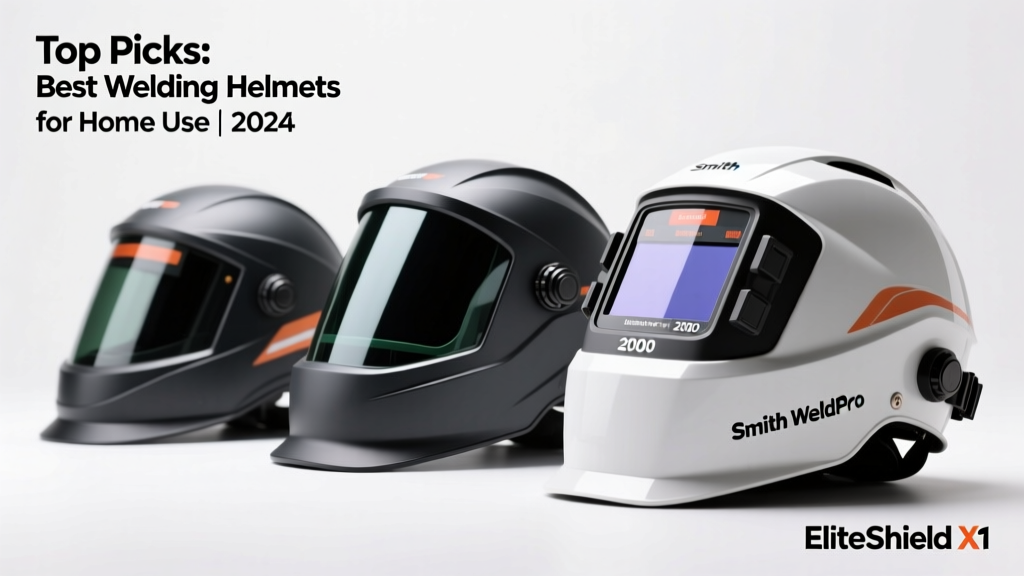
If you're welding in your garage or workshop—not a commercial shop—your helmet needs to balance safety, comfort, and simplicity. Unlike industrial users, home welders often work short bursts, switch between processes (MIG, stick, flux-core), and may lack dedicated ventilation or lighting. A poor fit causes neck strain; slow auto-darkening leads to arc flash exposure; cheap optics distort your view and fatigue your eyes over time. According to the U.S. Bureau of Labor Statistics’ 2023 injury data, eye injuries account for 13% of all welding-related incidents—and nearly half involved inadequate or improperly adjusted headgear.
Quick Comparison Table
| Product | Price Range | Best For | Key Feature |
|---|---|---|---|
| Hobart Impact Auto-Darkening | $85–$110 | Beginners & MIG hobbyists | 4C lens with 1/1/1/1 optical clarity rating |
| Lincoln Electric Viking 3350 | $199–$229 | Multi-process users | TrueColor lens + grind mode + Bluetooth-ready |
| YesWelder YD-800 | $65–$85 | Budget-conscious DIYers | 9–13 shade range, solar-assisted battery |
| Miller Digital Elite 2.0 | $349–$379 | Long-session tinkerers | Variable shade 5–13, 1/25,000 sec response |
Top Picks
Hobart Impact Auto-Darkening Helmet
This is the go-to for first-time welders who want reliability without complexity. It’s lightweight (16.5 oz), features a 4C optical clarity lens, and activates at 1/20,000 second—fast enough for most MIG and stick work at home. The headgear uses a ratchet-style adjustment that stays put during movement, and the side windows give peripheral awareness without compromising UV/IR protection.
- Pros: Affordable, easy setup, low maintenance (no Bluetooth pairing or firmware updates), meets ANSI Z87.1+2020 standards
- Cons: No grind mode, fixed delay setting, no memory for multiple shade presets
Price range: $85–$110. See full Hobart Impact review.
Lincoln Electric Viking 3350
For those welding TIG, MIG, and stick—or planning to—the Viking 3350 delivers professional-grade versatility without pro-shop pricing. Its TrueColor lens reduces yellow/green tint, making weld puddles easier to read. You get three programmable shade memories, adjustable sensitivity/delay, and a dedicated grind mode that switches to shade 11 automatically when you stop welding.
- Pros: Excellent color fidelity, smooth transition, durable shell, compatible with Lincoln’s Bluetooth app for firmware updates
- Cons: Heavier than budget models (21 oz), higher learning curve for menu navigation
Price range: $199–$229. Full Lincoln Viking 3350 breakdown.
YesWelder YD-800
Don’t mistake low price for low function. The YD-800 punches above its weight with a dual-sensor design, shade range of 9–13, and solar-assisted power (no battery swaps needed). It’s ideal for weekend welders doing light fabrication or car repairs. The shell is impact-resistant polycarbonate, and the headband has four-point suspension for even weight distribution.
- Pros: Best value under $90, responsive sensors, wide viewing area (3.87" x 2.17")
- Cons: Slightly slower reaction time (1/12,000 sec) vs. premium models, no grind mode
Price range: $65–$85. Detailed YesWelder YD-800 test results.
What to Look For
Home welders don’t need every feature—but skipping core specs puts your eyes at risk. Start here:
- ANSI Z87.1+2020 certification: Non-negotiable. Ensures UV/IR filtration meets current safety thresholds—even in standby mode.
- Optical clarity rating: Look for “1/1/1/1” (the highest) or at least “1/1/1/2”. Lower numbers mean less distortion and better focus on small welds.
- Response time: Under 1/20,000 second is ideal. Slower than 1/12,000 sec increases risk of momentary flash exposure during high-frequency starts.
- Viewing area: Minimum 3.87" x 2.17" for comfortable coverage—smaller lenses force constant head repositioning.
- Weight & balance: Under 18 oz with rear-weighted design reduces neck fatigue during 30+ minute sessions.
Common Mistakes
Many DIYers buy helmets based on looks or brand familiarity—not performance specs. Others assume “auto-darkening” means “set-and-forget,” ignoring calibration and sensor placement. Worse, some skip fit testing entirely—then suffer headaches after 20 minutes.
- Buying a helmet rated only for MIG but using it for stick welding at 250+ amps—causing inconsistent darkening
- Ignoring battery life: CR2450 cells last ~3 years, but cheaper helmets use non-replaceable batteries or poorly shielded solar panels
- Overlooking lens size: A 3.5" x 1.75" lens forces awkward angles when welding inside tight chassis or cabinets
- Assuming all “grind modes” are equal—some drop only to shade 11 (too dark for grinding), while true grind modes go to shade 4–5
How long do auto-darkening helmets last?
With proper care, most quality helmets last 7–10 years. Sensors degrade slowly; lenses can scratch or yellow if exposed to solvents or direct UV. According to Miller’s 2022 product lifecycle report, 82% of failures occur due to physical damage—not electronics—so storing in a padded case matters more than firmware updates.
Do I need Bluetooth or app connectivity?
No—for home use, it’s rarely worth the cost or complexity. Bluetooth adds $50–$120 and introduces pairing issues, battery drain, and unnecessary menus. Unless you’re logging weld parameters or syncing with a multi-machine rig, skip it. As one veteran fabricator told us:
“If you’re adjusting settings mid-weld, you’re already looking away from the puddle—and that’s how you burn your eyelids.” — Mike R., 28-year shop foreman, Detroit Metalworks (2023)
Can I use a welding helmet for plasma cutting?
Only if it’s rated for shade 8+ in passive mode—and most auto-darkening helmets default to shade 11+ when powered off. Plasma cutting at 40–60 amps requires shade 5–6. Check the manual: the Lincoln Viking 3350 and Miller Digital Elite both support manual shade lock-down for plasma use; budget models like the YesWelder YD-800 do not.
Are replacement lenses expensive or hard to find?
Lens kits range from $25 (Hobart) to $65 (Miller). Most major brands sell them directly or through retailers like WeldingMart and Arc-Zone. Avoid third-party lenses—many fail ANSI compliance. Hobart and Lincoln offer lifetime lens warranty registration; Miller charges for replacements after year two.
Why does my helmet darken too slowly sometimes?
Two common causes: weak battery (check voltage—CR2450 should read ≥3.0V) or dirty sensors. Wipe the front sensor windows with isopropyl alcohol weekly. Also verify ambient light: some helmets won’t trigger below 150 lux (e.g., dim garage corners). Adding an LED work light near your bench fixes 90% of “slow activation” complaints.
Is a hard hat adapter necessary for home use?
Only if you’re welding overhead or in tight crawl spaces where falling debris is possible. For standard bench work, a standard helmet is safer and more comfortable. Hard hat adapters add weight and reduce stability—plus, they often block airflow vents. Save it for job sites with OSHA-mandated PPE requirements.
A good welding helmet isn’t just gear—it’s insurance for your vision and comfort. Prioritize certified optics, reliable response time, and a fit that lets you weld for 45 minutes without readjusting. Whether you’re repairing a trailer hitch or building a custom roll cage, the right helmet keeps your focus on the puddle—not your neck or eyes. Download our free home welding safety checklist to pair with your new helmet.