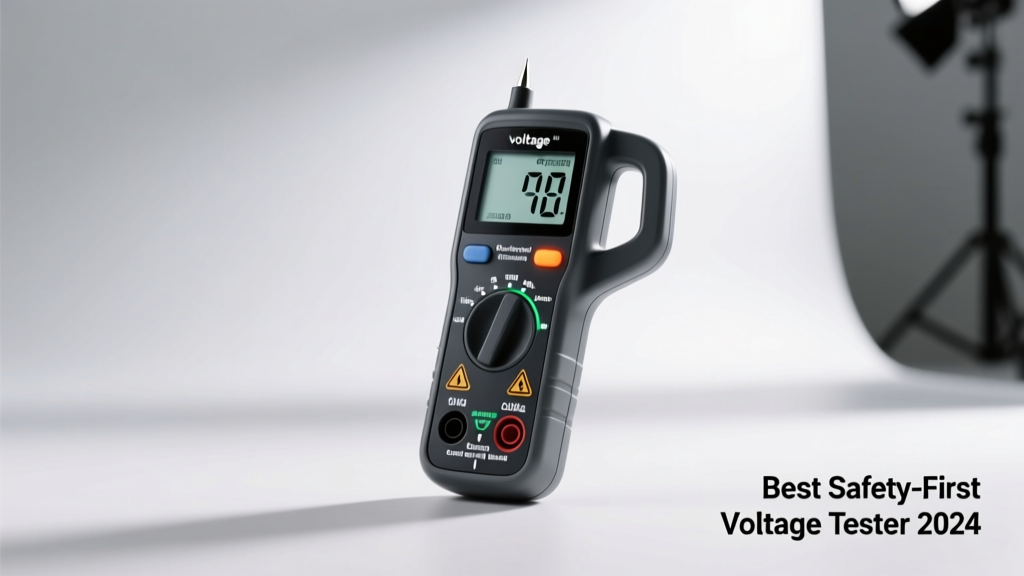
Testing for live voltage isn’t just about convenience—it’s a critical safety step before changing an outlet, installing a light fixture, or troubleshooting a dead switch. A faulty or misused tester can give false negatives, putting you at serious risk of shock or arc flash. For home use, you need something intuitive, CAT-rated for residential circuits (CAT II or III), and reliable enough to trust with your fingers near terminals.
Quick Comparison Table
| Product | Price Range | Best For | Key Feature |
|---|---|---|---|
| Klein Tools NCVT-1 | $25–$35 | Beginners & general home checks | Non-contact detection up to 1000V, LED + audible alerts |
| Fluke 1AC II VoltAlert | $30–$45 | Accuracy-focused users | Auto-range sensing, reduced false positives on EMI-heavy circuits |
| Southwire 40110N | $18–$26 | Budget-conscious DIYers | Dual-mode (contact/non-contact), built-in flashlight |
| Extech 480423 | $65–$85 | Homeowners adding smart switches or EV chargers | True RMS voltage reading + continuity test + GFCI check |
Top Picks
Klein Tools NCVT-1 Non-Contact Voltage Tester
Best for first-time users and quick wall scans—this is the model electricians often hand to new apprentices. Its bright red LED and piercing beep activate reliably at 90–1000V AC, and it fits comfortably in a tool pouch or jeans pocket. The tip design minimizes accidental activation against metal boxes or conduit.
- Pros: Rugged ABS housing, IP54 dust/water resistance, UL-listed for CAT IV 600V
- Cons: No contact mode; can’t verify neutral or ground presence
- Price range: $25–$35
Fluke 1AC II VoltAlert
Engineered to reduce nuisance triggers from nearby wiring or fluorescent ballasts, this tester uses dual-sensor logic that cross-checks field strength before alerting. It’s especially useful in older homes with knob-and-tube or bundled NM cables where ghost voltage is common.
- Pros: Lower false-positive rate than most non-contact testers, compact size, 2-year warranty
- Cons: Requires battery replacement every 12–18 months (CR2032)
- Price range: $30–$45
Southwire 40110N Dual-Mode Tester
This model bridges the gap between basic and pro-grade: it offers both non-contact detection and contact testing with exposed probe tips. The integrated LED flashlight helps in dark panels or under sinks—and unlike many budget testers, its contact mode reads down to 12V DC, useful for doorbell or thermostat wiring.
- Pros: Two-in-one functionality, clear voltage range indicators (green/yellow/red zones), rubberized grip
- Cons: Slightly bulkier than pure non-contact units; no continuity beeper
- Price range: $18–$26
What to Look For
Not all voltage testers meet the same safety or performance standards—even if they look identical on the shelf. Start with certification: look for UL 61010-1 listing and CAT II 600V or CAT III 300V rating (required for most branch circuits). Next, consider detection method: non-contact testers are faster but can miss low-voltage or shielded wires; contact testers require direct wire access but confirm actual potential. Battery life matters too—some units drain quickly when left in pockets near keys or tools.
- Voltage range: Minimum 12–1000V AC for standard home use (120/240V systems)
- Response time: Under 0.5 seconds ensures real-time feedback during live-panel work
- Ergonomics: A textured grip and angled tip help reach tight spaces behind outlets or inside breaker boxes
- Auto-power-off: Extends battery life—especially important for infrequent users
Common Mistakes
Many homeowners assume any beeping pen-style tester is “good enough”—but skipping verification steps leads to dangerous assumptions. One frequent error is testing only one conductor (e.g., hot) and assuming neutral is safe, when back-fed neutrals or shared circuits can carry voltage. Another is using a tester without verifying it works first—always test on a known live circuit (like an outlet you’ve confirmed is on) before trusting it on a de-energized one.
"Over 60% of electrical injuries reported to OSHA between 2020–2023 involved workers who believed circuits were de-energized—but hadn’t verified with a properly rated, functioning tester." — National Fire Protection Association (NFPA 70E Handbook, 2023)
Can I use a non-contact tester on armored cable (BX)?
Yes—but with caution. BX and MC cable shielding can block or attenuate the electric field, leading to false negatives. Always pair non-contact detection with a contact test (if accessible) or use a tester rated for shielded applications, like the Fluke T5-600, which includes a conductive tip for direct probing.
Do I need a tester that reads DC voltage?
For most home wiring (outlets, lighting, breakers), AC-only detection is sufficient. But if you’re working with solar microinverters, battery backups, or low-voltage landscape lighting, DC capability becomes essential. The Extech 480423 and Klein MM400 multimeter both include true DC voltage measurement.
Why does my tester beep near a lamp cord but not at the outlet?
This usually indicates induced voltage—not actual hazardous potential. Lamp cords often run parallel to other energized wires, creating electromagnetic coupling. A quality tester like the Fluke 1AC II will suppress this; cheaper units won’t. Always follow up with a contact test or verify with a multimeter.
Is a $10 tester from the hardware store safe?
Some are—many aren’t. A 2022 Consumer Reports evaluation found that 4 out of 7 sub-$20 testers failed basic safety tests (including false negatives at 120V) and lacked UL certification. Save money elsewhere—not here.
How often should I replace my voltage tester?
There’s no fixed expiration, but inspect it before each use: check for cracked casing, corroded contacts, or inconsistent beeping. Replace immediately if it fails a known-live verification test—or after 3 years of regular use, per NFPA 70E recommendations.
A good voltage tester isn’t a luxury—it’s the first line of defense between you and 120 volts. Prioritize certified safety ratings over flashy features, and always treat every wire as live until proven otherwise. Whether you’re swapping a dimmer switch or diagnosing a tripped GFCI, having the right tester means working confidently—not cautiously.