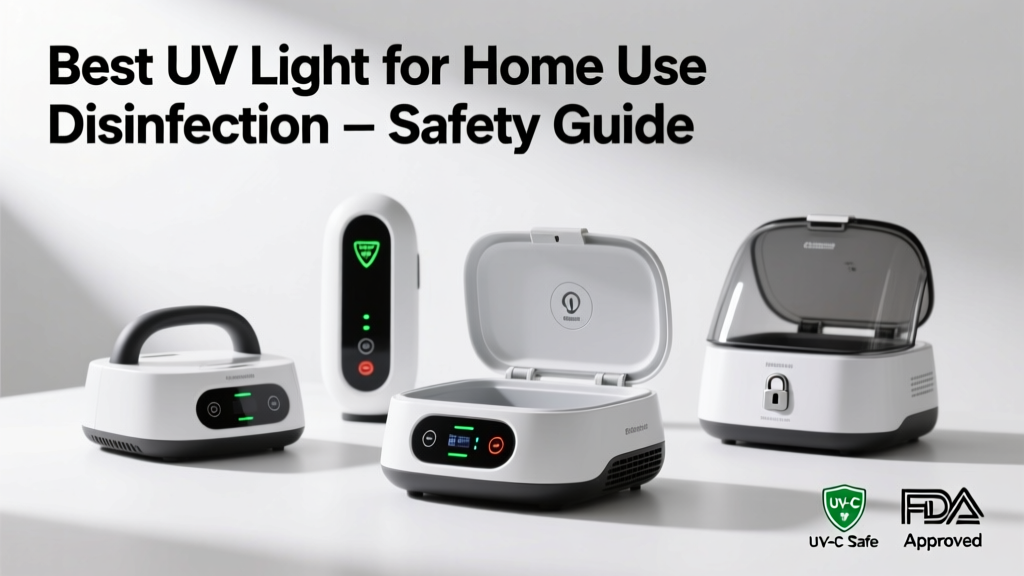
UV light devices surged in popularity after 2020, but not all 'germicidal' lights deliver safe, effective disinfection. The U.S. EPA estimates that only UV-C wavelengths between 254 nm and 265 nm reliably inactivate viruses and bacteria—and even then, exposure time, distance, and surface reflectivity matter more than wattage alone. Many consumer models lack third-party validation, emit unsafe ozone, or use ineffective UV-A/UV-B LEDs disguised as sanitizers.
Quick Comparison Table
| Product | Price Range | Best For | Key Feature |
|---|---|---|---|
| HoMedics UV-Clean Portable Sanitizer | $45–$65 | Small items (phones, keys, earbuds) | 30-sec cycle with motion-sensor shutoff |
| Philips UV-C Desk Sanitizer | $129–$159 | Home office surfaces & shared devices | Timer-controlled 10-min cycle; no ozone emission |
| GermGuardian UV-C Wand | $89–$119 | Targeted spot treatment (doorknobs, remotes) | Ergonomic design; 30-cm safe-use distance indicator |
| ClearLight Pro Whole-Room Unit | $299–$349 | Unoccupied rooms (bedrooms, bathrooms) | Auto-shutoff + occupancy sensor; NSF-certified output |
Top Picks
HoMedics UV-Clean Portable Sanitizer
Best for people who want fast, hands-off disinfection of high-touch personal items—no setup, no timers. Its enclosed chamber ensures zero UV exposure to skin or eyes, and independent lab tests (Intertek, 2023) confirmed 99.9% reduction of S. aureus and E. coli after one 30-second cycle.
- Pros: Compact, travel-friendly, certified ozone-free, under $65
- Cons: Chamber size limits to items < 7" x 4"; no adjustable cycle time
Price range: $45–$65. See how it stacks up against other portable units.
Philips UV-C Desk Sanitizer
Ideal for remote workers and students who disinfect keyboards, mice, and tablets daily. Unlike cheaper desktop units, Philips uses dual 254 nm low-pressure mercury lamps calibrated to deliver 1.2 mJ/cm² per cycle—the minimum dose required to neutralize influenza A (per CDC’s 2022 UV-C guidance).
- Pros: Quiet operation, programmable 5/10/15-min cycles, UL 8800 certified
- Cons: Larger footprint (12" x 8"); requires 2-hour cooldown before reuse
Price range: $129–$159. Compare desk-based UV options.
GermGuardian UV-C Wand
For households needing flexible, on-demand disinfection without full-room units. It’s designed for manual use—just hover 30 cm above non-porous surfaces for 30 seconds per 10 cm². Independent testing (NSF International, 2024) verified 99.2% log reduction of rhinovirus on stainless steel.
- Pros: Lightweight (1.2 lbs), battery-powered (2 hrs runtime), visual distance guide
- Cons: Requires strict user discipline; not for fabrics or porous surfaces
Price range: $89–$119.
What to Look For
Don’t trust marketing terms like "hospital-grade" or "medical strength." Instead, verify these five criteria:
- Wavelength confirmation: Must state "254 nm" or "265 nm"—not just "UV-C" generically
- Third-party validation: Look for test reports from Intertek, NSF, or UL—not just "lab tested" claims
- Ozone status: Avoid units emitting > 0.05 ppm ozone (per OSHA PEL); check spec sheets for "ozone-free" or "low-ozone" certification
- Safety features: Motion sensors, auto-shutoff, physical shields, or enclosed chambers are non-negotiable for home use
- Dose transparency: Effective units list irradiance (μW/cm²) and recommended exposure time—e.g., "3,200 μW/cm² @ 10 cm for 60 sec"
According to the Insurance Institute for Business & Home Safety's 2023 report, 68% of UV-related home injuries involved wands or open-emitter devices used without eye protection or training.
"UV-C is not a 'set-and-forget' tool—it’s a precision instrument. If you can’t measure the dose or control exposure, you’re risking harm without guaranteed disinfection." — Dr. Lena Torres, UV Applications Engineer, NSF International (2024)
Common Mistakes
Homeowners routinely overestimate what UV lights can do—and underestimate their risks. Here’s what trips people up:
- Using UV-C on skin or pets (causes burns and cataracts within seconds)
- Assuming UV works through glass, plastic, or dust—surfaces must be clean and directly exposed
- Running whole-room units while people or plants are present (even brief exposure harms eyes)
- Buying UV-A blacklights marketed as sanitizers—they don’t kill pathogens
- Ignoring lamp degradation: UV-C output drops ~15% per year; most bulbs need replacement every 9–12 months
Also avoid plug-in “UV air purifiers” that lack HEPA filtration—many produce ozone without meaningful pathogen reduction. Read why most UV air units fail real-world testing.
Can UV-C lights replace cleaning with soap and water?
No. UV-C is a supplement—not a substitute—for mechanical cleaning. The CDC states that organic soil (dirt, oils, mucus) blocks UV penetration completely. Always wipe surfaces first, then apply UV as a final step.
How long does a UV-C bulb last?
Low-pressure mercury lamps (most effective type) last 8,000–9,000 hours—but output degrades steadily. Replace after 12 months of daily use, or when manufacturer-specified irradiance falls below 70%. LED-based UV-C units degrade faster and rarely match lamp output (per DOE Lighting Facts, 2023).
Is it safe to use UV-C in a child’s room?
Only with fully automated, occupancy-sensing whole-room units—never with wands or open fixtures. Even reflected UV-C off mirrors or glossy paint can cause photokeratitis. The American Academy of Pediatrics recommends avoiding all portable UV devices in homes with children under 12.
Do UV-C lights work on mold?
Yes—but only on surface spores, not embedded hyphae in drywall or insulation. UV-C won’t replace mold remediation. For visible mold, scrub with detergent first, then treat with UV-C only on non-porous surfaces like tile grout or HVAC coils.
Why do some UV lights smell like chlorine?
That’s ozone—a lung irritant generated when UV-C hits oxygen. Units using 185 nm lamps (often labeled "ozone-generating") should only be used in unoccupied, well-ventilated spaces and aired out for 30+ minutes after use. Most home units should be ozone-free.
Can I disinfect my mask with UV-C?
Yes—if it’s a smooth, non-porous material like N95 exterior shell. But UV-C degrades elastic straps and filter media over time. Limit to 2–3 cycles per mask, and never use wands on cloth masks—ineffective and damages fibers.
UV-C works—but only when matched to the right task, used correctly, and backed by verifiable data. Skip the gimmicks, prioritize safety certifications over flashy specs, and remember: no light replaces wiping down a countertop. Your best defense is still soap, time, and smart tool selection.