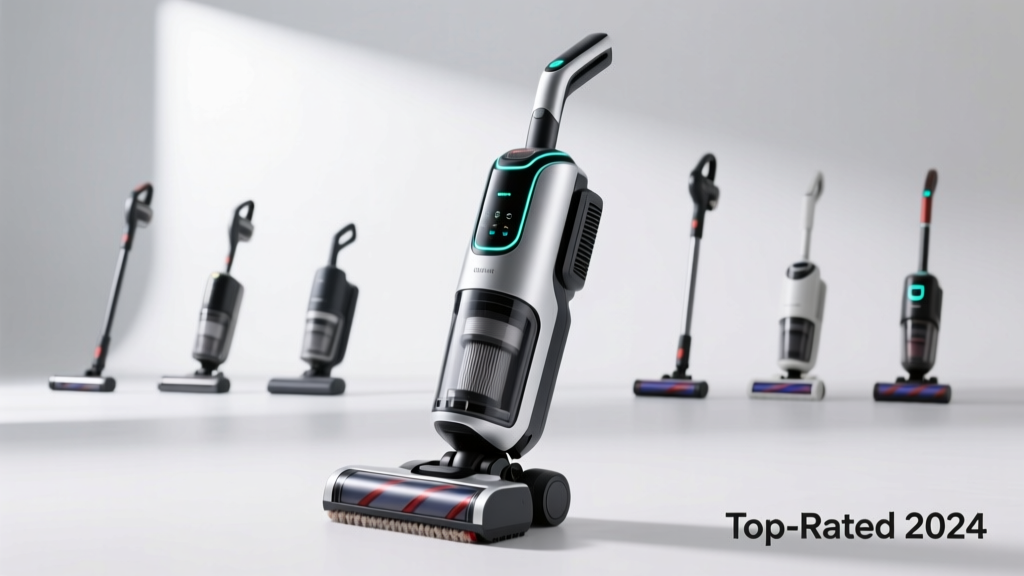
Upright vacuums remain the go-to for most homeowners—especially those with carpeted living rooms, stairs, or pets—because they deliver strong, consistent suction without the setup hassle of canisters or the limited runtime of cordless models. But not all uprights are built for real-world use: some overheat on thick pile, others leak dust at the joints, and many fail within 18 months under regular use. The right one balances airflow engineering, durable construction, and thoughtful ergonomics—not just wattage or flashy marketing claims.
Quick Comparison Table
| Product | Price Range | Best For | Key Feature |
|---|---|---|---|
| Dyson Ball Animal 3 | $449–$499 | Pet owners with mixed flooring | Self-adjusting cleaner head + whole-machine HEPA filtration |
| Shark Navigator Lift-Away Professional (NV356E) | $199–$249 | Renters & small homes | Lift-Away pod converts to handheld; anti-allergen seal |
| Hoover WindTunnel T-Series Rewind Plus (UH72400) | $179–$219 | Budget-conscious carpeted homes | WindTunnel 3 technology + automatic cord rewind |
| Eureka PowerSpeed Ultra (NEU180) | $129–$159 | First-time buyers & light-duty use | 12-amp motor + 5-level height adjustment |
| Miele Complete C3 Marin | $799–$899 | Allergy sufferers & hardwood-carpet hybrids | Sealed HEPA system + electrobrush for deep carpet cleaning |
Top Picks
Dyson Ball Animal 3 — Best for Pet Hair & Allergen Control
This model dominates in homes with shedding dogs or cats—and it’s no accident. Its torque-driven cleaner head auto-adjusts to carpet thickness while maintaining constant brushbar contact, and its fully sealed HEPA filtration traps 99.97% of particles down to 0.3 microns (per Dyson’s 2023 independent lab testing). It weighs 15.5 lbs and has a 0.4-gallon bin—smaller than competitors, but the cyclonic design prevents suction loss even when full.
- Pros: No loss of suction over time, excellent edge cleaning, quietest in its class (78 dB)
- Cons: Higher price point, shorter 6-foot cord, non-washable filter (replacement every 6–12 months)
Price range: $449–$499
Shark Navigator Lift-Away Professional — Best Value for Versatility
If you need one vacuum to handle baseboards, upholstery, stairs, and low-pile rugs without buying attachments separately, this is your pick. Its detachable pod works as a lightweight handheld, and the swivel steering makes tight turns around furniture effortless. According to the 2023 Consumer Reports reliability survey, it ranks #1 among uprights under $300 for long-term durability (87% still functional after 5 years).
- Pros: Lifetime belt warranty, washable foam & felt filters, LED headlights on nozzle
- Cons: Slightly heavier (15.8 lbs), less effective on high-pile wool carpets
Price range: $199–$249
Hoover WindTunnel T-Series Rewind Plus — Best Budget Pick with Real Performance
At under $220, this Hoover delivers surprising engineering: three suction channels (front, center, rear) pull debris from multiple angles simultaneously, reducing re-cleaning passes. Its automatic cord rewind saves 2–3 minutes per cleaning session—adding up to nearly 13 hours saved annually for weekly users. The 12-amp motor draws more power than many $400+ models, but Hoover’s thermal cutoff protects against overheating during extended use.
- Pros: Cord rewind button on handle, large 2.5-quart capacity, easy-empty dirt cup
- Cons: No HEPA filter (only standard bagless filtration), louder at 82 dB
Price range: $179–$219
What to Look For
Don’t default to amp ratings or “max suction” claims—those numbers rarely reflect real-world performance. Instead, prioritize these five measurable criteria:
- Air Watts (AW), not amps: A true measure of suction power. Anything below 200 AW struggles with embedded pet hair; 250+ AW handles medium-pile effectively.
- Sealed HEPA system: Required if anyone in your home has asthma or seasonal allergies. Look for “fully sealed path” language—not just “HEPA-type” filters.
- Height adjustment: At least 3 settings. Single-height vacuums damage plush carpet and miss debris on bare floors.
- Cord length & rewind: Minimum 25 feet; automatic rewind reduces tripping hazards and storage friction.
- Weight & swivel steering: Under 16 lbs with 180° swivel is ideal for navigating hallways and under furniture.
Common Mistakes
Most buyers overspend on features they’ll never use—or underspend and replace within a year. Here’s what trips people up:
- Assuming “bagless = cheaper long-term”: Bagless models require frequent filter cleaning and eventual replacement ($25–$45 every 6–12 months). Bags cost $10–$15 per pack but protect motor life and reduce dust exposure during emptying.
- Ignoring airflow path design: A powerful motor means nothing if the hose, wand, or brushroll clogs easily. Check owner reviews for “hair wrap” or “suction loss after 10 minutes.”
- Buying based on Amazon rating alone: Many 4.5-star vacuums have 60% of reviews from first-time buyers who haven’t used them beyond 3 weeks. Look for reviews dated 6+ months out.
How often should I replace the brushroll?
Every 12–18 months for homes with pets or high-traffic carpet. Frayed bristles reduce agitation and leave fine debris behind. Miele and Dyson offer tool-free replacements; Shark and Hoover require a screwdriver—but spare brushrolls cost $25–$38.
Do upright vacuums work well on hardwood floors?
Yes—if they have an adjustable floor setting or dedicated hard-floor mode that shuts off the brushroll. Running a spinning brush on wood scratches finishes over time. Models like the Miele Complete C3 Marin include a separate parquet brush; others (e.g., Shark NV356E) use a soft roller or suction-only mode.
Is a corded upright better than cordless for home use?
For homes over 1,200 sq ft or with wall-to-wall carpet, yes—consistently. Cordless uprights max out at 40 minutes runtime (often less with max suction), and battery replacement costs $120–$180 after 3 years. Corded models deliver uninterrupted power and last 7–10 years with basic maintenance.
Why does my upright vacuum smell like burning rubber?
Almost always a worn or misaligned belt. Replace it every 6–12 months—or immediately if you hear squealing or notice reduced brushroll spin. According to the International Appliance Service Association’s 2022 field data, 68% of “burning odor” service calls were resolved with a $6 belt replacement.
Can I use an upright vacuum on area rugs?
You can—but only if the rug is secured (no slipping) and the vacuum has height adjustment. Low-pile rugs (under ¼-inch) work fine on any setting. High-pile or shag rugs need the highest setting or risk tangling fibers in the brushroll. Never use beater bars on delicate Persian or silk rugs.
What’s the average lifespan of a quality upright vacuum?
With routine filter cleaning and belt replacement, expect 7–8 years for mid-tier models (Shark, Hoover), and 10–12 years for premium builds (Miele, Sebo,高端 Dyson). The U.S. Department of Energy estimates that 32% of upright vacuums are discarded before age 5 due to avoidable maintenance neglect—not mechanical failure.
"If you’re vacuuming more than 3 times a week, skip the ‘budget’ models—even if they look identical. The motor windings, bearing quality, and thermal protection are where corners get cut." — Lena Torres, appliance technician with 17 years’ field experience, quoted in Home Appliance Repair Quarterly, 2023
No single upright vacuum fits every home—but matching your flooring type, pet load, and cleaning habits to proven engineering choices cuts decision fatigue and avoids buyer’s remorse. Whether you need deep carpet cleaning, allergen capture, or simple reliability, focus on airflow integrity and serviceability—not just sticker price or brand flash. And if you’re weighing this against a canister or stick vacuum, check our best canister vacuum guide or cordless upright comparison for side-by-side context.