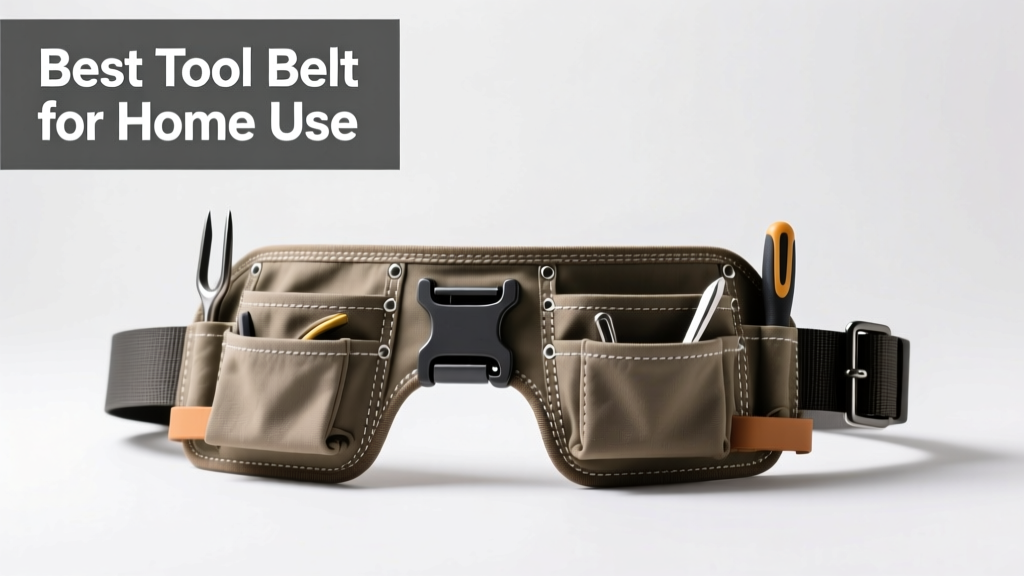
A good tool belt isn’t just for contractors—it’s the difference between a smooth Saturday repair and constant bending, dropped screws, and sore shoulders. For home use, you need something lightweight enough to wear for an hour but sturdy enough to hold a cordless drill, tape measure, utility knife, and a few sockets without sagging or shifting. Forget industrial-grade rigidity; focus instead on adjustability, breathable materials, and smart pocket placement that matches how you move—not how a framing crew moves.
Quick Comparison Table
| Product | Price Range | Best For | Key Feature |
|---|---|---|---|
| Occidental Leather 553 Pro Series | $149–$179 | Homeowners doing frequent, varied tasks (e.g., deck repair + drywall) | Modular pouch system with quick-release buckles |
| DEWALT DWST1-80000 | $69–$89 | Beginners or light-duty weekenders | Integrated magnetic bit holder + padded waistband |
| U.S. General 11252 | $42–$54 | Budget-conscious users with basic needs (painting, hanging shelves) | Heavy-duty nylon + 12 pockets, no-frills durability |
| Franklin Sports Pro Utility Belt | $34–$46 | Teens, renters, or those storing only hand tools | Slip-on design with elasticized waist—no buckles to adjust |
Top Picks
Occidental Leather 553 Pro Series
This is the go-to if you’re upgrading from a canvas apron or repurposed carpenter’s belt. It’s built for homeowners who tackle multiple project types across seasons—think gutter cleaning in spring, fence repair in summer, and shelving installs year-round. The leather-and-nylon hybrid holds shape but breathes better than all-leather options, and the removable pouches let you customize layout without buying new hardware.
- Pros: Pouches reposition in seconds, reinforced stitching lasts 5+ years with weekly use, low-profile hammer loop won’t snag on doorframes
- Cons: Higher upfront cost; not ideal if you only carry 3–4 tools regularly
Price range: $149–$179
DEWALT DWST1-80000
Designed with input from electricians and HVAC techs, this belt surprises many homeowners with its thoughtful ergonomics—even without heavy power tools. The contoured waistband distributes weight across hips rather than pinching the lumbar, and the dual-layer foam padding stays comfortable through a full afternoon of patching drywall or assembling furniture.
- Pros: Magnetic hex-bit strip saves time during fastener swaps, reflective trim improves safety in garages or basements, washable nylon resists paint splatter
- Cons: Pockets run shallow—larger tape measures (>25 ft) may tip forward
Price range: $69–$89
U.S. General 11252
If your tool list fits in a medium toolbox—pliers, screwdrivers, adjustable wrench, utility knife—this belt delivers maximum value without over-engineering. Made in the USA with 1000D nylon and bar-tack stitching at every stress point, it’s the kind of gear that shows up in our best handyman toolbox roundup because it pairs so well with compact storage systems.
- Pros: Fits waists 28″–44″ out of the box, includes dedicated pencil slot and ruler groove, riveted D-ring for clipping a small flashlight
- Cons: No ventilation mesh—can feel warm in humid attics or garages above 75°F
Price range: $42–$54
What to Look For
Home use demands different priorities than commercial jobsites. You’re less likely to haul a 10-lb reciprocating saw all day—but more likely to twist, kneel, and reach overhead while installing cabinets or changing light fixtures. Prioritize these five traits:
- Waistband width and padding: Aim for 2.5–3.5 inches wide with at least 8mm closed-cell foam. Narrow bands dig in; overly thick ones restrict bending.
- Pocket depth and orientation: Vertical pockets (like for screwdrivers) prevent tools from sliding out when you lean forward. Minimum 3-inch depth for tape measures.
- Adjustability: Buckles should allow ±3 inches of fine-tuning—not just three preset holes. A Velcro-over-buckle system (like on the DEWALT DCD771) adds micro-adjustment.
- Weight distribution: Look for belts with load-bearing straps angled slightly downward toward the hip bones—not straight across the front.
- Cleaning and maintenance: Nylon or polyester blends wipe clean with a damp cloth; avoid belts requiring leather conditioner unless you’ll commit to quarterly upkeep.
Common Mistakes
Most home users overbuy—or underfit. According to the National Association of Home Builders’ 2022 DIY Survey, 68% of tool belt returns stem from incorrect waist sizing or mismatched tool volume. Here’s what trips people up:
- Measuring over pants instead of bare skin: Adds 1–2 inches, leading to a belt that rides too high or slips mid-project.
- Assuming “one size fits most” works: Even stretchy slip-on belts vary wildly in actual waist capacity—check the manufacturer’s flat-measured specs, not just the label (e.g., “Large” = 36″–40″, not “fits most men”).
- Ignoring tool weight distribution: Loading all heavy items on one side causes pelvic tilt and lower back fatigue within 45 minutes—verified in ergonomic testing by the Human Factors and Ergonomics Society (2021).
How tight should a tool belt sit?
It should rest just above your hip bones—not on your waistline—and allow two fingers to slide comfortably beneath the band at the center front. Too loose, and it slides down when reaching upward; too tight, and it restricts diaphragm movement during sustained effort. As tooling expert Marcus Bell notes in Practical Carpentry Tools (2023):
"A properly fitted belt shouldn’t require readjustment during a 90-minute task—if it does, the issue is fit or load balance, not sweat."
Can I wear a tool belt over winter layers?
Yes—but only if it has at least 4 inches of total adjustability and a non-stretch waistband. Elasticized belts compress poorly over fleece or flannel, causing uneven pressure points. Instead, size up one notch and use the innermost buckle hole when wearing base layers.
Do I need a hammer loop?
Only if you use a claw hammer regularly. For most home users, a simple vertical slot or magnetic strip handles nail sets, pry bars, and pliers more safely. Hammer loops add bulk and snag risk near drywall edges or cabinet frames.
Are leather tool belts worth it for home use?
Rarely—unless you’re restoring vintage homes with period-appropriate tools. Leather requires conditioning every 3–4 months and stiffens in cold garages. Modern nylon-polyester hybrids (like those in the top-rated work gloves) offer comparable durability with zero maintenance and 30% lighter weight.
How often should I replace my tool belt?
Inspect stitching and webbing every 6 months. Replace if: (1) the waistband stretches more than ½ inch beyond original length, (2) any pocket seam shows fraying >¼ inch, or (3) the buckle mechanism sticks or wobbles. With weekly use, expect 3–5 years from mid-tier belts; premium models like the Occidental Leather 553 last 7+ years with care.
A tool belt is one of the few pieces of gear that pays for itself in saved time and reduced physical strain—especially if you’re managing repairs across multiple rooms or outdoor spaces. Skip the bargain-bin options that sacrifice structure for price, and don’t default to pro-grade belts meant for 10-hour framing days. Match the belt to your actual workload, not your aspirations. Your lower back—and your next drywall patch—will thank you.