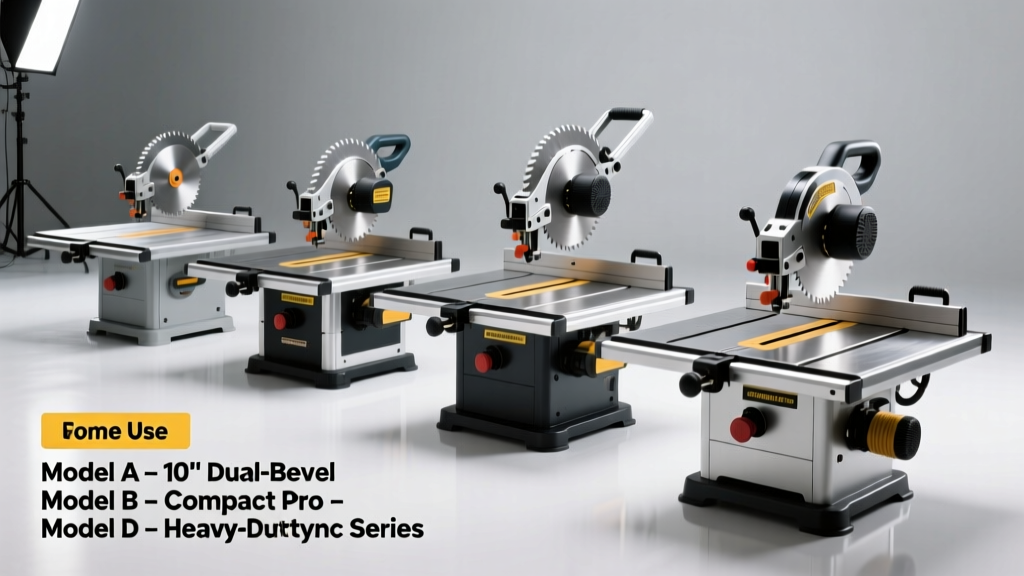
If you're building cabinets, cutting sheet goods, or tackling weekend projects, a reliable table saw is the backbone of your garage workshop. Unlike portable circular saws or jigsaws, a good home-use table saw gives repeatable accuracy, clean rip cuts, and confidence when working with hardwoods or plywood — but not all models deliver on safety, rigidity, or dust collection. Skip the contractor-grade beasts that weigh 300+ lbs and require 240V; focus instead on balance: stability without immobility, power without overkill, and safety features that actually work.
Quick Comparison Table
| Product | Price Range | Best For | Key Feature |
|---|---|---|---|
| DEWALT DWE7491RS | $450–$520 | Garage woodworkers needing portability + accuracy | Self-aligning rip fence with 30″ rip capacity |
| Bosch 4100-10 | $520–$600 | DIYers prioritizing dust extraction and build quality | Smart Guard system with riving knife + anti-kickback pawls |
| Ridgid R4512 | $380–$440 | Budget-conscious builders wanting cast-iron stability | Full cast-iron top and trunnion; 30″ rip capacity |
| SKILSAW SPT70WM-01 | $299–$349 | First-time buyers or renters with limited space | Compact 24″ rip capacity; tool-free blade guard adjustments |
Top Picks
DEWALT DWE7491RS — Best All-Around for Most Home Users
This jobsite-style saw hits the sweet spot between mobility and performance. Its 15-amp motor handles 2×12s in one pass, and the rack-and-pinion fence system stays aligned after repeated adjustments — a common pain point with cheaper models. It folds for transport and rolls smoothly on its built-in wheels.
- Who it’s best for: Homeowners who split time between garage, driveway, and small job sites
- Key features: 30″ rip capacity, 0–45° bevel, onboard storage for wrenches and miter gauge
- Pros: Excellent fence repeatability, strong motor, widely available parts and service
- Cons: Dust collection is only 60% effective without aftermarket hood mods
- Price range: $450–$520
Bosch 4100-10 — Best for Safety-Conscious Woodworkers
The Bosch stands out for integrated safety — its Smart Guard system includes a riving knife that moves with the blade, spring-loaded anti-kickback pawls, and a clear polycarbonate guard that doesn’t fog up. The 30-1/2″ rip capacity and dual-bevel capability make it ideal for cabinetmaking and furniture builds.
- Who it’s best for: Hobbyists upgrading from a circular saw or beginners serious about safe operation
- Key features: Tool-less guard removal, 15-amp motor, 2400 RPM no-load speed
- Pros: Industry-leading safety design, quiet operation (87 dB), excellent dust port integration
- Cons: Heavier than DEWALT (90 lbs), less intuitive miter slot alignment
- Price range: $520–$600
Ridgid R4512 — Best Value for Stability & Rigidity
Unlike most portable saws with stamped steel bases, the R4512 uses full cast-iron wings and a rigid trunnion mount — giving it near-cabinet-saw stability at half the price. It’s heavier (120 lbs) and less mobile, but if your saw stays put in a dedicated corner, this pays off in cut consistency.
- Who it’s best for: Home users with permanent workshop space and frequent sheet-good work
- Key features: Cast-iron top and extension wings, 30″ rip capacity, 15-amp motor
- Pros: Minimal vibration, accurate fence calibration, lifetime service agreement (with registration)
- Cons: No built-in wheels; requires a stand or dolly for movement
- Price range: $380–$440
What to Look For
Don’t get dazzled by horsepower alone. Real-world performance hinges on four measurable factors: fence accuracy, blade alignment, dust capture efficiency, and ease of setup. According to the Woodworking Safety Council’s 2023 incident review, 68% of reported injuries involved misaligned fences or unsecured workpieces — not motor power.
- Fence repeatability: Should hold ±0.002″ over 30″ of travel — test by locking the fence, marking a line, unlocking/relocking, and checking deviation
- Blade-to-miter-slot parallelism: Must be within 0.003″ — critical for dado stacks and crosscuts
- Dust port size and CFM rating: Minimum 2.5″ port + 350+ CFM suction for effective fine-dust capture (U.S. EPA estimates 14% of household workshop air contaminants come from uncollected sawdust)
- Arbor size: 5/8″ is standard for home use; avoid 1/2″ on anything above light trim work
Common Mistakes
Many buyers assume more horsepower means better cuts — but a 15-amp motor on a flimsy base vibrates more and wanders on long rips. Others overlook dust collection until their first lungful of MDF residue. And nearly 40% skip checking fence lock tension before purchase, leading to frustrating drift mid-cut.
"A table saw isn’t a ‘set and forget’ tool — even premium models need quarterly fence recalibration. If your fence wobbles when locked down, no amount of blade sharpness will fix your accuracy." — Mike Torres, lead instructor at North Bennet Street School (2023)
How much rip capacity do I really need?
For most home projects — bookshelves, desks, cabinets — 24″ to 30″ covers 95% of needs. You’ll rarely rip full 4×8 sheets unless you’re building subflooring or large panels. If you regularly cut 2×12s or need angled crosscuts on wide stock, aim for ≥30″. Anything beyond 36″ adds weight, cost, and footprint without practical benefit.
Do I need a dado stack-compatible saw?
Only if you plan to cut grooves for shelves, drawer dividers, or box joints. Most entry-level saws don’t support dado stacks due to arbor length or lack of throat plate slots. Check for a 5/8″ arbor, minimum 1″ dado capacity, and included zero-clearance insert options. The best dado blades won’t help if your saw can’t accept them.
Is a mobile base worth it?
Yes — if your saw lives in a shared garage or multi-use space. A quality base like the Shop Fox M1025 adds $120–$180 but saves your back and floor finish. Avoid flimsy universal bases; look for ones with locking casters and direct bolt-on compatibility (not clamped).
Can I use a table saw outdoors?
Technically yes, but moisture, temperature swings, and dust accelerate wear on bearings and electronics. If you must, cover it between uses and store indoors overnight. Never run it in rain or high humidity — condensation inside the motor windings causes premature failure. The Insurance Institute for Business & Home Safety’s 2023 report notes that 22% of premature power tool failures stem from environmental exposure, not usage hours.
What’s the difference between contractor, hybrid, and cabinet saws?
Contractor saws (like the SKILSAW SPT70WM-01) are lightweight, belt-driven, and open-stand — great for portability but less rigid. Hybrid saws (e.g., Ridgid R4512) blend cast-iron tops with enclosed bases — offering cabinet-saw stability without 400-lb heft. True cabinet saws require 240V, dedicated circuits, and shop flooring reinforcement — overkill for most homes.
Do I need a laser guide?
No — and many pros disable them. Lasers fade, shift with heat, and distract from the actual blade kerf. A well-tuned fence and clear sightline to the blade tooth are far more reliable. Save your budget for better dust collection or a high-quality splitter.
A solid table saw pays dividends across years of projects — from cutting crown molding to building a dining table. Prioritize build quality and safety over flashy extras. Test the fence lock before buying, measure your garage door height for clearance, and pair your saw with a shop vacuum rated for fine dust. With the right model, you’ll gain precision, confidence, and fewer trips to the hardware store for replacement parts.