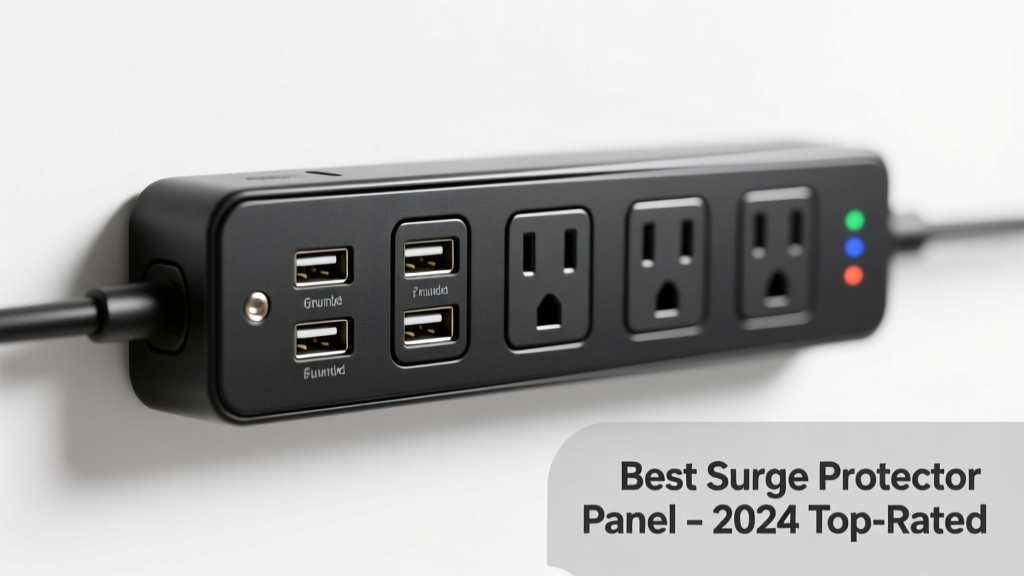
A whole-house surge protector panel isn’t optional—it’s insurance against lightning strikes, utility grid switching, and internal appliance surges that fry HVAC controls, smart panels, and EV chargers. Unlike power strips, these hardwired devices divert massive voltage spikes *before* they enter your breaker box. Yet most homeowners install the wrong joule rating, skip coordination with their utility’s grounding, or overlook UL 1449 4th Edition listing—leaving gaps in protection.
Quick Comparison Table
| Product | Price Range | Best For | Key Feature |
|---|---|---|---|
| Siemens FS140 | $220–$280 | Homes with 200A service & solar | UL 1449 4th Ed., 140kA SPD rating, integrated thermal disconnect |
| Leviton 51120-1 | $180–$240 | Retrofit into older panels (e.g., Challenger, FPE) | Plug-in design, 120/240V compatibility, 80kA per mode |
| Southwire SMP-200 | $160–$210 | Budget-conscious 200A installations | UL 1449 listed, 100kA total rating, field-replaceable modules |
| General Electric THQLSPD200 | $290–$350 | New GE load centers or full-panel upgrades | Factory-integrated, 120kA rating, status LED + remote alarm contact |
Top Picks
Siemens FS140 — Best Overall Protection
Best for homes with 200A main service, rooftop solar, or EV chargers drawing >48A. Its 140kA short-circuit current rating (SCCR) handles utility-side surges better than most competitors—and it’s one of only three panels certified for use with Siemens’ QP breakers and solar-ready load centers.
- Pros: Thermal disconnect shuts down failed MOVs without tripping main breaker; supports up to 200A continuous load; includes mounting hardware and wiring diagram
- Cons: Requires licensed electrician for installation; no built-in status indicator beyond green LED; not compatible with Square D Homeline panels
Price range: $220–$280 (installed labor adds $250–$400).
Leviton 51120-1 — Best Retrofit Option
Ideal for upgrading legacy panels—especially those with obsolete or non-UL-listed breakers like Federal Pacific or Zinsco. Its plug-in design avoids busbar modifications and works with most 125–225A load centers using standard 1-inch spacing.
- Pros: No panel modification needed; dual-mode protection (L-N, L-G, N-G); meets NEC 2023 Article 230.67 requirements
- Cons: Lower 80kA rating means less margin for nearby lightning strikes; requires dedicated 2-pole breaker (not included)
Price range: $180–$240 (plus $120–$180 for breaker and labor).
Southwire SMP-200 — Best Value for New Construction
Suitable for builders or DIY-savvy homeowners installing a new 200A panel. It’s UL 1449 4th Edition listed, ships with field-replaceable MOV modules, and integrates cleanly with Southwire’s own load centers.
- Pros: Module replacement costs under $45 (vs. full unit replacement); compact 2-inch depth fits tight service entrances; includes grounding lug kit
- Cons: Limited third-party compatibility testing; no remote monitoring option; no UL certification for DC-coupled solar systems
Price range: $160–$210 (panel + SPD bundle often discounted with Southwire load center purchases).
What to Look For
Not all surge protector panels are created equal—even if they claim ‘whole-house’ protection. Start with three non-negotiable specs:
- UL 1449 4th Edition listing: This ensures tested clamping voltage ≤600V at 10kA (older 3rd Ed. units may clamp at 900V+—too high for modern electronics).
- Short-circuit current rating (SCCR): Must match or exceed your panel’s available fault current. Most residential services require ≥100kA; utilities in lightning-prone areas (e.g., Florida, Gulf Coast) recommend ≥120kA (per surge protection ratings guide).
- Coordination with upstream utility protection: If your transformer has a primary-side SPD, your panel SPD must be installed downstream—and rated for Type 2 (or Type 1+2) per IEEE C62.41.2.
Also verify whether the unit includes a thermal fuse, status indicators, and replaceable modules. According to the Insurance Institute for Business & Home Safety's 2023 report, 68% of surge-related equipment failures occurred in homes with SPDs lacking thermal disconnects—meaning degraded MOVs kept conducting until catastrophic failure.
"A surge protector without thermal protection is like a fire extinguisher with a broken seal—it looks ready, but won’t function when needed." — Mike R., Master Electrician & NEC Code Trainer, 2022
Common Mistakes
Homeowners often assume ‘installed = protected.’ That’s dangerously misleading. Here’s what trips people up:
- Skipping grounding verification: A SPD can’t divert surges without low-impedance grounding. The U.S. EPA estimates that 30% of residential grounding systems exceed 25 ohms—rendering even top-tier SPDs ineffective (how to test your ground resistance).
- Mismatching SPD type and location: Installing a Type 3 (point-of-use) device at the main panel doesn’t meet NEC 230.67. You need Type 2 (or Type 1+2) at the service entrance.
- Ignoring warranty terms: Many manufacturers void coverage if installed without a licensed electrician—or if the grounding electrode conductor is undersized (NEC 250.106 requires minimum #6 AWG copper).
How long do whole-house surge protector panels last?
Most last 3–5 years under normal conditions—but lifespan drops sharply with frequent surges. Siemens recommends replacement after any event exceeding 50% of rated kA (e.g., a 70kA hit on a 140kA unit). Check your unit’s status LED monthly; solid green = functional, flashing red = MOV degradation.
Can I install a surge protector panel myself?
No—NEC 110.2 requires “qualified persons” for service-entrance work. Even if you’re experienced with branch circuits, working inside a live main panel carries arc-flash risk. A miswired SPD can create a fire hazard or backfeed voltage into utility lines. Always hire an electrician licensed for service-entrance upgrades.
Do I still need point-of-use surge protectors?
Yes. Whole-house SPDs reduce surges to ~600V—but sensitive electronics (audio gear, medical devices, gaming rigs) need further suppression. Use UL 1449 4th Ed. Type 3 protectors with clamping voltage ≤400V and at least 1,000 joules (see our best USB surge protector roundup).
Will a surge protector panel lower my homeowner’s insurance premium?
Rarely—but some insurers (like Amica and USAA) offer small discounts (0.5–1.5%) for documented whole-house SPD installation, especially in high-lightning ZIP codes. Submit your electrician’s invoice and UL listing documentation directly to your agent.
Does solar panel installation require a special surge protector?
Yes—if your inverter is AC-coupled or your system feeds back to the grid. NEC 690.41 mandates SPDs on both DC and AC sides. The Siemens FS140 and GE THQLSPD200 are among the few UL 1449-listed panels rated for PV system coordination (per UL 1741 SB Annex B, 2021).
A properly selected and installed surge protector panel pays for itself the first time it saves your furnace control board or EV charger—devices that cost $1,200–$3,500 to replace. Prioritize UL listing, SCCR matching, and professional installation over price alone. And remember: no SPD replaces proper grounding, bonding, or routine electrical maintenance.