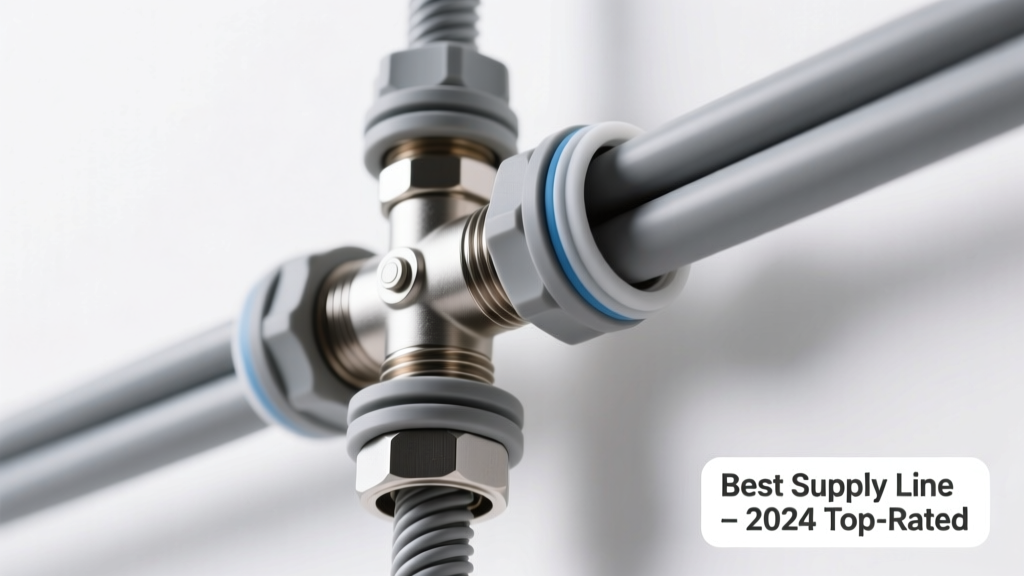
Supply lines are the unsung heroes of your plumbing system—small, flexible tubes connecting faucets, toilets, and appliances to shut-off valves. A failing line can cause a $10K water damage claim; the Insurance Institute for Business & Home Safety's 2023 report found that 28% of residential water losses stem from supply line failure. You need durability, corrosion resistance, and proper sizing—not just the cheapest coil from the hardware aisle.
Quick Comparison Table
| Product | Price Range | Best For | Key Feature |
|---|---|---|---|
| Braided Stainless Steel (3/8" FIP × 3/8" FIP) | $8–$15 | Standard kitchen sink & bathroom faucet | Double-braided 304 stainless, NSF/ANSI 61 certified |
| PEX-Al-PEX Composite | $12–$22 | High-temp applications (dishwasher, tankless heater) | Aluminum barrier prevents oxygen diffusion; rated to 200°F |
| Reinforced EPDM Rubber (with brass fittings) | $6–$10 | Rental properties or temporary fixes | Low-cost, vibration-dampening, but 5-year max service life |
| Stainless Steel with Swivel Nut | $18–$28 | Tight spaces (undersink cabinets, RVs) | 360° rotating nut reduces kinking during installation |
Top Picks
Braided Stainless Steel (3/8" FIP × 3/8" FIP)
Best for homeowners replacing standard sink or toilet lines who want proven reliability without overspending. Features double-layer 304 stainless braid over EPDM rubber core, crimped brass nuts, and NSF/ANSI 61 certification for potable water safety.
- Pros: Resists kinking, handles 125 PSI working pressure, widely available in 12"–36" lengths, easy to tighten by hand
- Cons: Not ideal for continuous high-temp exposure (e.g., under-sink water heaters), braiding can fray if over-torqued
Price range: $8–$15. For a trusted brand, see our braided stainless steel supply lines roundup.
PEX-Al-PEX Composite
Best for dishwashers, tankless water heaters, or any application where water exceeds 140°F. Combines PEX inner and outer layers with an aluminum barrier—blocking oxygen ingress that causes corrosion in closed-loop systems.
- Pros: Rated for 200°F and 160 PSI, won’t expand/contract like pure PEX, compatible with push-fit and compression fittings
- Cons: Requires specialty cutters and deburring tools, stiffer than braided steel—harder to route in cramped spaces
Price range: $12–$22. Learn more about proper installation in our PEX-Al-PEX installation guide.
Stainless Steel with Swivel Nut
Best for tight installations—think pedestal sinks, RVs, or cabinet-mounted bidets where standard nuts bind before sealing. The swivel design lets you fully seat the nut without twisting the hose body.
- Pros: Eliminates torsional stress on the seal, reduces leak risk at the fitting interface, same pressure/temp ratings as standard braided steel
- Cons: Slightly higher cost, fewer length options (mostly 12" and 24")
Price range: $18–$28.
What to Look For
Not all supply lines are created equal—even if they look identical on the shelf. Prioritize these five specs before buying:
- NSF/ANSI 61 certification — mandatory for potable water contact; confirms no lead leaching or chemical migration
- Working pressure rating — minimum 125 PSI (most homes run 40–80 PSI, but spikes occur)
- Temperature rating — cold water only (≤100°F) vs. hot/cold (≤200°F); mismatch causes premature failure
- Fitting type compatibility — verify thread size (3/8" FIP is standard) and whether your valve uses male or female threads
- Length + bend radius — measure from valve outlet to fixture inlet, then add 2" slack; avoid lines shorter than 12" unless space is truly constrained
Common Mistakes
Homeowners often install supply lines incorrectly—not because they’re careless, but because subtle errors go unnoticed until it’s too late. Here’s what pros see most often:
- Over-tightening brass nuts until the threads strip or the ferrule deforms—finger-tight plus 1/4 to 1/2 turn with a wrench is sufficient
- Using hot-water-rated lines for cold-only fixtures (wastes money) or vice versa (creates failure risk)
- Ignoring the shut-off valve condition—replacing a line while keeping a corroded, leaking valve invites future trouble
- Choosing rubber lines for permanent installs—EPDM degrades faster than stainless, especially near heat sources or UV exposure
"We replace 3–5 supply lines per week in service calls—and 70% of those failures trace back to using non-NSF-certified rubber lines installed beyond their 5-year lifespan." — Mike Torres, Master Plumber, Chicago Plumbing Co. (2024)
How long do braided stainless supply lines last?
When properly installed and not exposed to sustained high heat, braided stainless lines typically last 8–12 years. The U.S. EPA estimates that 14% of household water usage is from leaks—including slow seeps at supply line connections—so replacing them proactively every decade cuts waste and risk.
Can I reuse an old supply line when replacing a faucet?
No—unless it’s less than 2 years old, shows zero signs of swelling, discoloration, or braid fraying, and was never used with a high-temp fixture. Most manufacturers void warranties if reused lines fail. It’s cheaper to buy new ($8–$15) than repair drywall later.
What’s the difference between 3/8" and 1/2" supply lines?
3/8" is the universal standard for residential faucets, toilets, and most appliances. 1/2" lines are rare in homes—they’re used in commercial settings or for main feeds to whole-house filters. Using 1/2" on a 3/8" valve creates a dangerous gap and leak path. Always match the valve’s outlet size.
Do I need Teflon tape on supply line threads?
No—if the line has brass compression nuts with integrated rubber or EPDM washers (which nearly all do), Teflon tape adds no benefit and may interfere with the seal. Tape is only appropriate for threaded pipe joints without factory seals.
Why do some supply lines have blue and red markings?
Blue = cold water, red = hot water—purely for installer orientation. Both are rated for hot/cold use unless labeled “cold water only.” Don’t assume color-coding indicates temperature rating; always check the packaging specs.
Are there supply lines safe for well water with high iron content?
Yes—but avoid rubber-core lines. Iron deposits accelerate EPDM degradation. Opt for all-metal construction (e.g., stainless steel with solid copper or brass core) or PEX-Al-PEX, which resists mineral buildup better than standard PEX.
Replacing supply lines isn’t glamorous—but doing it right protects your home, your wallet, and your peace of mind. Stick with NSF-certified, properly sized, and temperature-rated lines, and pair them with a functional shut-off valve. And if you’re upgrading multiple fixtures, consider bundling with a shut-off valve replacement kit to ensure full system integrity.