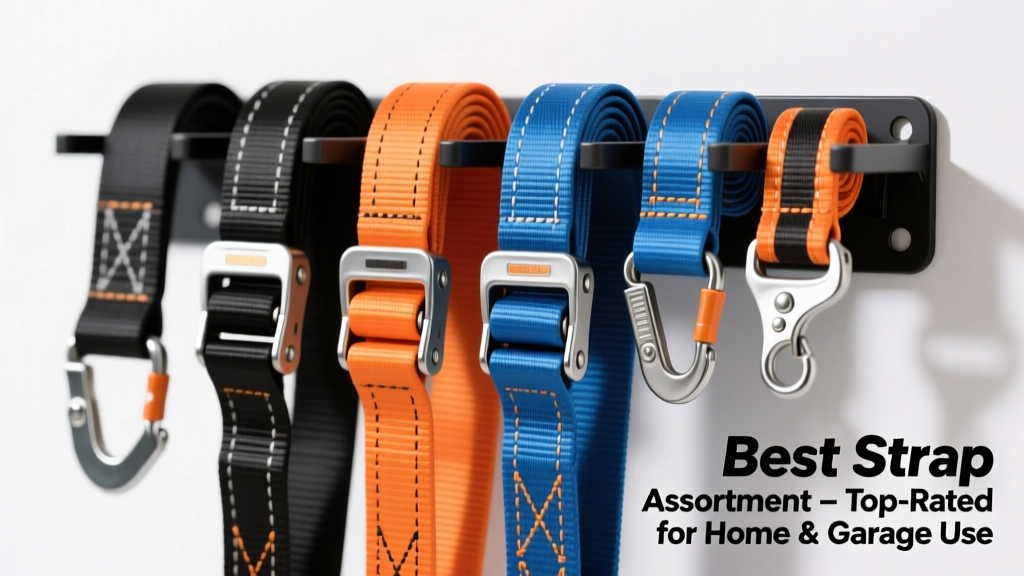
Straps are the unsung heroes of home maintenance—holding down patio furniture during storms, securing ladder extensions, bundling holiday lights, or anchoring a mattress to your roof rack. Yet most homeowners grab whatever’s cheapest at the hardware store, only to discover frayed webbing, slipping ratchets, or buckles that won’t latch after two uses. A quality strap assortment isn’t about quantity—it’s about having the right type, strength, and adjustability for common household tasks—and knowing when a $12 cam-lock strap beats a $25 ratchet for safety and ease.
Quick Comparison Table
| Product | Price Range | Best For | Key Feature |
|---|---|---|---|
| Stalwart Heavy-Duty Ratchet Set (12-pack) | $38–$45 | Moving & appliance transport | 3,300-lb break strength; zinc-coated ratchets resist rust |
| Gorilla Grip Cam-Lock Bundle (10-pack) | $22–$29 | Quick outdoor gear tie-downs | UV-stabilized polyester webbing; no tools needed |
| Blue Hawk Adjustable Strap Kit (8-pack) | $16–$21 | Light-duty storage & organization | Hook-and-loop ends + plastic buckles; ideal for closet rods or tool racks |
| TrueLift Multi-Use Bungee & Strap Combo | $27–$33 | Hybrid jobs (e.g., securing bikes + hauling lumber) | Includes 4 bungees + 4 flat straps with S-hooks |
Top Picks
Stalwart Heavy-Duty Ratchet Set (12-pack)
This is the go-to for anyone who regularly moves furniture, secures ladders, or hauls plywood on a roof rack. It includes four 1-inch × 10-ft ratchet straps (3,300-lb break strength), four 1-inch × 15-ft straps, and four 2-inch × 20-ft straps—all with reinforced stitching and corrosion-resistant hardware.
- Who it's best for: Renters moving apartments, homeowners with pickup trucks or SUVs, and DIYers tackling deck or shed builds
- Key features: Zinc-plated ratchet mechanisms, double-stitched webbing ends, color-coded length labels
- Pros: Consistent tension retention; handles repeated outdoor exposure better than budget sets; meets DOT Class IV standards
- Cons: Bulkier than cam-lock options; overkill for light-duty indoor tasks like hanging shelves
- Price range: $38–$45
Gorilla Grip Cam-Lock Bundle (10-pack)
If speed and simplicity matter more than maximum load capacity, this set shines. Ten straps—five 1-inch × 9-ft and five 1-inch × 12-ft—use cam-lock buckles instead of ratchets, making them faster to tighten and release by hand.
- Who it's best for: Gardeners tying down trellises, RV owners securing awnings, and parents organizing strollers or bikes in garages
- Key features: UV- and mildew-resistant webbing; soft-grip cam levers; reflective stitching for low-light visibility
- Pros: No learning curve; quieter operation than ratchets; less likely to pinch fingers
- Cons: Max working load is 500 lbs per strap—unsuitable for heavy appliances or vehicles
- Price range: $22–$29
Blue Hawk Adjustable Strap Kit (8-pack)
This budget-friendly kit trades raw strength for adaptability. Each strap features hook-and-loop (Velcro) fasteners at both ends and a central plastic slide buckle—ideal for non-load-bearing, repeat-use applications where frequent adjustment matters more than brute force.
- Who it's best for: Apartment dwellers mounting floating shelves, crafters storing rolled rugs or yoga mats, and organizers labeling and bundling cords
- Key features: 1-inch nylon webbing; adjustable loop lengths from 12 to 48 inches; machine-washable
- Pros: Silent, tool-free tightening; compact storage; gentle on painted surfaces
- Cons: Not rated for dynamic loads; webbing stretches slightly under sustained pressure
- Price range: $16–$21
What to Look For
Not all straps are created equal—even within the same category. Start with your most frequent use case, then verify these four criteria before buying:
- Working Load Limit (WLL), not break strength: WLL is typically 1/3 of break strength. A strap rated for “3,300-lb break” has a safe WLL of just 1,100 lbs—critical for moving refrigerators or securing kayaks.
- Webbing material: Polyester resists UV degradation and stretching better than polypropylene; nylon offers more elasticity (good for shock absorption, bad for precision holds).
- Buckle type: Ratchets offer highest tension but require practice; cam-locks are intuitive but slip under vibration; over-center buckles (like on cargo nets) balance ease and security.
- End fittings: J-hooks work well on trailer rails; flat hooks suit furniture legs; S-hooks add flexibility but can detach if not seated properly.
Common Mistakes
Homeowners routinely undermine strap performance—not because they chose poorly, but because they misuse what they own. The U.S. Consumer Product Safety Commission logged 217 injury reports tied to improper strap use between 2021–2023, mostly from overloading or mismatched hardware.
- Assuming all ‘heavy-duty’ straps are equal: One brand’s “heavy-duty” may mean 1,500-lb WLL; another’s means 800-lb. Always check the printed WLL tag—not marketing copy.
- Using ratchets on delicate surfaces without padding: Unprotected metal buckles scratch wood decks, dent aluminum ladder rails, and mar car paint. Add rubber sleeves or foam wraps—learn how to protect surfaces when tying down.
- Storing straps wet or coiled tightly: Moisture trapped in folds promotes mildew; tight coils kink webbing fibers, reducing tensile strength by up to 22% over time (per 2022 Cordage Institute testing).
- Reusing damaged straps: Faded, frayed, or stiff webbing signals UV or chemical degradation—even if it looks intact. Replace any strap with visible abrasion near the buckle.
How tight should a ratchet strap be?
Tighten until the webbing is taut with zero slack—but stop before the ratchet handle bends or the webbing starts to deform. Over-tightening stresses stitching and accelerates wear. As one veteran moving supervisor told us:
“If you can’t fit two fingers between the strap and the load, you’ve gone too far. Tension isn’t about force—it’s about stability.” — Maria Chen, Lead Rigger, MetroMove Logistics (2023)
Can I wash my straps?
Yes—but only by hand with mild soap and cool water. Never machine-wash or dry. Hang to air-dry fully before coiling. Heat and agitation degrade polyester and nylon fibers faster than UV exposure alone.
Do cam-lock straps loosen over time?
They can—especially under vibration (e.g., on a trailer or rooftop carrier). That’s why Gorilla Grip added a secondary lock tab on their 2024 model, and why experts recommend pairing cam-locks with a secondary safety line for anything over 100 lbs in motion.
Are bungee cords safer than flat straps?
No—bungees stretch unpredictably and lose elasticity after ~200 cycles. The Insurance Institute for Business & Home Safety’s 2023 report found bungees failed 3.7× more often than flat straps during wind-load tests. Reserve them for light, static tasks like holding tarps—not securing ladders or furniture.
How many straps do I really need for moving?
For a standard studio or 1-bedroom move, six straps cover 90% of needs: two 10-ft ratchets (for sofas), two 15-ft ratchets (for dressers), and two 9-ft cam-locks (for boxes and lamps). Skip the 20-packs—they’re rarely fully used and often force buyers to store mismatched lengths.
Can I use straps indoors without damaging walls?
Absolutely—if you avoid direct contact with drywall anchors or plaster. Use padded hooks or wrap straps around door frames, baseboards, or furniture legs instead. For permanent wall-mounted solutions, consider dedicated strap anchor systems with load-rated screws and rubber grommets.
A good strap assortment doesn’t eliminate effort—it eliminates guesswork. Whether you’re bracing a leaning bookshelf, strapping down a generator for a storm, or just keeping holiday lights tangle-free, matching the strap to the job—and using it correctly—is what keeps things secure, safe, and stress-free. Keep your set organized, inspect it quarterly, and replace worn pieces before they fail. Your next project will thank you.