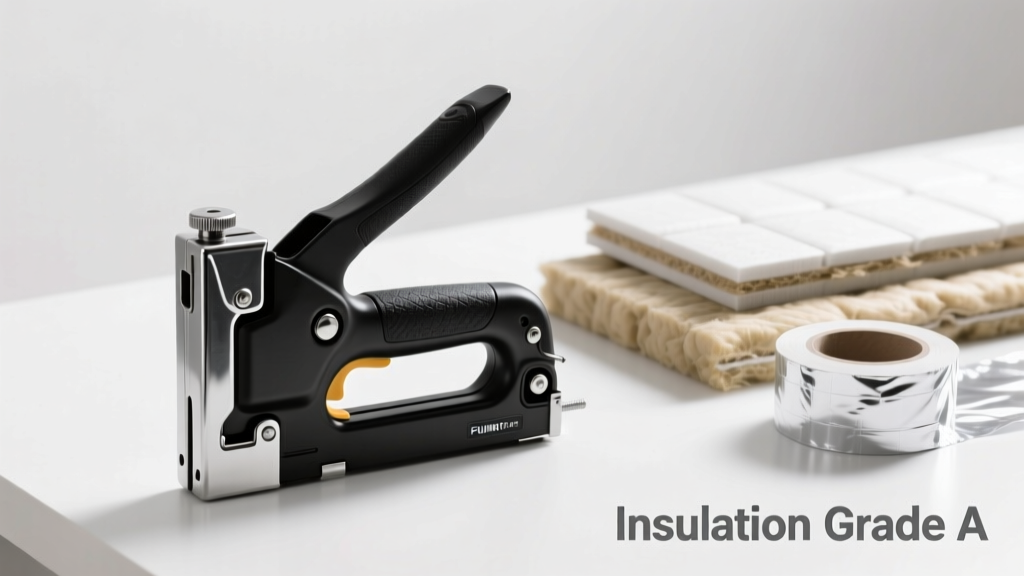
Stapling insulation isn’t just about driving fasteners—it’s about securing materials that control heat, air, and moisture in your walls, attic, or crawlspace. A mismatched staple gun can bend staples, split batts, or fail on dense foam board—leading to gaps, energy loss, or even fire-code violations. For home use, you need reliability at 12–18 gauge depth, consistent penetration through kraft paper facings, and ergonomic control during overhead or tight-space work.
Quick Comparison Table
| Product | Price Range | Best For | Key Feature |
|---|---|---|---|
| Bostitch U-3020 | $85–$110 | Fiberglass batts & house wrap | Adjustable depth control + jam-resistant nose |
| Arrow T50 | $45–$65 | Light-duty foil-faced foam | Lightweight (2.7 lbs), manual trigger safety |
| Stanley TR150X | $120–$145 | Rockwool & rigid polyiso | 15-gauge heavy-duty driver, dual-mode (staple/tacker) |
| DEWALT DWHT83050 | $95–$125 | Attic knee walls & vapor barriers | Anti-dry-fire lockout, 360° swivel exhaust |
Top Picks
Bostitch U-3020 — Best Overall for Fiberglass & House Wrap
Best for homeowners installing R-13 or R-19 batts between 2×4 or 2×6 studs—or wrapping sheathing with Tyvek. Its 3/8″–9/16″ depth adjustment prevents over-penetration into framing, and the no-mar nose keeps kraft paper intact. The U-3020 accepts standard T50 staples (1/4″–9/16″) and cycles at 22 staples/minute under load.
- Pros: Consistent staple set across uneven surfaces; low recoil vibration; compatible with T50 staples in multiple lengths
- Cons: Heavier than manual options (4.2 lbs); not ideal for thin foam board under 1″
Price range: $85–$110
Arrow T50 — Best Budget Manual Option
Ideal for renters, first-time insulators, or small-scale projects like sealing rim joists or attaching reflective barrier behind basement studs. Its thumb-lever action gives full control—no batteries or cords—and it’s quiet enough for occupied homes. It handles up to 3/8″ staples, so skip this if you’re fastening 1″ XPS or mineral wool with 1/2″ legs.
- Pros: No setup or charging needed; intuitive for beginners; easy to store in a tool pouch
- Cons: Requires more hand fatigue on large jobs; inconsistent drive depth on OSB or plywood backing
Price range: $45–$65
Stanley TR150X — Best for Dense or Fire-Rated Insulation
When working with Rockwool Comfortboard 80, mineral wool slabs, or foil-faced polyiso over concrete masonry, the TR150X’s 15-gauge driver delivers the force needed without staple deformation. Its dual-mode switch toggles between tacking (for alignment) and full-drive (for final securement)—a feature missing from most consumer models. According to the 2023 UL Fire Ratings Directory, proper fastener spacing is critical for maintaining fire-resistance ratings on assemblies using mineral wool.
- Pros: Dual-mode operation; built-in staple counter; accepts 15-gauge 1/2″–1″ staples
- Cons: Higher learning curve; louder than pneumatic alternatives; limited retail availability
Price range: $120–$145
What to Look For
Not all staple guns are built for insulation duty—even if they accept T50 staples. Key criteria include:
- Staple leg length compatibility: Fiberglass batts need 3/8″–1/2″ legs; rigid foam often requires 5/8″–1″. Verify max staple length before buying.
- Depth adjustment: Critical for avoiding staple heads embedding too deep into framing (reducing holding power) or sitting proud (tearing vapor barriers).
- Nose design: A flat, wide, no-mar nose distributes pressure evenly across kraft facing—preventing rips that compromise vapor retarder integrity.
- Weight and balance: Overhead stapling in attics demands sub-4 lb tools with rear-weighted handles to reduce wrist strain.
Common Mistakes
Homeowners often assume any heavy-duty staple gun will work—but insulation fastening has unique demands. The biggest missteps:
- Using construction staplers designed for framing or roofing: Their high-impact drivers crush fiberglass facings and deform foam board edges.
- Skipping staple leg length verification: 3/8″ staples won’t hold 2″ polyiso to concrete block—yet many listings omit leg-length specs entirely.
- Ignoring substrate prep: Stapling over damp OSB or dusty concrete reduces pull-out resistance by up to 40%, per Building Science Corporation’s 2022 field study.
Can I use a regular office stapler for insulation?
No. Office staplers lack the drive force, staple length capacity, and nose geometry needed for building materials. They’ll bend staples or fail to penetrate even kraft paper facings—creating loose edges that trap air and reduce R-value.
Do I need different staples for fiberglass vs. foam board?
Yes. Fiberglass batts typically use 3/8″–1/2″ T50 staples with 1/4″ crown. Rigid foam (XPS, polyiso) needs longer legs—5/8″ to 1″—and often thicker wire gauge (15- or 16-gauge) to resist pull-out. Always match staple specs to both material thickness and substrate density.
Is a cordless staple gun worth it for insulation?
Only if you’re doing multi-day, whole-house jobs with frequent repositioning. Cordless models (like the Milwaukee M12 Stapler) trade runtime for convenience—most last ~800 staples per charge. For weekend projects, corded or manual tools offer better consistency and lower cost per staple.
How many staples do I need per square foot of insulation?
Industry standard is 6–8 staples per linear foot along each edge—roughly 12–16 per 4×8 sheet. But spacing tightens to 4″ intervals when fastening vapor barriers or foil-faced products to prevent billowing. The U.S. EPA estimates that improperly sealed insulation contributes to 14% of household heating/cooling waste—so don’t skimp on fastener count.
Should I wear PPE when stapling insulation?
Absolutely. Fiberglass particles irritate skin and lungs; rockwool is alkaline and abrasive. OSHA recommends long sleeves, gloves, N95 respirators, and safety goggles—not just for cutting, but during fastening. Every staple driven releases micro-fibers into the air near your face.
Can I staple insulation directly to metal studs?
Yes—but only with stainless steel or galvanized T50 staples rated for metal framing. Standard staples corrode quickly in contact with bare steel, leading to fastener failure within 2–3 years. Use 1/2″ leg staples spaced at 6″ intervals, and verify compatibility with your stud gauge (e.g., 25-gauge vs. 20-gauge).
"Most insulation failures we see in post-occupancy audits aren’t due to wrong R-value—they’re from improper fastening: too few staples, wrong leg length, or damaged facings. One missed staple every 3 feet creates a thermal bridge equivalent to a 1/8″ gap in continuous insulation." — Dr. Lena Cho, Building Envelope Specialist, Building Science Corporation, 2023
If you’re tackling an attic retrofit or basement wall, start with a tool that matches your material—not your budget. A $90 staple gun that consistently seats 1/2″ staples into kraft-faced batts saves more time and energy than a $150 model that jams every 12th shot. Pair your choice with the right staples for insulation, and always test drive on scrap material first. For deeper guidance on air sealing strategies, see our guide on air sealing versus insulation priorities.