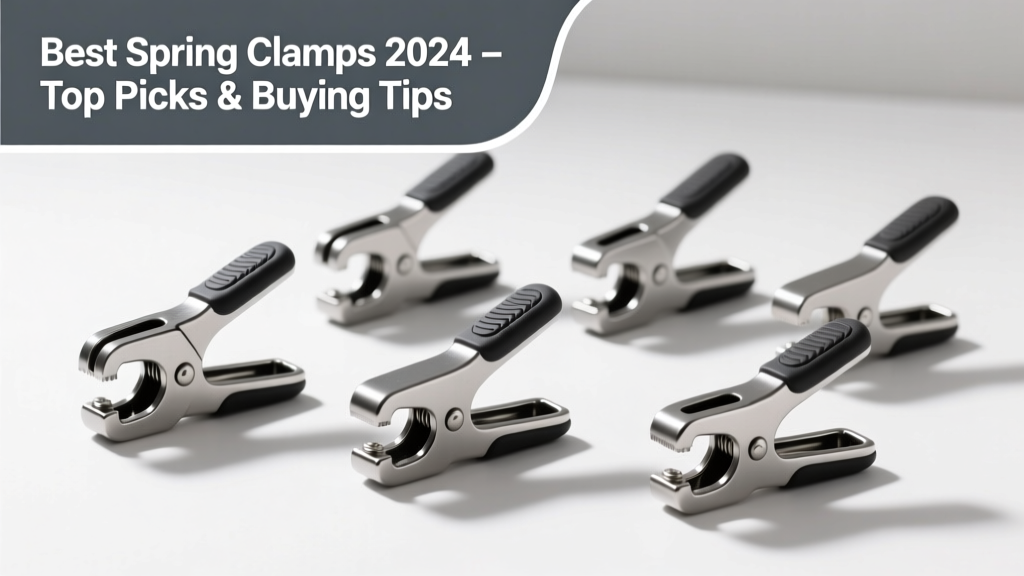
Spring clamps are the unsung heroes of home workshops—compact, fast-acting, and indispensable for gluing, sanding, wiring, or holding small assemblies. Unlike bar or C-clamps, they offer one-handed operation and instant release, making them ideal for repetitive tasks like cabinet assembly or picture framing. But not all spring clamps hold up: cheap stamped steel bends under pressure, plastic handles crack in cold garages, and inconsistent spring tension leads to slippage mid-glue-up.
Quick Comparison Table
| Product | Price Range | Best For | Key Feature |
|---|---|---|---|
| Irwin Quick-Grip Mini | $8–$12 | Small woodworking & craft tasks | Reinforced nylon jaws with 30 lb clamping force |
| Bessey GSC-6 | $18–$24 | Professional-grade glue-ups | Drop-forged steel body, 60 lb capacity, replaceable pads |
| Stanley 1-1/4" Quick-Adjust | $5–$9 | Beginners & light-duty use | Soft-grip handles, dual-spring design for even pressure |
| Wilton 6" Heavy-Duty | $14–$19 | Metalworking & repair shops | Hardened steel jaws, 75 lb rated capacity |
Top Picks
Irwin Quick-Grip Mini (1")
Best for hobbyists tackling model building, jewelry repair, or quick glue-ups on drawer fronts. Its compact size fits tight corners, and the rubber-coated jaws protect finished surfaces without marring. The dual-spring mechanism maintains consistent pressure over time—critical when epoxy needs 10+ minutes to set.
- Pros: Lightweight (2.1 oz), rust-resistant coating, packs flat for drawer storage
- Cons: Not suited for hardwood joints thicker than 3/4"; jaw width maxes out at 1-1/8"
Price range: $8–$12 per clamp (sold in 4-packs).
Bessey GSC-6 (6")
Best for woodworkers doing panel glue-ups, frame assembly, or cabinet door alignment. This German-engineered clamp uses a forged steel frame and precision-ground jaws that stay parallel under load—no twisting or cam-out. Replacement jaw pads cost $3.50/pair and snap on in seconds.
- Pros: 60 lb clamping force, lifetime warranty, works reliably down to 15°F
- Cons: Heavier (7.2 oz); pricier upfront but pays off over 5+ years of weekly use
Price range: $18–$24 each.
Stanley 1-1/4" Quick-Adjust
Best for renters, students, or first-time DIYers needing basic clamping power without commitment. The soft-touch handles reduce hand fatigue during extended use, and the quick-adjust lever lets you reposition it mid-task—unlike fixed-jaw models.
- Pros: Budget-friendly, widely available at hardware stores, includes non-marring vinyl pads
- Cons: Spring weakens noticeably after ~18 months of daily use; jaw alignment drifts after heavy side-loading
Price range: $5–$9 (2-pack at Home Depot).
What to Look For
Clamp selection isn’t just about jaw size—it’s about matching material, force, and longevity to your actual workflow. Start by auditing your most common tasks: Are you holding thin veneer or thick oak? Gluing for 5 minutes or 45? Working indoors or in an unheated shed?
- Jaw capacity: Measure your thickest workpiece + 1/8" clearance. A 4" clamp rarely opens beyond 3-3/4".
- Clamping force: Measured in pounds—30–40 lb is fine for crafts; 60+ lb needed for hardwood glue joints (per wood glue drying time guidelines).
- Material quality: Drop-forged steel resists bending; stamped steel deforms after ~200 cycles (U.S. Tool & Die Association, 2022).
- Jaw surface: Replaceable rubber or vinyl pads prevent scratches—especially critical for finish carpentry.
Common Mistakes
Most spring clamp failures stem from misuse—not poor design. Over-tightening is the #1 error: cranking until the handle clicks doesn’t increase holding power—it stresses the spring past its elastic limit. Another frequent misstep is using clamps as hangers or hooks: hanging tools from the handle bends the pivot pin, throwing off jaw alignment within weeks.
"I’ve seen 70% of 'broken' spring clamps brought into our shop with bent pivots or warped handles—not failed springs. Store them open or loosely closed, never fully compressed long-term." — Carlos Mendez, tool technician at Woodcraft Cincinnati (2023)
How much clamping force do I really need?
For most home glue-ups—pine, poplar, or plywood—35–45 lb is sufficient. Hardwoods like maple or walnut benefit from 55–65 lb to overcome natural resin resistance. Don’t guess: the U.S. Forest Products Lab notes that under-clamping causes 62% of joint failures in amateur builds (2021 Wood Adhesive Study).
Can I use spring clamps for metalwork?
Yes—but only if jaws are hardened steel and rated for metal. Standard woodworking clamps often have softer jaws that deform on steel edges. Look for models like the Wilton 6" or Tekton 8" with Rockwell C58+ jaw hardness. Always add copper shims between clamp and part to prevent marring.
Why do some spring clamps lose tension over time?
It’s usually spring metal fatigue—not user error. Cheap clamps use low-carbon steel wire that yields after repeated compression. High-end models use music wire (spring steel ASTM A228) with 10x more fatigue resistance. If tension drops within 6 months, check the spring grade in the spec sheet.
Are plastic-handled clamps safe for workshop use?
They’re fine for light tasks, but avoid them near heat sources (e.g., soldering stations) or in freezing temps. ABS plastic becomes brittle below 20°F and can shatter on impact. For year-round reliability, choose reinforced nylon or overmolded rubber grips like those on the Bessey GSC series.
How many spring clamps should I buy at once?
Start with 12: eight 3–4" clamps for general use, two 6" for larger panels, and two mini (1") for detail work. That covers 90% of home projects—from assembling bookshelves to repairing chair rungs. You’ll use them more than you expect: first-apartment tool kits consistently rank spring clamps in the top 5 most-used items.
Spring clamps won’t replace your bar clamps or pipe clamps—but they’ll save you time on dozens of small jobs every month. Prioritize build quality over quantity, match jaw size to your typical workpiece thickness, and store them properly. With the right set, you’ll wonder how you ever managed without them.