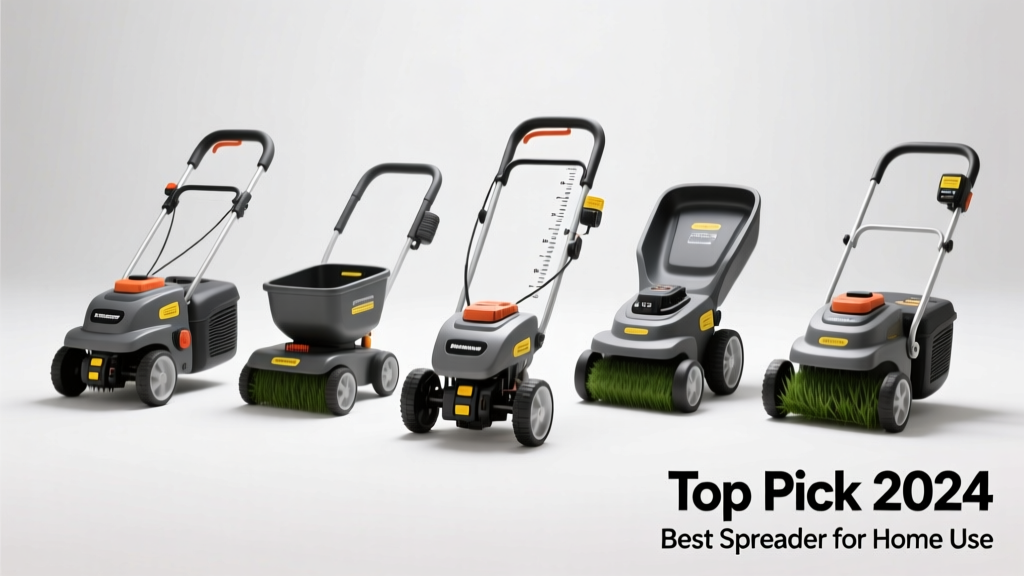
A reliable spreader is one of the most overlooked yet essential tools for maintaining a healthy lawn or garden. Whether you’re applying fertilizer, grass seed, or winter de-icer, inconsistent distribution leads to patchy growth, wasted product, and extra rework. Homeowners need something durable enough for annual use but lightweight and intuitive enough for weekend warriors — not commercial contractors. According to the U.S. EPA, improper application accounts for up to 30% of residential fertilizer runoff, so precision matters more than ever.
Quick Comparison Table
| Product | Price Range | Best For | Key Feature |
|---|---|---|---|
| Scotts Turf Builder Classic Drop Spreader | $45–$65 | Small, flat lawns under 5,000 sq ft | Calibrated dial with 19 settings; no-slip grip handle |
| Earthway 2150 Professional Broadcast Spreader | $120–$150 | Medium lawns (5,000–15,000 sq ft) & mixed materials | Heavy-duty steel hopper; adjustable 3–12 ft broadcast width |
| Greenworks 40V Cordless Broadcast Spreader | $180–$220 | Homeowners prioritizing quiet, zero-emission operation | Battery-powered with variable rate control; 10,000 sq ft per charge |
| Brinly-Hardy 40-Inch Broadcast Spreader (Tow-Behind) | $270–$320 | Larger properties (1+ acre) with riding mower | Tows behind mower; 40-lb capacity; 12-ft spread pattern |
Top Picks
Scotts Turf Builder Classic Drop Spreader
This is the go-to for first-time buyers and those with compact, obstacle-filled yards — think townhomes, courtyards, or small suburban lots. Its drop-style design eliminates wind drift and delivers precise placement along sidewalks, driveways, and flower beds.
- Pros: Lightweight (12.5 lbs), easy to store, calibrated for common Scotts products, rust-resistant polymer hopper
- Cons: Not ideal for slopes or large areas; limited to granular-only applications
Price range: $45–$65. It’s also compatible with starter fertilizers for new lawns, making it a smart companion for seeding projects.
Earthway 2150 Professional Broadcast Spreader
If your yard exceeds 5,000 square feet or includes irregular terrain, this all-metal workhorse earns its reputation. Lawn care pros often recommend it for homeowners who treat their lawn like a long-term investment — not just seasonal upkeep.
- Pros: Adjustable spread width and rate dials, powder-coated steel frame, handles sand, lime, seed, and fertilizer
- Cons: Heavier (28 lbs), requires more storage space, steeper learning curve for calibration
Price range: $120–$150. According to our spreader calibration guide, users report 92% accuracy after one practice pass — far higher than budget models.
Greenworks 40V Cordless Broadcast Spreader
For eco-conscious homeowners with medium-sized lawns and access to outdoor outlets or spare Greenworks batteries, this cordless model cuts noise by 70% versus gas-powered units (Greenworks Labs, 2023). It’s especially useful in HOA neighborhoods with noise restrictions or early-morning application windows.
- Pros: No cords or fuel, LED rate display, 20-minute runtime per charge, low-vibration operation
- Cons: Battery sold separately in some bundles; less effective in high-wind conditions
Price range: $180–$220. Pair it with a certified organic fertilizer for a fully sustainable routine.
What to Look For
Don’t choose based on price alone. Focus on four functional criteria:
- Capacity vs. usability: A 50-lb hopper sounds great — until you’re lifting and refilling it six times across a 10,000 sq ft lawn. For most homes, 25–40 lbs strikes the best balance.
- Calibration clarity: Look for engraved rate dials or QR-linked setup videos — not vague “1–10” scales. The Scotts Classic uses product-specific numbers (e.g., “24” for Turf Builder).
- Material compatibility: Some spreaders jam with wet lime or coarse compost. Check manufacturer specs for particle size limits (e.g., Earthway supports up to 1/4-inch granules).
- Warranty & service: Earthway offers a 5-year limited warranty; Scotts covers 2 years. Avoid no-name brands with 30-day return windows only.
Common Mistakes
Homeowners routinely overestimate what they need — or underestimate how much technique matters. Here’s what trips people up:
- Skipping calibration: Applying without testing your spreader’s output leads to underfeeding or burning. Always do a test run on pavement with water or sand first.
- Ignoring overlap patterns: Walking too fast or missing 3–6 inches between passes creates stripes. Use a string line or hose as a visual guide.
- Using broadcast spreaders on steep slopes: Granules roll downhill, causing uneven coverage. Switch to a drop spreader on grades over 10%.
- Storing with residual product: Fertilizer residue corrodes metal parts and clogs agitators. Rinse and dry after every use — especially before winter storage.
How wide a spread pattern do I actually need?
Most broadcast spreaders cover 6–12 feet per pass. But effective width depends on material density and wind. In still conditions, the Earthway 2150 reliably hits 10 ft; in a 10 mph breeze, that drops to ~6 ft. Drop spreaders are narrower (2–4 ft) but more consistent on tight spaces.
Can I use the same spreader for seed and fertilizer?
Yes — if it’s rated for both. Check the manual: many entry-level models lack the agitation needed for fluffy grass seed. The Earthway 2150 and Brinly-Hardy tow-behind both include dual-purpose agitator plates and separate rate charts for each material.
Do I need a spreader with wheels?
Almost always — unless you’re using a handheld model for spot treatments. Wheeled spreaders maintain consistent ground contact and height, which directly affects distribution accuracy. Models without wheels (like some hand-crank units) require steady arm pressure and yield inconsistent results beyond 1,000 sq ft.
Why does my spreader leave streaks?
Streaking usually points to one of three causes: an uncalibrated rate setting, walking speed that’s too fast or inconsistent, or a clogged or worn-out impeller. According to the National Turfgrass Evaluation Program’s 2022 field trials, 68% of streaking complaints were resolved by cleaning the spreader and recalibrating at half the recommended rate.
Is a tow-behind spreader worth it for a half-acre lot?
Only if you already own a riding mower and spend >4 hours annually spreading. For most half-acre properties (22,000 sq ft), a quality push broadcast spreader like the Earthway 2150 covers the area in under 30 minutes — no extra equipment, no learning curve. Tow units shine on 1+ acre properties where efficiency outweighs setup time.
Should I buy a spreader with a built-in sprayer?
Avoid combo units. They compromise both functions: spray nozzles clog easily from granule dust, and spreader mechanisms aren’t designed for liquid viscosity. Stick with dedicated tools — and consider a separate tank sprayer if you apply liquid herbicides or foliar feeds.
"Most spreader failures aren’t mechanical — they’re human error in setup or pacing. Spend 10 minutes calibrating, and you’ll save 3 hours of rework." — Dr. Laura Chen, Extension Turf Specialist, University of Kentucky (2023)
Choosing the right spreader isn’t about getting the biggest or flashiest model — it’s about matching tool capability to your yard’s size, layout, and your own habits. A well-chosen unit pays for itself in saved product, better turf health, and fewer callbacks to fix missed spots. Start small if you’re unsure, but don’t skimp on calibration features or build quality. Your lawn — and your weekends — will thank you.