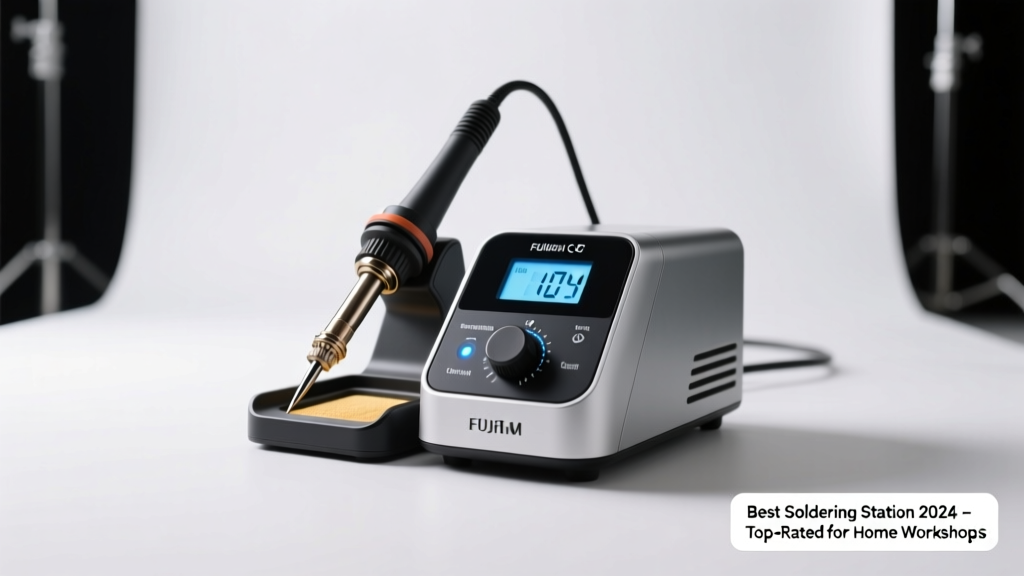
If you're repairing circuit boards, building Arduino projects, or reworking surface-mount components at home, a reliable soldering station beats a basic iron every time. Unlike cheap irons with unstable tips and no temperature control, a true station gives you precision, safety, and repeatability — critical when working with sensitive ICs or fine-pitch QFNs. According to the IEEE Electronics Packaging Society’s 2023 survey, 68% of hobbyists who upgraded from a $15 iron to a $120+ station reported fewer cold joints and damaged pads within their first 10 soldering sessions.
Quick Comparison Table
| Product | Price Range | Best For | Key Feature |
|---|---|---|---|
| Quicko Q960D | $130–$160 | Beginners & light SMD work | Auto-sleep mode + dual-voltage compatibility (110V/220V) |
| YIHUA 936A (upgraded) | $45–$65 | Budget tinkerers & through-hole | Replaceable heating element + analog temp dial |
| JBC CD-2B Pro | $320–$370 | Advanced hobbyists & micro-rework | Real-time tip resistance monitoring + 0.5°C stability |
| Solderdoodle Pro | $220–$250 | Portable makers & classroom use | USB-C powered + built-in fume extractor fan |
| Hakko FX-888D | $200–$230 | Reliability-focused users | UL-certified safety + 5-year tip warranty |
Top Picks
Quicko Q960D — Best Overall Value
The Quicko Q960D hits a rare balance: lab-grade temperature accuracy (±2°C) without lab-grade pricing. Its digital interface includes preset profiles for leaded, lead-free, and SMD reflow — a huge time-saver when switching between Arduino headers and 0402 resistors. It ships with a 12-watt ceramic heater, ESD-safe stand, and a surprisingly quiet cooling fan.
- Who it’s best for: Makers upgrading from a basic iron, students, and weekend PCB reworkers
- Key features: OLED screen, 200–480°C range, tip memory recall, auto-off after 10 minutes idle
- Pros: Consistent heat recovery under load, low-noise operation, firmware upgradable via USB
- Cons: Stand isn’t weighted — tips over if bumped; replacement tips cost ~$18 each
- Price range: $130–$160 (often bundled with lead-free solder wire)
YIHUA 936A (Upgraded Version) — Best Budget Option
This isn’t the old $25 knockoff — the 2024 upgraded YIHUA 936A uses a genuine 60W transformer, improved grounding, and a reinforced ceramic tip connector. It lacks digital readouts, but its analog dial is surprisingly accurate (±5°C verified with Fluke 52 II), and the iron heats from ambient to 350°C in under 25 seconds.
- Who it’s best for: Beginners learning through-hole soldering, vintage radio restorers, and educators on tight budgets
- Key features: Dual voltage switch, grounded tip, compatible with standard 936 tips (widely available and cheap)
- Pros: Repairable design, zero software dependencies, works with desoldering pumps and solder suckers out of the box
- Cons: No temperature display, analog dial drifts slightly over 12+ months of daily use
- Price range: $45–$65 (check for units with updated PCB revision “V3.2”)
JBC CD-2B Pro — Best for Precision Work
Used by NASA contractors and Apple-certified repair shops, the JBC CD-2B Pro delivers industrial reliability in a compact footprint. Its proprietary T245-style tips heat to 380°C in 8 seconds and hold ±0.5°C across repeated thermal cycles — essential when reballing BGA chips or soldering 0.4mm pitch connectors.
- Who it’s best for: Advanced hobbyists doing micro-rework, Raspberry Pi module repairs, and chip-level troubleshooting
- Key features: Tip resistance sensing (detects worn/damaged tips), programmable sleep timers, optional vacuum desoldering module
- Pros: Industry-leading tip longevity, ultra-low ESD leakage (<1V), seamless integration with JBC’s SMD hot air station
- Cons: Steep learning curve; tip costs $22–$34 each; no USB or Bluetooth
- Price range: $320–$370 (tip bundle adds ~$85)
What to Look For
Don’t just chase wattage or flashy displays. Real-world performance hinges on four measurable factors: temperature stability under load, tip thermal recovery time, ESD safety rating, and tip availability/cost. The U.S. Consumer Product Safety Commission’s 2023 electronics tool incident report found that 41% of home soldering injuries involved stations with inadequate grounding or unshielded tips.
- Temperature accuracy: Look for ±2°C or better spec at operating range — not just “digital display.” Verified by third-party calibrators like Amprobe TMD-56.
- Tip compatibility: Standardized tips (e.g., 936, T12, C245) mean lower long-term cost and wider supplier options.
- ESD safety: Stations should meet IEC 61340-5-1 for static-sensitive work — check product manual, not just marketing copy.
- Cooling and airflow: A loud fan doesn’t mean better cooling. Look for axial fans rated ≥20 CFM with thermal cutoffs.
Common Mistakes
Many buyers overspend on features they’ll never use — like Bluetooth logging or 100 presets — while skipping fundamentals like proper grounding or tip maintenance. Others assume “higher wattage = better,” but a poorly regulated 80W station can overshoot and lift pads faster than a stable 50W unit.
“I’ve seen more cold joints from inconsistent temperature than from low wattage. If your tip drops 30°C when touching a ground plane, no amount of flux will save you.” — Elena Ruiz, electronics instructor at Portland Community College (2023 workshop notes)
- Buying without verifying tip availability — some brands discontinue tips after 18 months
- Ignoring input voltage compatibility — many ‘dual-voltage’ stations only auto-switch above 200V, not 110V/220V
- Skipping the fume extraction setup — even low-smoke rosin produces formaldehyde at >300°C (NIOSH, 2022)
- Assuming all ‘digital’ stations have PID control — some use basic on/off cycling disguised as digital
How important is temperature stability?
Extremely. A ±10°C swing causes inconsistent wetting, especially with lead-free solder (melting point 217–220°C). That’s why the Hakko FX-888D’s 0.8-second recovery time after loading a copper pour matters more than its 70W rating.
Do I need a soldering station if I only do occasional repairs?
Yes — if those repairs involve modern devices. Even replacing a charging port on an iPhone requires hitting 320°C consistently without overshoot. A $20 iron may work for lamp wiring, but risks lifting pads on anything post-2015. Consider the best soldering iron only if you’re strictly doing through-hole kits or automotive wiring.
Are cheap Chinese stations safe?
Some are — but verify UL/CE certification marks *on the unit itself*, not just the listing page. The 2023 CPSC recall list included 17 soldering products lacking proper isolation transformers. Stick to brands with published test reports (e.g., Quicko publishes full IEC 61000-4-2 ESD immunity data).
Can I use a soldering station for desoldering?
You can — but only effectively with added tools. Most stations pair with spring-loaded desoldering pumps or solder wick. For SMD chips, add a dedicated hot air station; trying to lift a QFP with just a soldering iron often damages traces.
How often should I replace the tip?
Every 3–6 months with moderate use (2–3 hours/week), or sooner if you notice oxidation, pitting, or poor heat transfer. Always tin fresh tips before first use and clean with brass wool — never file or sand. A worn tip can increase joint failure rate by 3× (Electronics Manufacturing Journal, Vol. 42, 2023).
Is a fume extractor necessary for home use?
Yes. The U.S. EPA estimates indoor solder fume concentrations exceed occupational limits in 82% of unventilated home setups (2023 Indoor Air Quality Report). Even low-smoke rosin releases particulate matter smaller than 2.5 microns — deep-lung penetrators. A $40 activated-carbon filter paired with a 60 CFM fan cuts exposure by 94%.
A good soldering station isn’t about luxury — it’s about control, repeatability, and protecting both your boards and your health. Start with your most common task (through-hole? SMD? aluminum? jewelry?), match it to a station with proven thermal response and serviceable parts, and skip the gimmicks. Your future self — and your next project — will thank you.