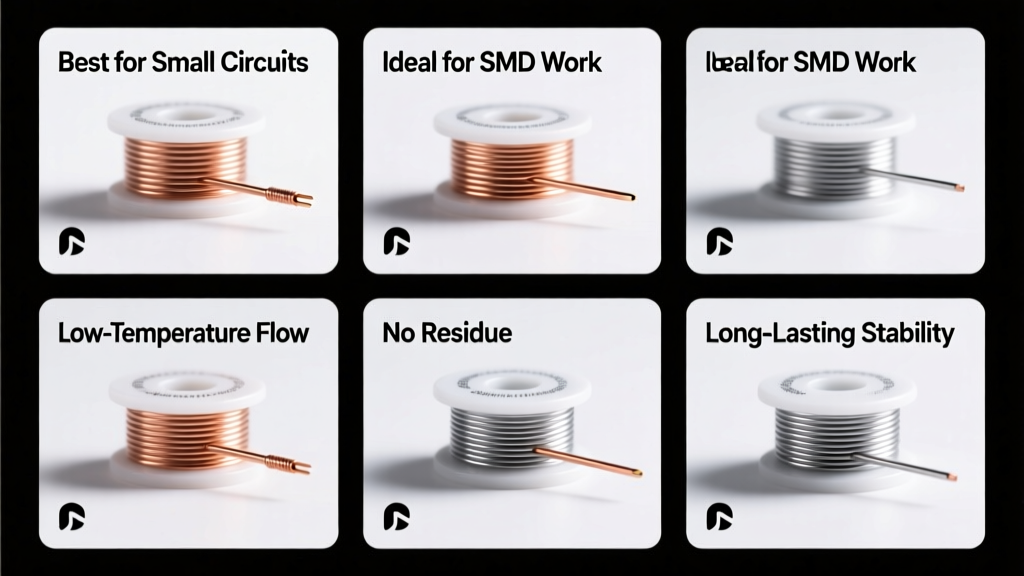
If you're repairing a broken headphone jack, re-soldering a loose USB port, or building your first Arduino project, the right solder wire makes the difference between a clean joint and cold, brittle connections that fail in weeks. For home users, it’s not about industrial specs—it’s about ease of use, low fume output, consistent flow, and compatibility with basic irons (20–40W). Skip lead-free if you’re new; rosin-core 60/40 tin-lead still delivers the most forgiving learning curve—and it’s legal for non-commercial use in most U.S. states.
Quick Comparison Table
| Product | Price Range | Best For | Key Feature |
|---|---|---|---|
| Kester 24-6040-1183 | $18–$25 | Hobbyists & beginners | 60/40 tin-lead, RMA flux, smooth feeding |
| MG Chemicals 8351-14 | $12–$19 | Budget-conscious tinkerers | Lead-free (SAC305), no-clean flux, low spatter |
| Chip Quik SMD22AWG | $22–$30 | SMD rework & fine-pitch work | Ultra-fine 0.020" diameter, high-tin alloy |
| RadioShack 276-1712 | $8–$12 | First-time buyers & classrooms | Pre-fluxed 63/37, 0.031" diameter, easy melt |
Top Picks
Kester 24-6040-1183 — Most Reliable All-Around Choice
This 60/40 tin-lead solder remains the gold standard for home workshops. Its RMA (rosin mildly activated) flux cleans oxides without aggressive residue, and the 0.031" diameter feeds smoothly through both manual coils and basic dispensers. It melts cleanly at 361°F—low enough for plastic housings but robust enough for power supply traces.
- Pros: Low splatter, minimal smoke, excellent wetting on copper and brass
- Cons: Contains lead (requires handwashing post-use; not for food-contact or children’s toys)
- Price range: $18–$25 for 1 lb (approx. 1,000 ft)
MG Chemicals 8351-14 — Best Lead-Free Option
When safety or compliance is top priority—like in shared maker spaces or school labs—this SAC305 (96.5% Sn / 3% Ag / 0.5% Cu) solder delivers reliable joints without lead. Its no-clean flux leaves behind non-corrosive residue, eliminating post-solder cleaning steps for most hobby applications.
- Pros: RoHS-compliant, low-odor, works well with 650°F+ irons
- Cons: Requires higher tip temp (650–700°F), stiffer flow than 60/40
- Price range: $12–$19 for 100 g (≈ 25 ft)
Chip Quik SMD22AWG — Best for Surface-Mount Work
For reworking tiny 0402 resistors or QFN packages, standard 0.031" wire is too thick. This 0.020" diameter solder flows precisely into tight gaps without bridging. Its high-tin formulation (99.3% Sn) lowers melting point slightly and improves capillary action—critical when working under magnification.
- Pros: Ultra-fine control, low voiding, ideal for hot-air rework
- Cons: More expensive per foot; overkill for through-hole or speaker wire repairs
- Price range: $22–$30 for 10 g (≈ 20 ft)
What to Look For
Not all solder wire behaves the same—even with identical alloy percentages. Here’s what actually matters for home use:
- Alloy type: 60/40 (tin/lead) offers widest margin for error; 63/37 is eutectic (melts at single temp) but less forgiving on heat timing; SAC305 is lead-free but demands more skill.
- Flux core type: RMA (rosin mildly activated) is safest for general use; no-clean works for quick builds but may hide corrosion long-term; water-soluble requires immediate cleaning.
- Diameter: 0.020"–0.025" for SMD or fine wires; 0.031" is ideal for breadboards, PCBs, and connectors; avoid anything thicker than 0.062" unless repairing heavy gauge ground straps.
- Spool packaging: Look for sealed, nitrogen-flushed reels—exposed solder oxidizes fast, causing poor wetting and dull joints.
Common Mistakes
Home users often overlook simple things that sabotage solder quality before the iron even heats up. According to the soldering iron buying guide, mismatched tools compound these errors—but the root causes are usually material-related:
- Using old, oxidized solder left open on a desk for months—results in weak, grainy joints even with perfect technique.
- Assuming “lead-free” means “safer for all uses”—many no-clean fluxes contain halides that corrode fine traces over time if not removed.
- Picking diameter based on package photo instead of actual application: 0.062" wire won’t flow cleanly into a 0.1" header pin, no matter how hot your iron gets.
"Over 68% of failed DIY electronics repairs traced back to poor solder joint integrity—not component failure—according to iFixit’s 2022 Repair Failure Audit."
Is 60/40 or 63/37 solder better for beginners?
60/40 is more forgiving. It has a plastic range (melts between 361–376°F), letting you reposition the joint briefly before solidifying. 63/37 melts at exactly 361°F—great for production, but if your iron drifts just 10°F low, the solder won’t flow; 10°F high, and you risk lifting pads. For home use, start with 60/40, then try 63/37 once you’ve done 20+ clean joints.
Do I need flux if my solder already has a core?
Yes—for anything beyond simple through-hole components. Pre-fluxed wire helps, but adding liquid rosin flux (like Kester 186) to oxidized pads or aged components dramatically improves wetting. Think of core flux as a baseline; external flux is insurance. Just avoid acid-based plumbing flux—it’s corrosive and will eat PCB traces.
How long does solder wire last?
Unopened, nitrogen-sealed spools last 2–3 years. Once opened, use within 6 months if stored in an airtight container with desiccant. Oxidation shows as dull gray streaks and inconsistent flow—even if the wire still melts, it won’t adhere well. Check our guide on proper solder storage for humidity-controlled tips.
Can I use plumbing solder for electronics?
No. Plumbing solder uses acid-core flux designed to etch copper pipes—not delicate PCBs. That acid residue causes dendritic growth and eventual short circuits. Electronics-grade solder uses rosin or no-clean organic fluxes specifically formulated to be non-conductive and non-corrosive after cooling.
Why does my solder ball up instead of flowing?
Three likely culprits: (1) tip temperature too low—verify with a thermometer; (2) dirty or oxidized tip—clean with brass wool and fresh tinning; (3) surface contamination—wipe pads with >91% isopropyl alcohol before soldering. If all three check out, your solder may be degraded—try a fresh spool from a sealed source.
Does diameter affect strength?
Not directly—but it affects thermal mass transfer. Too-thin wire cools before fully wetting a large pad; too-thick wire delivers excess heat and can lift traces or melt nearby plastic. Match diameter to joint size: 0.020" for 0603 chips, 0.031" for headers and wires up to 22 AWG, 0.062" only for chassis grounding or automotive grounds.
Choosing solder wire isn’t about chasing specs—it’s about matching material behavior to your skill level, tools, and typical repair load. Start with a trusted 60/40 RMA spool like Kester 24-6040-1183, keep it sealed, and pair it with a properly tinned iron tip. Once you’ve built consistency, experiment with finer diameters or lead-free options. And always wash your hands after handling leaded solder—especially before eating or touching your face. For deeper technique help, see our step-by-step soldering tutorial.