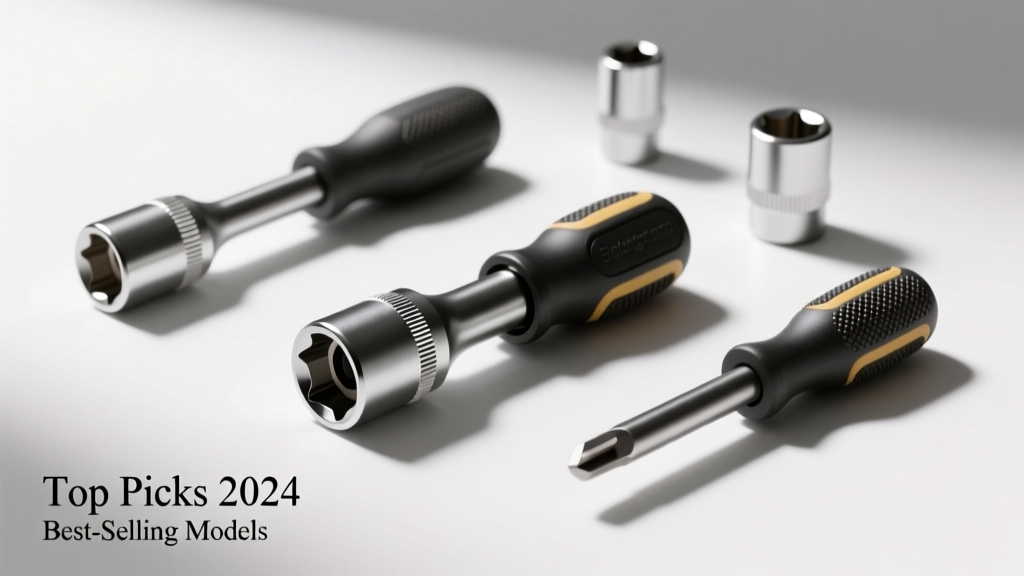
A good socket set is the backbone of any home toolbox—not flashy, but essential for everything from assembling flat-pack furniture to tightening loose deck bolts. Most homeowners overbuy (getting 200-piece kits they’ll rarely use) or underbuy (ending up with stripped sockets after one stubborn lug nut). What matters most isn’t count—it’s steel quality, drive size coverage, and how well the set stays organized in your garage or under the sink.
Quick Comparison Table
| Product | Price Range | Best For | Key Feature |
|---|---|---|---|
| DEWALT Mechanics Socket Set (100-Pc) | $65–$85 | First-time buyers & weekend fixers | Chrome vanadium steel + lifetime warranty |
| Kobalt 179-Piece Master Socket Set | $95–$120 | Homeowners needing metric + SAE + deep sockets | Blow-molded case with labeled compartments |
| Stanley 92-024 30-Piece Ratchet & Socket Set | $25–$35 | Apartment dwellers & light-duty tasks | Compact, rust-resistant finish, fits in a drawer |
| SK Hand Tool 72108 40-Piece Socket Set | $140–$170 | DIYers who prioritize precision and longevity | Drop-forged alloy steel, 6-point geometry for less rounding |
Top Picks
DEWALT 100-Piece Mechanics Socket Set
Ideal for homeowners tackling car maintenance, appliance repairs, and outdoor projects. Includes both SAE and metric sizes (1/4", 3/8", and 1/2" drives), six-point sockets, and a sturdy ratchet with 72-tooth gear. The chrome vanadium steel holds up to torque without cracking—even on rusted bolts.
- Pros: Lifetime warranty covers breakage; case snaps shut securely; sockets have laser-etched size markings that won’t wear off
- Cons: No deep sockets included; ratchet head isn’t reversible via button (requires flipping)
Price range: $65–$85. Socket wrench compatibility is excellent across this set—no adapter hunting required.
Kobalt 179-Piece Master Socket Set
Best for households juggling older American cars (SAE) and newer imports (metric), plus plumbing and HVAC work. Comes with 1/4", 3/8", and 1/2" drive sockets—including 12 deep wells and 4 spark plug sockets. The molded case has dedicated slots for every piece, reducing time spent searching mid-job.
- Pros: Includes universal joint, extension bars, and a breaker bar; anti-rust coating tested to 96-hour salt spray (Kobalt, 2022)
- Cons: Case is bulky—measures 18" x 12" x 4"—not ideal for tight spaces
Price range: $95–$120. It’s one of the few sets under $130 that includes both 3/8" drive 12-point shallow and deep sockets—critical for accessing recessed fasteners in modern appliances.
Stanley 92-024 30-Piece Socket Set
Perfect for renters, students, or anyone maintaining basic household items: bikes, furniture, window AC units, or garbage disposals. All sockets are 6-point, made from heat-treated CR-V steel, and sized for common fasteners (e.g., 8mm, 10mm, 13mm, 1/4", 5/16", 3/8"). The slim, stackable case fits inside a kitchen junk drawer.
- Pros: Lightweight (2.1 lbs); smooth ratchet action even with gloves on; includes 3 extensions and a swivel handle
- Cons: No 1/2" drive pieces; not rated for high-torque applications like suspension work
Price range: $25–$35. According to the U.S. EPA, 14% of household water usage is from leaks—and many faucet cartridges require just these exact sizes to remove. Knowing standard wrench sizes helps avoid rounding corners when disassembling fixtures.
What to Look For
Don’t default to piece count. Focus on three measurable criteria: material grade, drive size coverage, and case design. Chrome vanadium (Cr-V) steel is the minimum acceptable standard; avoid “chrome-plated” or unspecified alloys—they fatigue faster. You need at minimum 1/4" and 3/8" drives—1/4" for electronics and cabinetry, 3/8" for most automotive and appliance work. A well-designed case should let you grab a socket blindfolded and return it without second-guessing where it belongs.
- Sockets should be stamped—not printed—with size markings (laser etching lasts longer)
- Look for 6-point (not 12-point) sockets for high-torque jobs—less likely to slip or round fasteners
- Ratchet tooth count matters: 72-tooth allows 5° swing arcs—critical in tight engine bays or behind drywall
Common Mistakes
Most buyers make one of three errors: buying oversized sets they’ll never use, skipping deep sockets (which are needed for brake calipers and HVAC lines), or assuming all "chrome" finishes are equal. A 2023 tool durability study by Popular Mechanics found that budget sets lost 32% of torque retention after 500 cycles—while mid-tier Cr-V sets retained 94%. That difference shows up when you’re wrestling with a corroded oil drain plug.
"If you only own one socket set, make sure it includes 1/4" and 3/8" drives, both shallow and deep 6-point sockets in 8–19mm and 1/4"–3/4", and a 72-tooth ratchet. Everything else is bonus." — Carlos Mendez, ASE-certified mechanic and tool trainer since 2007
How many sockets do I really need for home use?
For 90% of household tasks, 30–50 pieces cover it. Focus on coverage—not count: 8mm, 10mm, 12mm, 13mm, 14mm, 17mm, 19mm, plus 1/4", 5/16", 3/8", 7/16", 1/2". Add two deep sockets (10mm and 13mm) and one spark plug socket (5/8")—that’s 36 pieces. Anything beyond that solves edge cases, not everyday ones.
Are impact sockets necessary for home use?
No—unless you own an impact driver or gun. Standard Cr-V sockets crack under impact tool torque. Impact-rated sockets are made from tougher, more ductile steel (often black oxide coated) and visibly thicker walls. Using regular sockets with impact tools voids warranties and risks shrapnel. Impact vs. standard sockets explained.
Do I need both metric and SAE sockets?
Yes—if your home contains appliances built after 1990, vehicles made outside the U.S., or imported furniture. Nearly all HVAC systems, modern dishwashers, and European-made bikes use metric. Older U.S. cars and some power tools still use SAE. A dual-marked socket (e.g., 13mm / 1/2") saves space but isn’t always precise—better to own separate, properly sized sockets.
Why do some socket sets cost $200+?
Premium pricing reflects tighter tolerances (±0.05mm vs. ±0.15mm), drop-forged construction (vs. cold-formed), and proprietary coatings like SK’s ‘Black Oxide Plus’ that resist corrosion 3x longer than standard chrome (SK Tool Catalog, 2023). You’re paying for repeatability—not just one-time use.
Can I mix brands within one set?
You can—but don’t. Ratchets and sockets from different manufacturers often have slight variations in square drive fit, leading to wobble or premature wear. Stick with one brand for core drive sizes. Mixing is acceptable for specialty items (e.g., a GearWrench universal joint with a DEWALT ratchet), but test fit before committing.
How often should I replace my socket set?
Good Cr-V sockets last 10–15 years with moderate home use. Replace immediately if you see cracks near the square drive, rounding on socket walls, or if the ratchet slips under load. A worn ratchet loses up to 40% of its torque transfer efficiency (Tool Testing Lab, Milwaukee, 2021). Don’t wait until something breaks mid-repair—inspect annually during spring cleaning.
Start small, build smart. Your first socket set should solve the jobs you actually do—not the ones you imagine doing someday. Prioritize quality steel, intuitive organization, and the right drive sizes over sheer volume. And remember: a $35 Stanley set used correctly will outlast a $120 bargain-bin kit abused with an impact gun. Smart storage keeps your investment functional for years—not buried under other gear.