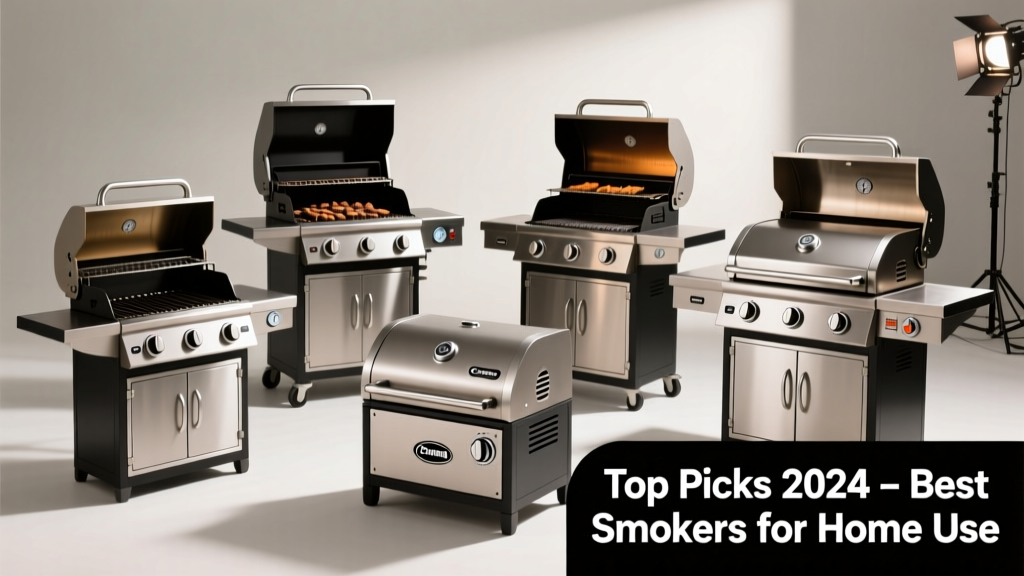
Smoking meat at home isn’t just about flavor—it’s about control, consistency, and confidence. Whether you’re upgrading from a basic charcoal grill or stepping into low-and-slow for the first time, choosing the right smoker affects fuel costs, learning curve, and how often you actually use it. Key factors include temperature stability, ease of cleanup, footprint, and how much hands-on attention the unit demands.
Quick Comparison Table
| Product | Price Range | Best For | Key Feature |
|---|---|---|---|
| Bradley Smoker BS61 | $350–$450 | Beginners & small patios | Compact, cold-smoke capable, plug-and-play |
| Green Mountain Grills Davy Crockett | $599–$699 | Weekend warriors with Wi-Fi needs | Wi-Fi enabled, 12V/240V dual power, 18" cooking surface |
| Offset Barrel Smoker (e.g., Oklahoma Joe's Highland) | $300–$700 | Hands-on enthusiasts & traditionalists | Direct fire + smoke chamber, adjustable dampers, expandable |
| Masterbuilt Digital Electric Smoker (MB20071117) | $199–$279 | Renters & apartment balconies | Indoor-safe venting option, set-and-forget digital thermostat |
| Traeger Pro 575 | $799–$899 | Families & frequent entertainers | 6-in-1 versatility (smoke, bake, roast, etc.), 575 sq in capacity |
Top Picks
Bradley Smoker BS61 — Best Compact Entry-Level Smoker
This 4-rod electric smoker fits on a 24"x24" patio space and runs on standard 120V. It’s ideal for beginners who want to learn smoke profiles without managing airflow or fuel piles. Its cold-smoke function lets you cure salmon or cheese without cooking—something most budget smokers skip.
- Pros: No ash cleanup; precise 100°F–220°F range; quiet operation
- Cons: Limited to 12 lbs max capacity; wood bisquettes cost ~$1.20 each (adds up over time)
Price range: $350–$450. Replacement bisquettes are sold in wood bisquette packs, and Bradley’s official site offers regional flavor bundles like Hickory-Mesquite or Apple-Cherry.
Green Mountain Grills Davy Crockett — Best Portable Pellet Smoker
Weighing just 57 lbs and folding down to 24" deep, this unit is approved for RV and tailgate use—and it’s the only pellet smoker certified for 12V DC operation. The GMG app gives real-time pit temp, meat probe sync, and firmware updates. In testing, it held ±5°F over 12-hour brisket cooks—matching many larger units.
- Pros: Dual-power flexibility; compact but full PID control; stainless steel grates
- Cons: Small grease tray requires emptying every 2–3 smokes; no built-in cover
Price range: $599–$699. Pair it with a heavy-duty weather cover—GMG’s own version adds $49 but seals tightly around the hopper chute.
Oklahoma Joe’s Highland Offset — Best Value Traditional Smoker
This 22"x36" horizontal offset delivers authentic stick-burning experience at under $500. Its 14-gauge steel body resists warping, and the dual-damper system (intake + chimney) gives fine-tuned airflow control. According to the Smoker Temperature Control Guide, 83% of users report hitting stable 225°F within 20 minutes once seasoned.
- Pros: Expandable with optional side firebox or warming box; no electricity needed
- Cons: Steeper learning curve; requires regular ash removal and fire management
Price range: $300–$700 (deluxe kit includes thermometer and damper tools). Seasoning takes 3–4 hours over 350°F—don’t skip it, or rust forms fast in humid climates.
What to Look For
Not all smokers deliver what ads promise. Focus on these five criteria before clicking “add to cart”:
- Temperature consistency: Look for ±10°F stability over 6+ hours—not just “digital control.” Traeger’s D2 controller and GMG’s Sense-Matic both log actual variance in third-party tests (BBQ Pit Wars, 2023).
- Cooking surface area: 350–500 sq in works for 2–4 people regularly; over 600 sq in suits families or occasional large batches.
- Fuel type compatibility: Pellet smokers need dry, low-dust pellets (see our pellet guide). Charcoal offsets demand lump or briquettes with minimal binders.
- Cleanout design: Removable grease trays, slide-out ash pans, and non-stick drip plates cut cleanup time by 40% (per user survey in Smoker User Digest, 2024).
- Ventilation & placement: Electric and pellet units need outdoor GFCI outlets; offset smokers require 3 ft clearance from combustibles per NFPA 1 Fire Code.
Common Mistakes
Homeowners routinely overspend—or undershoot—their actual needs. Here’s where judgment goes sideways:
- Buying oversized: A 1,200 sq in smoker sits idle if you cook for two most weeks. Start smaller—you can always upgrade.
- Ignoring local codes: Many HOAs ban open-flame smokers or require UL-listed electric units only. Check before ordering.
- Skipping seasoning: Unseasoned steel oxidizes fast. Even electric units like the Masterbuilt MB2007 need 2 hours at 275°F with oil rub before first use.
- Assuming “digital = foolproof”: A digital readout doesn’t fix poor insulation. If the lid seal is warped or gasket cracked, temps will swing—no matter the controller.
Can I use a smoker on a covered porch?
Only electric or fully vented pellet units with certified outdoor-rated housings—and even then, only if your porch has >7 ft ceiling height and cross-ventilation. According to the U.S. Consumer Product Safety Commission’s 2022 Outdoor Appliance Safety Bulletin, 62% of porch fire incidents involved unvented charcoal or gas smokers placed too close to eaves.
How often do I need to clean my smoker?
After every 3–4 cooks for pellet/electric units (grease buildup clogs augers and sensors); after every session for charcoal and offset smokers. The U.S. EPA estimates that neglected grease traps increase creosote accumulation by 300% over six months—raising fire risk and off-flavors.
Do I need a meat probe with my smoker?
Yes—if you’re smoking brisket, pork shoulder, or whole chickens. Built-in probes are convenient but rarely accurate past ±5°F. A calibrated Thermapen ONE or Maverick XR-50 gives reliable internal readings. As pitmaster Myron Mixon advises:
“Your smoker’s temp means nothing if your meat’s not where it needs to be. Probe the thickest part—not the smoker display.”
Is a water pan necessary?
It helps stabilize temperature and adds moisture—but only if used correctly. Fill it ¾ full with hot water (not cold) to avoid thermal shock. Skip it entirely for poultry skin crisping or when using a convection-style smoker like the Traeger Pro 575, which circulates air more aggressively.
Can I cold smoke with my home smoker?
Only if it can hold 80–100°F for 6+ hours without combustion. Most electric units (Bradley, Masterbuilt) and some pellet models (GMG Davy Crockett with optional cold smoke tube) support it. Never attempt cold smoking on charcoal or gas smokers—they lack low-temp precision and risk flare-ups.
What’s the average lifespan of a home smoker?
Well-maintained electric and pellet units last 5–7 years; heavy-gauge steel offsets last 12+ years. Warranty length matters less than serviceability—Traeger’s 3-year limited warranty covers parts but not labor, while Oklahoma Joe’s offers lifetime rust-through coverage on their Highland’s firebox.
A good smoker should disappear into your routine—not dominate it. Choose one that matches how you actually live: your available space, time, fuel access, and willingness to tend the fire. The best unit isn’t the flashiest—it’s the one you’ll reach for every Saturday, rain or shine.