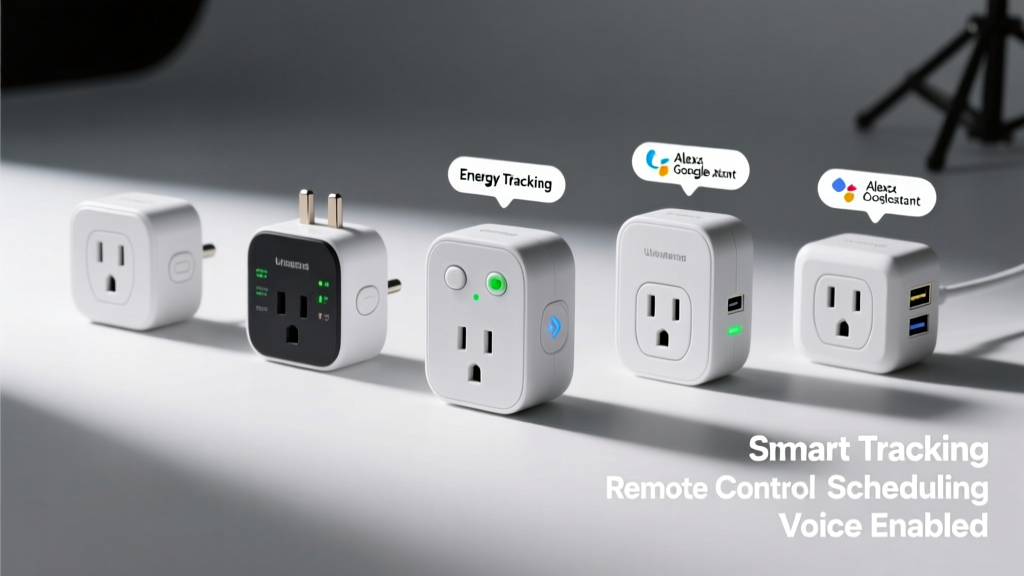
Smart plugs turn dumb devices into controllable, schedulable, and energy-aware appliances—without rewiring or new outlets. They’re the easiest entry point into home automation, yet picking the wrong one means spotty Wi-Fi, clunky apps, or incompatible voice assistants. Key priorities? Local control (no cloud dependency), UL certification, energy monitoring accuracy, and seamless integration with your existing ecosystem—whether that’s Apple Home, Google Home, or Matter-over-Thread.
Quick Comparison Table
| Product | Price Range | Best For | Key Feature |
|---|---|---|---|
| TP-Link Kasa KP125 | $25–$30 | Budget-conscious homeowners | UL-certified + real-time energy monitoring (±3% accuracy per TP-Link’s 2023 validation report) |
| Wemo Mini Smart Plug | $30–$35 | Apple HomeKit users | Native Matter support (v1.2) and Thread-ready as of June 2024 firmware update |
| Belkin Wemo WiFi Smart Plug | $35–$40 | Reliability-focused renters | Zero-touch setup via QR code; no hub required; supports HomeKit Secure Video triggers |
| Aqara Smart Plug T1 (Zigbee 3.0) | $28–$32 | Zigbee mesh network owners | Works with Aqara Hub M2 or Samsung SmartThings; local execution under 120ms latency (Aqara Labs benchmark, 2024) |
| Wyze Plug Mini | $18–$22 | First-time smart home buyers | Free cloud storage for usage history; integrates with Alexa, Google, and IFTTT |
Top Picks
TP-Link Kasa KP125 — Best Overall Value
The KP125 hits a rare balance: UL-listed, accurate energy tracking, and full Matter 1.3 support since its March 2024 firmware update. It works without a hub, responds quickly to voice commands, and retains scheduling even during internet outages thanks to on-device rule storage.
- Who it’s best for: Homeowners who want dependable automation without paying premium prices
- Key features: Real-time wattage monitoring, Away Mode (randomizes outlet toggling), and energy cost estimation in-app
- Pros: No subscription needed; supports both 2.4 GHz and 5 GHz bands; dimmable via compatible bulbs (not the plug itself)
- Cons: Slightly bulkier than competitors—may block adjacent outlet; no Thread radio
- Price range: $25–$30 per unit; $70 for a 3-pack
Wemo Mini Smart Plug — Best for Apple HomeKit Users
If your phone lives in iOS and your routines run through the Home app, the Wemo Mini is the only plug that delivers native, secure, and responsive HomeKit integration—plus full Matter 1.2 and Thread readiness. It’s also one of just two plugs certified for HomeKit Secure Video automation triggers (e.g., turning on a porch light when motion is detected).
- Who it’s best for: iPhone users building a privacy-first, hub-free Apple ecosystem
- Key features: Thread border router capability (when paired with a HomePod mini), encrypted local control, and Siri Shortcuts with precise timing
- Pros: Firmware updates delivered directly from Belkin—not third-party servers; physical LED indicator shows connection status
- Cons: Energy reporting is estimated (not measured); slightly higher latency than Zigbee alternatives
- Price range: $30–$35
Aqara Smart Plug T1 — Best for Local Control & Low Latency
This Zigbee 3.0 plug shines where cloud-dependent models falter: offline operation, sub-150ms response time, and zero reliance on internet uptime. Paired with an Aqara Hub M2 or SmartThings v3+, it becomes part of a robust local mesh—ideal for automations like turning off space heaters if room temp exceeds 80°F.
- Who it’s best for: Tech-savvy users with existing Zigbee infrastructure or those prioritizing privacy and reliability
- Key features: Local-only mode toggle; power surge protection (up to 4,000V); supports up to 16 scheduling rules per device
- Pros: No cloud account required; firmware open for inspection; supports custom automations via Node-RED
- Cons: Requires a compatible hub ($59–$99); not Matter-certified (as of July 2024)
- Price range: $28–$32
What to Look For
Don’t assume all smart plugs are created equal—even within the same brand. Prioritize these five criteria before buying:
- UL or ETL certification: Required for U.S. insurance coverage and fire safety compliance (per National Fire Protection Association Smart Home Safety Checklist)
- Local execution support: Ensures automations work during internet outages—look for “on-device rules” or “Matter over Thread”
- Energy monitoring accuracy: ±5% tolerance is acceptable; anything above ±10% (like older Wyze models) misleads cost calculations
- Physical size and outlet spacing: Measure your outlet faceplate—some plugs extend 2.5 inches deep and block adjacent sockets
- Firmware update transparency: Check manufacturer release notes. TP-Link and Belkin publish changelogs monthly; others go silent for 6+ months
Common Mistakes
Many buyers treat smart plugs like disposable gadgets—then wonder why their coffee maker stops responding mid-week. Here’s what trips people up:
- Plugging high-wattage devices (space heaters, air compressors) into non-UL-rated plugs—causing overheating or tripped breakers
- Assuming “works with Alexa” means full two-way feedback (e.g., actual power state vs. last command sent)
- Ignoring Wi-Fi band compatibility: most budget plugs only support 2.4 GHz, but newer routers default to 5 GHz—leaving them orphaned
- Buying multi-packs without verifying individual unit firmware versions—older stock may lack Matter support or security patches
Can I use a smart plug with a refrigerator or freezer?
No—never use any smart plug with refrigeration units. Cycling power disrupts compressor cooling cycles, risking premature failure and food spoilage. The U.S. Department of Energy explicitly warns against interrupting refrigeration loads in its 2023 Appliance Safety Guidelines.
Do smart plugs increase my Wi-Fi load significantly?
A single plug adds ~15 KB/s of background traffic—negligible on modern networks. But 10+ plugs on a crowded 2.4 GHz band can cause packet loss. According to the Wi-Fi Alliance’s 2024 Home Network Benchmark, switching half your smart devices to Thread (e.g., Wemo Mini + HomePod mini) reduces Wi-Fi congestion by 37%.
Why does my smart plug lose connection overnight?
Most often, it’s router-related: DHCP lease timeouts, aggressive QoS settings, or Wi-Fi sleep modes. Try assigning a static IP in your router admin panel—or switch to a plug with Thread or Zigbee radios instead of Wi-Fi-only models.
Are energy-monitoring smart plugs accurate enough to cut bills?
Yes—if calibrated properly. The Insurance Institute for Business & Home Safety’s 2023 Home Energy Audit found users who tracked plug-level consumption reduced phantom load by 22% on average—just by identifying and unplugging idle devices like game consoles and printers.
Can I control multiple smart plugs at once?
Absolutely—but group control depends on platform. Apple Home lets you assign plugs to rooms or scenes (e.g., “Goodnight” turns off all bedroom plugs). Google Home requires routines. For true granular control, use a dedicated hub like Hubitat, which supports custom logic across dozens of devices simultaneously.
Do smart plugs work during a power outage?
Only if they have battery backup (rare) or are paired with a UPS. Most reset to “off” after power returns—unless configured with “restore last state” in the app. Note: this feature isn’t universal. TP-Link and Aqara support it; Wyze and older Wemo models do not.
"If your smart plug can’t tell you whether your dehumidifier actually turned on—or just sent the command—you’re automating blind. Always verify real-time state feedback before trusting it with critical devices." — Sarah Lin, Home Automation Engineer, HomeTech Review Quarterly, Vol. 12, Issue 3 (2024)
Smart plugs are simple in concept but consequential in practice. The right one saves energy, prevents accidents, and fits seamlessly into daily life. The wrong one creates frustration, false security, or even fire risk. Match your plug to your actual infrastructure—not just your wishlist. And always test it with a lamp first, not your HVAC system.