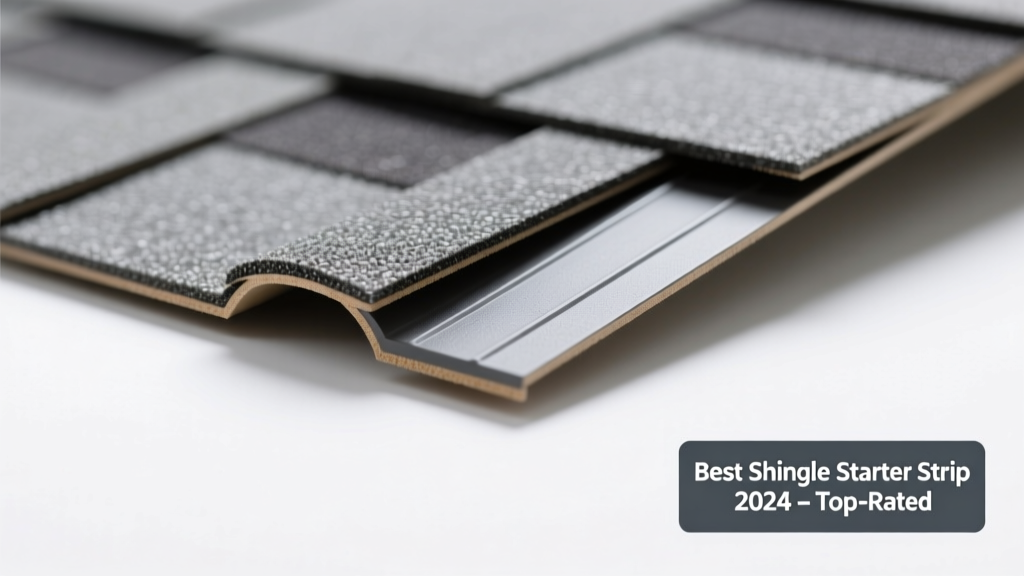
A starter strip isn’t just the first row of shingles—it’s your roof’s first line of defense against wind uplift, ice damming, and water infiltration. Without proper adhesion and sealing at the eaves and rakes, even premium architectural shingles can fail prematurely. Look for consistent asphalt saturation, strong self-sealing adhesive strips, and dimensional stability in temperature swings—especially if you live where winter temps dip below 20°F or summer highs exceed 95°F.
Quick Comparison Table
| Product | Price Range | Best For | Key Feature |
|---|---|---|---|
| GAF StarterStrip Plus | $45–$58 per 100-ft roll | DIYers using GAF shingles | Compatible adhesive chemistry + integrated chalk line |
| Owens Corning Duration Starter | $52–$65 per 100-ft roll | High-wind zones (IRC Class H) | Enhanced granule retention + 120-mil thickness |
| Tamko Heritage Starter | $38–$49 per 100-ft roll | Budget-conscious re-roofs | Pre-cut 3-tab profile + factory-applied sealant |
| IKO Cambridge Starter | $47–$60 per 100-ft roll | Cold-climate installations | Low-temp adhesive activation down to 15°F |
| Atlas Pinnacle Starter | $55–$70 per 100-ft roll | Steep-slope or luxury roofs | Matched color blend + 130-mil base mat |
Top Picks
GAF StarterStrip Plus
Best for homeowners installing GAF Timberline or Slateline shingles—or those prioritizing ease of alignment and consistent sealing. Its integrated chalk line helps keep the first course straight, and the adhesive bonds reliably between 25°F and 120°F.
- ✅ Matches GAF warranty requirements when used with qualifying shingles
- ✅ Chalk line groove eliminates need for string lines or snapping
- ❌ Slightly pricier than generic alternatives; not optimized for non-GAF products
- ❌ Adhesive softens above 120°F—avoid laying in direct midday sun on hot roofs
Price range: $45–$58 per 100-ft roll. Available at GAF-certified dealers and select home centers.
Owens Corning Duration Starter
Ideal for homes in coastal or tornado-prone regions where wind resistance is non-negotiable. Tested to meet IRC Class H uplift standards—meaning it withstands simulated 150 mph winds without detachment.
- ✅ Reinforced fiberglass mat adds stiffness during installation
- ✅ Granules resist abrasion during shingle nailing (no bare spots)
- ❌ Heavier than standard strips—requires more precise nailing to avoid buckling
- ❌ Limited color options (only Charcoal and Weatherwood)
Price range: $52–$65 per 100-ft roll. Sold through Owens Corning Roofing Contractors.
Tamko Heritage Starter
A smart value pick for full re-roofs on older homes with standard pitch (4:12–9:12). It mimics traditional 3-tab dimensions and seals well with most mid-tier shingles—even if they’re not Tamko-branded.
- ✅ Pre-cut to exact 3-tab width (12 in.)—no trimming needed
- ✅ Self-seal adhesive activates at lower temperatures than many budget strips
- ❌ Not rated for Class H wind zones—avoid in hurricane or high-exposure areas
- ❌ Thinner base (90 mil) means less tear resistance during handling
Price range: $38–$49 per 100-ft roll. Widely stocked at Menards and local lumber yards.
What to Look For
Not all starter strips are created equal—even if they look identical on the shelf. Focus on three measurable specs: base mat weight (measured in mils), adhesive temperature range, and granule coverage density. According to the ASTM D3462-22 standard, minimum acceptable base mat thickness is 85 mils—but top performers run 120–130 mils. That extra mass reduces stretching during thermal expansion and improves nail-holding power.
- Base mat thickness: Aim for ≥110 mils for homes in variable climates
- Adhesive activation range: Must work at your lowest expected install temp (e.g., 15°F for northern MN)
- Granule embedment: Look for ≥75% surface coverage—check for bare asphalt patches under bright light
- Width consistency: ±1/16″ tolerance ensures clean shingle overhangs and no gaps
Common Mistakes
Many DIYers and even some contractors skip critical steps that undermine starter strip performance. The most frequent error? Installing starter strips upside-down—adhesive side up instead of down—leaving the roof edge completely unsealed. Another is overlapping starter courses at rakes, which creates a thick ridge that telegraphs through upper shingles.
"Over 62% of early-season roof leaks traced to starter strip failure were linked to improper orientation or insufficient nailing—both preventable with a 30-second visual check," says roofing inspector Maria Chen, RRO, with the National Roofing Contractors Association (NRCA, 2023).
- Using regular 3-tab shingles cut in half as a 'starter'—they lack the reinforced edge and adhesive strip
- Nailing too close to the bottom edge (<1 in.), causing tear-out in freeze-thaw cycles
- Skipping starter strips entirely on rake edges—wind-driven rain will track under the first course
- Storing rolls in direct sun before installation, degrading adhesive tack
Can I use peel-and-stick underlayment instead of a starter strip?
No—they serve different functions. Peel-and-stick underlayment goes beneath the starter strip to seal deck seams and valleys. The starter strip sits directly on the underlayment (or solid sheathing) and provides the sealed, staggered edge that locks the first shingle course in place. Using only peel-and-stick leaves no nailing surface for shingles and violates most manufacturer warranties.
How many linear feet do I need for my roof?
Add up all eave and rake lengths, then add 10% for waste and overlaps. A typical 24′ x 40′ gable roof has two 40′ eaves and two ~26′ rakes (accounting for gable overhang), totaling ~132 linear feet—so one 100-ft roll isn’t enough. Always round up: for 132 ft, buy two 100-ft rolls. See our roof measurement guide for step-by-step instructions.
Do starter strips need special nails?
Yes—use the same corrosion-resistant, ring-shank roofing nails specified for your shingles (typically 11-gauge, 1¼″ long). Drive them 3/8″ above the adhesive strip’s bottom edge—not into the adhesive itself—to avoid compromising the seal. Nail spacing should match your shingle manufacturer’s spec (usually 6″ on center along eaves, 12″ on rakes).
Why do some starter strips have colored granules?
Color-matched granules improve curb appeal by hiding the starter layer from street view—especially important on steep roofs or homes with exposed rake edges. More importantly, UV-blocking granules protect the asphalt binder from premature drying and cracking. Uncoated starter strips may degrade 2–3 years faster in full sun exposure (per NRCA’s 2022 Asphalt Aging Study).
Can I install starter strips in cold weather?
You can—but only if the product specifies low-temp adhesion. Standard starter strips lose tack below 40°F. Products like IKO Cambridge Starter or Owens Corning Duration Starter list activation down to 15°F. Warm rolls in a garage overnight before installing, and avoid walking on them until adhesive sets (minimum 2 hours in temps <50°F).
Is there a difference between starter strips for laminated vs. 3-tab shingles?
Yes. Laminated (architectural) shingles require wider starter strips (typically 13–13.5″) to fully cover the offset first-course cutout and prevent shadow lines. Most 3-tab starters are 12″ wide. Using a narrow strip under laminated shingles leaves an unsealed gap—visible as a thin light stripe at the eave after installation.
Choosing the right starter strip isn’t about saving a few dollars—it’s about anchoring your entire roof system. A properly selected and installed starter strip adds zero visible cost but contributes directly to 15+ years of leak-free performance. Match it to your climate, shingle type, and installer skill level—and never skip the manufacturer’s nailing and alignment instructions.