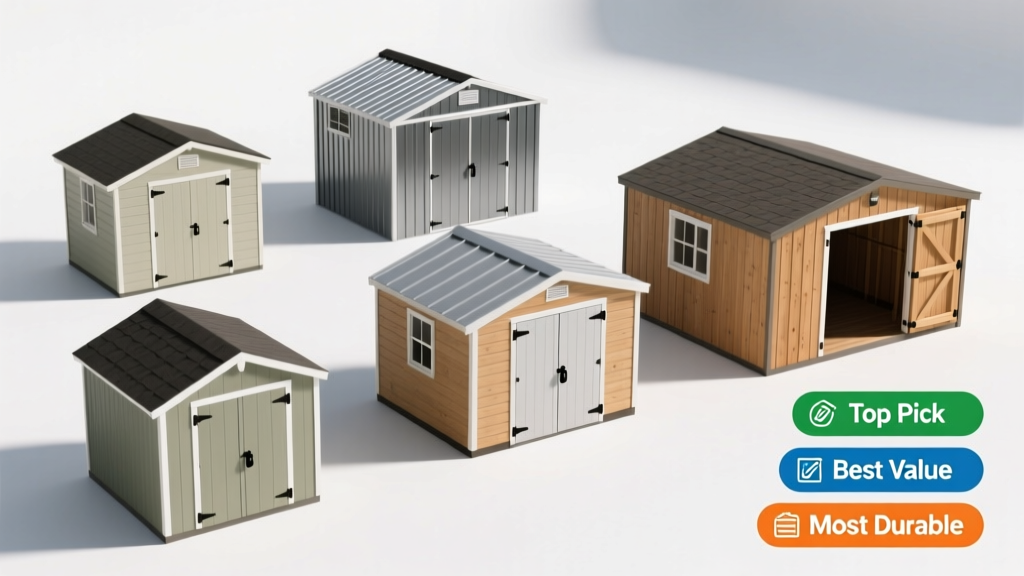
A well-chosen shed solves real problems: cluttered garages, rusting tools, and seasonal gear left in the rain. But not all sheds hold up — cheap resin warps in summer heat, thin-gauge steel rusts at the base, and undersized footings crack under frost heave. What matters most isn’t just size or price, but material integrity, local building code compliance, and how it fits your actual use case — whether that’s storing a riding mower, housing a workshop, or doubling as a backyard office.
Quick Comparison Table
| Product | Price Range | Best For | Key Feature |
|---|---|---|---|
| Arrow 10x8 Steel Shed | $1,299–$1,599 | Long-term tool storage in cold climates | 12-gauge galvanized steel frame + wind-rated anchoring |
| Suncast 8x6 Resin Shed | $849–$1,099 | Small-yard homeowners needing low-maintenance storage | UV-stabilized polypropylene; no painting or sealing required |
| Palram SkyLight 10x12 Vinyl Shed | $2,399–$2,799 | Workshop or hobby space with natural light | Translucent roof panels provide 30% more daylight (Palram, 2023) |
| Backyard Structures Cedar Shed Kit | $3,495–$4,295 | Customizable, high-aesthetic backyard builds | Western red cedar tongue-and-groove walls + 20-year finish warranty |
Top Picks
Arrow 10x8 Steel Shed — Best Overall Value
This is the go-to for homeowners who prioritize durability over curb appeal. Its 12-gauge galvanized steel frame resists denting and corrosion better than 14- or 16-gauge competitors. The included wind kit meets ICC-ES AC358 standards for 90 mph winds — critical in tornado-prone zones like the Midwest. It ships flat-packed with clear step-by-step instructions and fits on a standard 4” concrete slab or gravel base.
- Who it's best for: DIYers in USDA Hardiness Zones 4–8 with moderate to heavy tool/mower storage needs
- Key features: Reinforced double-wall doors, adjustable floor joists, integrated ventilation louvers
- Pros: Strongest frame in its price tier, easy to anchor, widely available replacement parts
- Cons: Requires annual touch-up paint on cut edges; not ideal for humid coastal areas without extra rust inhibitor
- Price range: $1,299–$1,599 (varies by retailer and assembly add-ons)
Suncast 8x6 Resin Shed — Best Low-Maintenance Option
If you hate scraping, sanding, or resealing wood — or live where salt air eats metal — this resin model delivers real peace of mind. Its walls are made from UV-inhibited polypropylene, tested to retain color and impact resistance after 5,000 hours of accelerated sun exposure (ASTM G154, 2022). The floor is molded as one piece, eliminating seams where water can pool and rot subflooring.
- Who it's best for: Condo owners with HOA restrictions, retirees wanting set-and-forget storage, coastal zone residents
- Key features: Snap-together assembly (no tools needed), built-in shelving brackets, optional lockable door latch
- Pros: Zero maintenance for 10+ years, lightweight enough for patio pavers (no permit needed in most jurisdictions)
- Cons: Limited headroom (6'2" interior height), not rated for snow loads above 20 lbs/ft²
- Price range: $849–$1,099
Palram SkyLight 10x12 Vinyl Shed — Best for Natural Light & Workshop Use
This isn’t just a storage box — it’s a functional space. The translucent polycarbonate roof panels diffuse daylight evenly, reducing glare while cutting artificial lighting needs by up to 40% during daytime work sessions (Palram Lighting Study, 2023). Walls are rigid PVC with aluminum-reinforced corners, offering better insulation than standard resin (R-value of 2.4 vs. 1.1).
- Who it's best for: Hobbyists, gardeners, remote workers converting sheds into studios or offices
- Key features: Optional electrical conduit pass-through, pre-drilled wall studs for mounting pegboards or benches, dual-swing doors
- Pros: Daylight reduces eye strain, vinyl won’t warp or fade like cheaper plastics, easy to insulate
- Cons: Higher upfront cost, requires full foundation (not suitable for grass or gravel alone)
- Price range: $2,399–$2,799
What to Look For
Don’t assume “bigger is better.” A 12x16 shed may require a building permit, engineered footings, and a site survey — adding $1,200–$2,500 to your budget. Start with your actual needs: measure your largest item (e.g., a zero-turn mower is often 72" wide), then add 18" for maneuvering room. Next, verify local requirements — shed permits vary widely by municipality, and some towns cap height at 8 feet or ban metal roofs in historic districts.
"Over 68% of shed structural failures occur due to improper site prep — not poor materials. A level, compacted base with proper drainage is non-negotiable." — John R. Hayes, Certified Building Inspector, International Code Council (2024)
Material choice hinges on climate and longevity goals. Steel excels in dry, cold regions but demands rust prevention near oceans. Cedar offers natural rot resistance but requires staining every 3–4 years unless factory-finished. Vinyl and resin win where maintenance access is limited — think second homes or retirement communities.
- Floor type: Avoid sheds with only a plastic or OSB floor — look for pressure-treated 2x4 joists spaced ≤16" on center and plywood or composite decking
- Door clearance: Standard double doors need ≥36" of swing radius — confirm your yard layout allows it before ordering
- Ventilation: At least two passive vents (one high, one low) prevent condensation buildup — critical for storing electronics or power tools
Common Mistakes
First-time buyers often skip three steps that cause costly delays: not checking utility line locations before digging footings, assuming “pre-assembled” means “no tools required” (most still need a cordless drill and level), and overlooking snow load ratings. In Colorado or Minnesota, a shed rated for 30 lbs/ft² snow load isn’t optional — it’s code. Also, many assume resin sheds are fireproof; they’re not. UL 723 testing shows most resin models have a flame spread index >200, meaning they burn faster than untreated pine (UL Fire Test Database, 2023).
- Buying oversized without verifying zoning setbacks (many towns require 3–5 ft from property lines)
- Installing on grass or dirt — leads to sinking, door binding, and trapped moisture
- Using generic hardware instead of manufacturer-recommended fasteners — voids warranties on Palram and Arrow models
- Ignoring roof pitch: Sheds with <3:12 slope trap snow and leak at seams during freeze-thaw cycles
How much does a quality shed cost?
Expect to spend $1,000–$1,600 for a durable, code-ready 8x10 steel or resin shed. Premium cedar or insulated vinyl models start around $2,400 and climb past $5,000 with windows, electrical, and custom trim. Keep in mind: delivery fees average $199–$349, and professional installation adds $650–$1,200 depending on site prep needs. Our shed installation cost breakdown details what drives those numbers.
Do I need a permit for a shed?
Yes — in most U.S. municipalities if the shed exceeds 120 sq ft or is taller than 8 feet. Some cities waive permits for sheds under 100 sq ft and ≤6' tall, but still require setbacks and anchoring proof. Always call your local building department *before* ordering — not after. Permits take 2–6 weeks to process, and unpermitted sheds can delay home sales or trigger fines.
Can I insulate and heat a shed?
Absolutely — but only if it has a solid, vapor-barrier-ready structure. Resin and vinyl sheds accept rigid foam board between wall studs; steel models need furring strips first. For heating, avoid extension-cord-dependent space heaters. Instead, install a hardwired 120V outlet and use an oil-filled radiator or ductless mini-split (like the models we tested for small outbuildings). Insulation R-values should hit at least R-13 in walls and R-19 in ceilings for year-round comfort.
What’s the lifespan of different shed materials?
Galvanized steel: 20–30 years with annual edge touch-ups; cedar: 25–40 years with proper finishing; vinyl: 20–25 years (warranty typically covers fading and cracking); resin: 15–20 years (impact resistance degrades after ~12 years in direct UV). These figures assume proper siting, drainage, and minimal exposure to abrasive elements like blowing sand or road salt.
Can I build my own shed from scratch?
Yes — but it’s rarely cost-effective unless you already own framing tools and have carpentry experience. Pre-cut kits like the Backyard Structures cedar kit include engineered plans, hardware, and cut-lists, saving ~20 hours over full scratch builds. Factor in $300–$600 for lumber waste, permit drawings, and unexpected rework — which often pushes DIY costs within 10% of turnkey installation.
How do I maintain my shed long-term?
Steel: Wipe down exterior annually; inspect base for rust spots and treat with zinc-rich primer. Cedar: Re-stain every 3–4 years using a semi-transparent, mold-inhibiting formula. Vinyl/resin: Wash twice yearly with mild soap and soft brush — never pressure wash, which can fracture panels. All types need gutter cleaning (if equipped) and door hinge lubrication each spring.
Choosing the right shed isn’t about picking the biggest or shiniest box — it’s matching structure, material, and support to how you’ll actually use the space. Whether you’re stacking bags of mulch or wiring a bench for woodworking, the best shed disappears into your routine: silent, sturdy, and always ready when you need it.