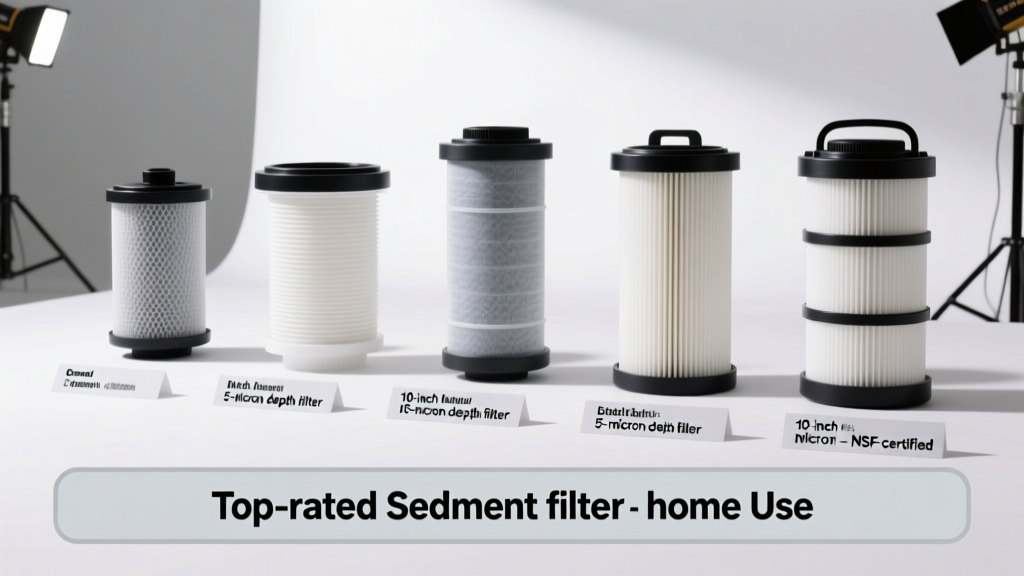
Sediment filters are the unsung first line of defense in any home water filtration system—stopping dirt, rust, sand, and silt before they reach your faucets, appliances, or downstream filters like carbon or RO units. A poorly chosen or undersized filter can lead to frequent cartridge changes, pressure drops, or even damage to water heaters and washing machines. According to the U.S. EPA, sediment-related issues account for nearly 22% of residential water complaints in rural and older-municipal systems (EPA Water Quality Report, 2022). Start here to match filter specs to your water source, flow needs, and maintenance tolerance.
Quick Comparison Table
| Product | Price Range | Best For | Key Feature |
|---|---|---|---|
| 3M Aqua-Pure AP902 | $45–$65 | Standard municipal supply with light rust/silt | 20-micron pleated polypropylene; NSF/ANSI 42 certified |
| Aquasana AQ-SED | $75–$95 | Well water with visible sand or iron particles | 5-micron dual-stage stainless steel + polypropylene |
| US Water Systems SED-10 | $120–$150 | High-flow homes (4+ bathrooms) or irrigation tie-in | 10-inch big blue housing; handles up to 25 GPM |
| Home Depot HDX 10" Sediment Filter | $22–$34 | Renters or short-term solutions | Replaceable 5-micron cartridge; fits standard 10" housings |
| FiltersFast FF-SPC-10 | $28–$38 | Budget-conscious DIYers needing NSF-certified replacement | 10-micron spun polypropylene; NSF/ANSI 42 listed |
Top Picks
3M Aqua-Pure AP902 — Best Overall for Municipal Homes
This compact, NSF-certified filter strikes the best balance of reliability, ease of install, and value for homes on city water with occasional rust or pipe scale. Its 20-micron pleated design offers longer life than string-wound alternatives—typically 6–9 months at 10 GPM—and includes a built-in pressure gauge port.
- Who it’s best for: Homeowners with municipal supply, 1–3 bathrooms, and moderate sediment (e.g., brown water after hydrant flushing)
- Key features: NSF/ANSI 42 certified, 4.5-gallon-per-minute capacity, reusable plastic housing, gauge-ready port
- Pros: Widely available, low-pressure drop, simple wrench-free cartridge change
Cons: Not rated for well water with high sand load; housing lacks mounting bracket - Price range: $45–$65 (cartridge only: $18–$24)
Aquasana AQ-SED — Best for Well Water Users
If your water comes from a private well, this dual-stage filter tackles both coarse debris (up to 100 microns) and fine particulates (down to 5 microns) without sacrificing flow. It’s designed to work as a pre-filter before Aquasana’s whole-house carbon systems—but stands alone just as well.
- Who it’s best for: Rural homeowners with shallow wells, old galvanized piping, or seasonal turbidity spikes
- Key features: Stainless steel outer screen + inner polypropylene core; 15 GPM max flow; 1-year warranty
- Pros: Handles gritty sand better than pleated-only filters; corrosion-resistant housing
Cons: Heavier (12 lbs); requires 1.5" inlet/outlet—may need adapters for 3/4" plumbing - Price range: $75–$95 (includes housing and cartridge)
US Water Systems SED-10 — Best High-Capacity Option
For larger homes, irrigation systems, or homes feeding multiple point-of-use filters, the SED-10 delivers industrial-grade performance in a residential package. Its 10-inch ‘big blue’ housing accepts standard 10" x 2.5" cartridges and supports up to 25 GPM with minimal pressure loss—even at 1-micron rating.
- Who it’s best for: 4+ bathroom homes, properties with sprinkler systems, or those planning future RO or softener upgrades
- Key features: NSF-listed housing, reinforced polypropylene body, integrated bypass valve, 3/4" NPT ports
- Pros: Future-proof design; easy cartridge swaps; compatible with whole-house carbon filters
Cons: Requires dedicated space under sink or in garage; initial setup takes 20+ minutes - Price range: $120–$150 (housing only; cartridges $15–$40 depending on micron)
What to Look For
Not all sediment filters perform equally—even if they share the same micron rating. Prioritize these five criteria before buying:
- Micron rating matched to your water source: 50–100 microns for heavy sand (well water), 20–25 microns for rust/silt (older municipal lines), 1–5 microns only if paired with a pre-filter or for ultra-sensitive applications (e.g., espresso machine feed)
- Flow rate compatibility: Check your home’s peak demand (e.g., shower + dishwasher + laundry = ~18 GPM). Choose a filter rated ≥20% above that number to avoid pressure drop.
- Housing type: Spin-down filters work for coarse debris but don’t capture fine silt. Cartridge-based housings (10" or 20") offer more precision and certification options.
- NSF/ANSI certification: Look for NSF/ANSI 42 (aesthetic effects) or 53 (health effects) listing—especially if filtering iron or manganese-laden water.
- Service interval & cost: A $12 cartridge changed every 2 months costs more long-term than a $35 cartridge lasting 8 months. Calculate annual filter cost before deciding.
Common Mistakes
Homeowners often overspend—or underperform—by overlooking real-world constraints. Here’s what trips people up most:
- Assuming “lower micron = better”: A 1-micron filter clogs fast with well water and can starve your water heater. Start coarse, then add finer stages downstream.
- Ignoring pressure drop data: Some filters lose >15 PSI at rated flow—enough to stall tankless heaters. Always check manufacturer’s pressure-loss curve, not just “max flow.”
- Skipping a pressure regulator: If your home pressure exceeds 80 PSI, even quality filters degrade faster. Add a regulator upstream—it’s $25 and extends filter life by 30% (per Water Pressure Regulator Buying Guide).
- Mounting vertically without drain access: Cartridge changes drip water. Install with a shut-off valve and bucket-friendly orientation—or use a horizontal mount kit.
How often should I replace my sediment filter?
It depends on your water quality—not the calendar. Monitor your pressure gauge (if equipped) or watch for reduced flow at multiple fixtures. In average municipal homes, 20-micron filters last 6–9 months. Well water users may need changes every 2–4 months during spring runoff. As Mike R., master plumber with 28 years’ experience advises:
“If your faucet aerators clog more than twice a year, your sediment filter is either undersized or overdue. Don’t wait for symptoms—track cartridge color: gray means silt, orange means iron, black means organic decay.”
Can I use a sediment filter with a water softener?
Yes—and you should. Sediment filters protect softener resin tanks from fouling. Install the sediment filter *before* the softener, ideally within 3 feet of the main shutoff. Avoid placing it after the softener unless you’re targeting post-softener debris (e.g., resin beads from aging units).
Do I need a whole-house sediment filter if I already have a fridge filter?
Absolutely. Fridge filters (typically 20-micron carbon blocks) aren’t designed to handle sand or rust—they’ll clog in days. A whole-house sediment filter protects *all* plumbing, extends appliance life, and reduces the frequency of replacing smaller point-of-use filters.
Is a spin-down filter enough for well water?
Only for coarse debris. Spin-downs remove particles >40 microns but let fine clay, iron bacteria, and silt pass through. Pair one with a 5-micron cartridge filter for full protection—or upgrade to a dual-stage unit like the best well water filtration system.
Why does my sediment filter turn brown/orange so fast?
That’s usually dissolved iron oxidizing into rust (ferric iron) inside the cartridge. It’s common in well water with >0.3 ppm iron. While the filter is working, it signals you may need an iron-specific solution soon—like an air injection oxidizer or greensand filter—before red stains become permanent.
Choosing the right sediment filter isn’t about chasing the lowest price or smallest micron—it’s about matching engineering to your actual water, plumbing, and lifestyle. Whether you’re protecting a new espresso machine or safeguarding a 20-year-old water heater, start with flow and source, not specs on a box. And remember: the best filter is the one you’ll actually maintain—and that starts with picking a model that fits your space, skill level, and schedule.