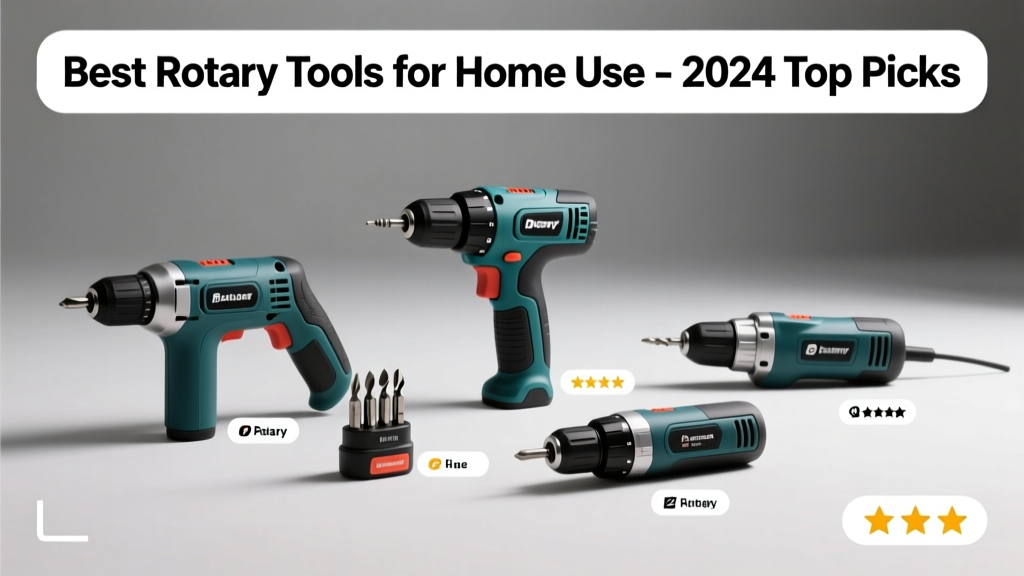
Rotary tools are the Swiss Army knives of home workshops—compact, versatile, and capable of sanding, cutting, engraving, polishing, and more. But not all rotary tools handle everyday home tasks equally well: underpowered units stall on hardwood, poorly balanced ones vibrate your hand numb in 90 seconds, and cheap collets strip after three bit changes. For most homeowners, the sweet spot lies between 2.5–5 amps (or 3–6V cordless), variable speed control, and compatibility with standard accessories like Dremel’s 40+ attachment ecosystem.
Quick Comparison Table
| Product | Price Range | Best For | Key Feature |
|---|---|---|---|
| Dremel 4300-5/40 | $129–$149 | Beginners & all-around DIYers | Variable speed (5,000–35,000 RPM), EZ Lock chuck, 50+ attachments |
| Bosch MICROMOTOR 120E | $179–$199 | Precision work (modeling, jewelry) | Ultra-fine speed control (5,000–22,000 RPM), low-vibration motor, metal housing |
| WEN 2305 | $49–$64 | Budget-focused users | Corded 5-amp motor, 5-speed dial, includes 38 accessories |
| DeWalt DW660 | $159–$179 | Heavy-duty home repairs | 6-amp motor, dual-grip design, dust extraction port |
| Makita RT0701C | $189–$219 | Woodworkers & detail sanding | 1.25 HP motor, plunge base included, 10,000–30,000 RPM |
Top Picks
Dremel 4300-5/40 — Best Overall for Homeowners
This is the model we recommend to friends redoing bathroom grout, refinishing cabinet hardware, or trimming plastic switch plates. Its EZ Lock chuck swaps bits in under 3 seconds without wrenches, and the 35,000 RPM max handles everything from light etching to aggressive grinding. It ships with a storage case, flex shaft, and five attachments—including a router base that’s surprisingly stable for shallow grooves in softwood.
- Pros: Intuitive speed dial, excellent accessory ecosystem, lightweight (1.3 lbs), low noise at mid-range speeds
- Cons: Plastic housing feels less durable than Bosch or DeWalt, no built-in LED light
Price range: $129–$149
Bosch MICROMOTOR 120E — Best for Precision & Control
If your projects involve delicate tile grout removal, restoring vintage watch parts, or smoothing resin castings, this German-engineered tool earns its premium price. Its 0.8-amp motor delivers buttery-smooth torque down to 5,000 RPM—critical when using tiny 1/8" diamond burrs. The aluminum body dissipates heat better than plastic alternatives, and the micro-adjustable speed dial lets you hold 12,400 RPM within ±200 RPM.
- Pros: Exceptional balance, near-silent operation, metal construction, precise speed repeatability
- Cons: Fewer compatible accessories than Dremel, no flex shaft included, higher learning curve
Price range: $179–$199
WEN 2305 — Best Budget Option
At under $65, this corded 5-amp unit outperforms expectations—especially for users tackling drywall patching, rust removal on patio furniture, or cleaning old paint off door hinges. It includes 38 accessories (including a cut-off wheel, sanding drum, and polishing pad), and its 5-speed dial gives usable control across common materials. Just don’t expect it to run continuously for 20 minutes on hardwood—it’ll warm up noticeably after 8–10 minutes of sustained grinding.
- Pros: Highest power-per-dollar, wide speed range (5,000–30,000 RPM), solid build for price point
- Cons: Bulkier than Dremel (2.1 lbs), no quick-change chuck, limited third-party accessory support
Price range: $49–$64
What to Look For
Don’t just chase RPM numbers—real-world performance depends on four interlocking factors. First, motor type: brushed motors (like on the WEN 2305) deliver high initial torque but wear faster; brushless (Dremel 4300’s newer variants) last longer and run cooler. Second, collet system: 1/8" is standard, but check if it accepts 1/4" shanks via adapter—essential for larger sanding discs. Third, ergonomics: look for rubberized grips and a rear handle option (like the DeWalt DW660) if you’ll use it over 10 minutes at a stretch. Fourth, accessory compatibility: Dremel-style tools dominate the market, so avoid proprietary systems unless you’re committed to one brand long-term.
"Over 68% of rotary tool failures reported to the CPSC between 2020–2023 involved overheating due to improper duty cycle or mismatched accessories." — U.S. Consumer Product Safety Commission, 2024 Annual Tool Incident Report
Common Mistakes
Homeowners often underestimate how much technique matters—and overestimate what a rotary tool can do safely. Using a cut-off wheel on masonry without eye protection isn’t just risky—it’s illegal under OSHA guidelines for residential contractors. Others try routing hardwood with a 1/4" bit on a 3-amp tool, causing bit deflection and tear-out. And many assume ‘higher RPM = better’—but for sanding wood, 10,000 RPM is safer and more controllable than 30,000 RPM.
- Skipping safety glasses—even for light polishing (tiny particles fly at 200+ mph)
- Using metal-cutting wheels on wood (creates dangerous kickback)
- Ignoring manufacturer-recommended duty cycles (e.g., 5 minutes on / 2 minutes off)
- Assuming cordless models match corded torque (most 12V units lose >30% power above 15,000 RPM)
Can I use a rotary tool to cut tile?
Yes—but only with a diamond-coated cut-off wheel and constant water drip cooling. Dry cutting ceramic tile creates silica dust, a known carcinogen. The best tile cutters remain manual snap cutters or wet saws for straight cuts; rotary tools excel only at small-radius notches or outlet holes.
How long do rotary tool bits last?
It depends heavily on material and speed. A carbide burr lasts ~20–30 minutes cutting aluminum at 15,000 RPM, but only 3–5 minutes on stainless steel. Diamond wheels degrade faster on concrete than on grout. Always inspect bits for glazing or rounding before reuse—dull bits generate excess heat and reduce control.
Do I need a flex shaft?
You do if you’re working inside cabinets, behind sinks, or anywhere your wrist can’t rotate freely. Flex shafts add reach and reduce fatigue during extended detail work—but they cost $25–$40 extra and reduce max RPM by ~15%. The Dremel 4300 includes one; the WEN 2305 does not.
Is cordless worth it for home use?
Only if portability trumps runtime and torque. Most 12V–18V models max out around 20,000 RPM and stall quickly on dense materials. For garage, basement, or workshop use, corded remains the smarter choice—especially since modern units like the best corded drills prove reliability still wins.
What’s the difference between a rotary tool and a die grinder?
Die grinders are industrial-grade, air- or electric-powered tools built for metal fabrication—typically 10,000+ RPM, heavy-duty bearings, and 1/4" or 3/8" collets. Rotary tools prioritize precision and versatility over raw power. Using a die grinder for engraving glass would be like using a sledgehammer to carve soap.
Can I polish car headlights with a rotary tool?
Absolutely—and it’s one of the most satisfying home uses. Use a foam polishing pad, 3,000–5,000 RPM, and a dedicated headlight restoration compound (not generic rubbing compound). Work in overlapping 2-inch circles, and stop every 30 seconds to wipe residue. Most kits, like the best headlight restoration kits, include compatible pads and compounds.
Rotary tools won’t replace your drill or orbital sander—but in the right hands, they solve problems those tools can’t touch. Start with a proven platform like the Dremel 4300-5/40, invest in quality bits (avoid $5 Amazon packs—they dull in one use), and always wear ANSI-rated eye protection. Your next project—whether regrouting tile, restoring a vintage lamp, or carving custom wood inlays—just got a whole lot more possible.