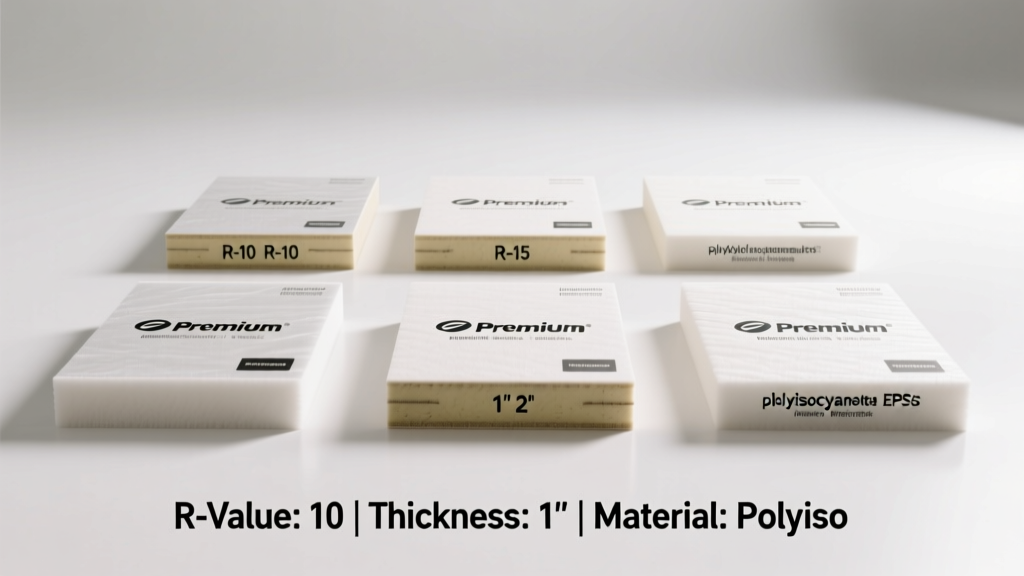
Rigid foam board insulation is one of the most cost-effective ways to boost your home’s energy efficiency—especially in retrofit projects where adding thickness isn’t an option. Unlike batts or spray foam, it delivers high R-value per inch, resists moisture, and doubles as an air barrier when seams are properly sealed. But not all boards perform equally: extruded polystyrene (XPS), expanded polystyrene (EPS), and polyisocyanurate (polyiso) differ sharply in thermal performance, compressive strength, and long-term aging behavior.
Quick Comparison Table
| Product Type | Price Range (per 4'×8' sheet) | Best For | Key Feature |
|---|---|---|---|
| XPS (e.g., Owens Corning FOAMULAR®) | $22–$36 | Below-grade foundation walls, roof decks | R-5 per inch; closed-cell structure resists water absorption |
| EPS (e.g., Atlas RoofBoard®) | $14–$25 | Attic hatches, rim joists, DIY wall sheathing | R-3.6–R-4.2 per inch; lowest cost; vapor-permeable |
| Polyiso (e.g., GAF EnergyGuard®) | $28–$44 | Roofing underlayment, cathedral ceilings | R-6.5–R-7 per inch (initial); requires foil facing for best performance |
| Graphite EPS (e.g., Neopor®) | $26–$38 | Exterior wall sheathing, cold-climate retrofits | R-4.7 per inch; infrared-reflective particles improve thermal resistance |
Top Picks
Owens Corning FOAMULAR® 250 (XPS)
Best for contractors and homeowners installing below-grade insulation or continuous exterior sheathing where moisture exposure is likely. Its blue XPS core maintains R-5 per inch even after decades of field exposure, and its 25 psi compressive strength holds up under backfill pressure.
- Pros: Excellent moisture resistance (0.0–0.3 perm), easy to cut with a utility knife, widely available at big-box stores
- Cons: Contains HFC blowing agents (being phased out per EPA SNAP rules), slightly lower long-term R-value than polyiso
Price range: $24–$32 per 4'×8'×1" sheet.
Atlas RoofBoard® EPS (Type I & II)
Ideal for budget-conscious DIYers tackling attic floor insulation, garage walls, or non-load-bearing applications. This white EPS offers predictable performance without off-gassing concerns—and it’s Class 1 fire-rated when covered.
- Pros: Lowest upfront cost, recyclable, vapor-open (perm rating ~2–5), works well with housewrap systems
- Cons: Lower compressive strength (10–15 psi), loses ~10% R-value in cold temps below 20°F (per ASHRAE Fundamentals 2023)
Price range: $16–$23 per 4'×8'×1" sheet.
GAF EnergyGuard® HD Polyiso
The go-to choice for roofing professionals and high-R ceiling retrofits. Its factory-applied aluminum foil facer reflects radiant heat and acts as a vapor retarder—critical for unvented cathedral ceilings.
- Pros: Highest initial R-value (R-7/inch), excellent fire resistance (ASTM E84 Class A), stable above 120°F
- Cons: R-value drops to ~R-5.6/inch after aging (per NRCA 2022 Technical Bulletin), foil facing must be protected from UV exposure
Price range: $32–$44 per 4'×8'×1" sheet.
What to Look For
Don’t just chase the highest R-value on the label. Real-world performance depends on three interlocking factors: installed R-value (including thermal bridging), moisture management, and compatibility with your assembly.
- R-value stability: Polyiso degrades faster in cold weather; XPS holds steady but loses ~5% over 10 years (per Oak Ridge National Lab 2021 study)
- Permeance: Use vapor-open EPS behind brick veneer; choose foil-faced polyiso only where you need a Class II vapor retarder (0.1–1.0 perm)
- Compressive strength: Minimum 15 psi for above-slab applications; 25+ psi required for below-slab or foundation backfill
- Facing compatibility: Foil facers bond poorly with some adhesives—check manufacturer specs before using liquid-applied membranes
Common Mistakes
Homeowners often overlook how rigid foam interacts with other layers—leading to condensation, mold, or code violations. The most frequent errors include:
- Installing foil-faced polyiso directly against interior drywall in cold climates (creates a vapor trap)
- Using EPS under concrete slabs without verifying compressive strength—some Type I boards crush at just 10 psi
- Skipping seam sealing on exterior applications, which cuts effective R-value by up to 25% (per Building Science Corporation Field Guide 2020)
- Assuming all "R-5" boards perform identically—aging, temperature, and moisture drastically shift real-world performance
Can I install rigid foam over existing fiberglass batts?
Yes—but only if you’re creating a continuous layer that breaks thermal bridging. Never sandwich foam between two vapor barriers. For example, adding 2" XPS over kraft-faced batts in a vented attic is fine; doing so in a cathedral ceiling without venting risks interstitial condensation. Always consult our attic insulation guide for assembly-specific advice.
Do I need to tape the seams?
Absolutely—if you want the rated R-value and air-sealing benefit. Untaped seams leak air at rates up to 10x more than the foam itself (per RESNET Standard 350). Use ASTM D3418-compliant tape like 3M All Weather Flashing Tape or SikaBoom Polyiso Tape—not duct tape or caulk.
Is rigid foam safe around electrical boxes?
Yes, but with limits. Most rigid foams are combustible and require ½" gypsum board protection when used within 3" of recessed lighting or outlets (NEC 314.16(A)(1)). XPS and polyiso have higher flame-spread ratings than EPS, but none are exempt from thermal barrier requirements.
How thick should rigid foam be for my climate zone?
Minimum thickness depends on your location and assembly. In Climate Zone 5, the IRC requires R-10 continuous exterior foam over 2×6 wood-framed walls to prevent sheathing condensation. That’s ~2" of XPS or ~1.5" of polyiso. See our R-value by climate zone chart for exact recommendations.
Can I use rigid foam in a basement with high water table?
XPS is your safest bet—it absorbs <0.3% moisture by volume even after 180 days submerged (per ASTM C272 testing). EPS absorbs up to 4%, and polyiso’s facers can delaminate if wet. Pair XPS with a dimple drainage mat and perimeter drain, and never rely solely on foam for waterproofing.
Does rigid foam emit VOCs after installation?
Modern EPS and XPS emit negligible VOCs post-installation (<0.5 µg/m³ at 7 days, per UL GREENGUARD Gold certification data). Polyiso may off-gas trace amines during first 48 hours—ventilate well during installation, especially in tight attics. No product meets strict indoor air quality standards if installed without proper ventilation.
"Foam board isn't just about R-value—it's about continuity, control layers, and compatibility. A 1-inch gap at the rim joist undermines 3 inches of perfect foam elsewhere." — Dr. Joseph Lstiburek, Building Science Corporation, 2022
Rigid foam board remains one of the smartest upgrades for older homes—especially when paired with air sealing and proper detailing. Whether you’re insulating a crawlspace, upgrading a garage wall, or prepping for a siding replacement, matching the right board to your assembly prevents costly callbacks and keeps your home comfortable year-round. For deeper guidance on integrating foam with framing or cladding, explore our exterior wall insulation primer.