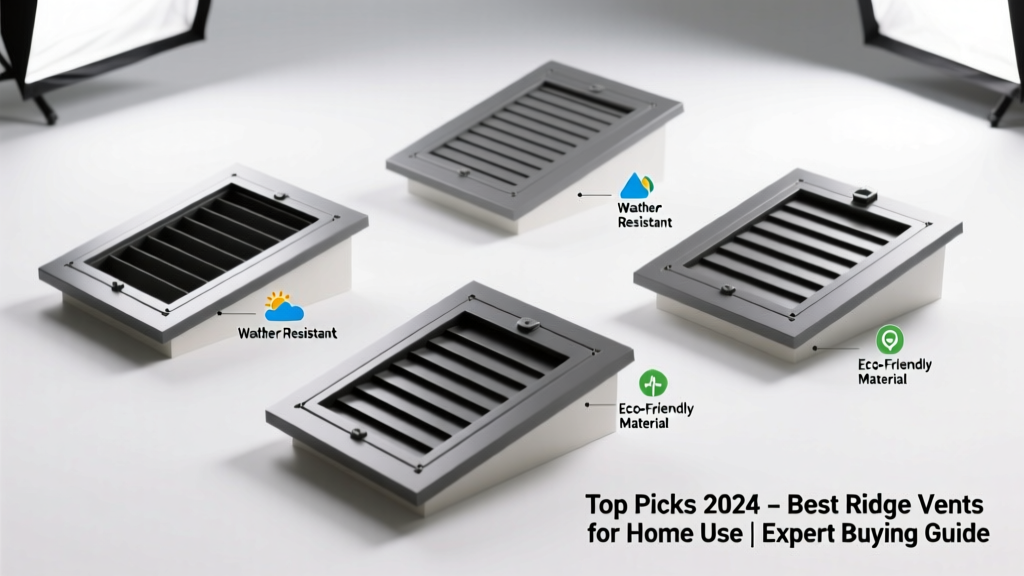
Ridge vents are the unsung heroes of attic ventilation—quiet, low-profile, and highly effective when installed correctly. They run along the peak of your roof, allowing hot, humid air to escape naturally while blocking rain, snow, and pests. According to the U.S. Department of Energy, properly ventilated attics can reduce summer cooling costs by up to 10% and extend shingle life by 2–3 years. But not all ridge vents perform equally: airflow capacity, weather resistance, and compatibility with your roofing system matter more than price alone.
Quick Comparison Table
| Product | Price Range | Best For | Key Feature |
|---|---|---|---|
| GAF Cobra3 | $0.75–$1.10/ft | Asphalt shingle roofs, moderate climates | Integrated baffle + wind-driven lift design |
| O'Hagin ProVent 360 | $1.20–$1.60/ft | High-wind zones, metal or tile roofs | 360° intake/exhaust, no external cap needed |
| DCI RVC-2000 | $0.95–$1.35/ft | Budget-conscious re-roofs | Polypropylene construction, UL 2218 Class 4 impact rating |
| ATI ShingleVent II | $1.40–$1.85/ft | Steep-pitch roofs (>8:12), premium installations | Shingle-over design, seamless visual integration |
Top Picks
GAF Cobra3 Ridge Vent
Best for homeowners with standard asphalt shingle roofs in regions with average rainfall and wind speeds under 70 mph. Its patented internal baffle creates consistent airflow even at low wind speeds, and it’s certified to meet ASTM E1680 for water resistance.
- Pros: Easy DIY installation with standard nail guns; compatible with most starter strips; backed by GAF’s 25-year limited warranty
- Cons: Less effective on roofs steeper than 12:12; not rated for hurricane-prone areas
Price range: $0.75–$1.10 per linear foot (installed cost averages $280–$420 for a 30-ft ridge).
O'Hagin ProVent 360
Ideal for coastal homes, high-elevation properties, or roofs with metal, clay, or concrete tile. Unlike traditional ridge vents, it draws air from both sides and exhausts upward—no reliance on wind direction—and requires no external cap or ridge cap shingles.
- Pros: Tested to withstand 150 mph winds (Miami-Dade County HVHZ approved); integrates with existing underlayment; zero visible profile
- Cons: Requires precise rafter spacing (24” OC max); professional installation strongly recommended
Price range: $1.20–$1.60 per linear foot (installed cost typically $450–$680 for 30 ft).
DCI RVC-2000
A solid mid-tier option for contractors and DIYers replacing older ridge vents during re-roofing. Made from UV-stabilized polypropylene, it resists cracking in freeze-thaw cycles and includes built-in insect screening.
- Pros: UL 2218 Class 4 impact-rated—meets strict hail resistance standards; fits over standard 1x6 or 2x6 ridge boards; includes pre-cut tabs for shingle alignment
- Cons: Lower net free area (18 sq. in./ft) vs. premium models; not recommended for roofs with less than 1:300 ventilation ratio
Price range: $0.95–$1.35 per linear foot (installed cost ~$350–$510 for 30 ft).
What to Look For
Three technical specs determine real-world performance—not just marketing claims. First, net free area (NFA): aim for ≥18 sq. in./ft for standard homes; above 22 sq. in./ft if your attic has vaulted ceilings or poor soffit intake. Second, water intrusion rating: look for ASTM E1680 or Miami-Dade PA certification—especially if you’re in Florida, Texas, or the Carolinas. Third, material durability: polypropylene holds up better than PVC in UV exposure, and aluminum versions (like the ATI Aluminum Ridge Vent) excel in corrosive coastal air.
- Check compatibility with your underlayment—some vents require specific self-adhering membranes
- Verify local building codes: California Title 24 and Washington State WAC 51-51 require minimum NFA ratios
- Match ridge vent depth to your roof deck thickness—standard is 1.5”, but some metal roofs need low-profile variants
Common Mistakes
Homeowners often overlook two critical errors: installing ridge vent without adequate soffit intake (causing negative pressure that pulls conditioned air from living spaces), and covering the vent with ridge cap shingles too tightly—blocking airflow. According to the Attic Ventilation Council’s 2023 field audit, nearly 62% of underperforming ridge vents had insufficient intake or improper shingle overlap.
"A ridge vent is only as good as the air it can pull in. If your soffits are blocked or undersized, you’re just exhausting attic air—and creating a vacuum that sucks heat from your ceiling insulation." — Mike R., certified NRCA roofing consultant, 2024
How much ridge vent do I need?
Calculate total linear feet using your roof’s ridge length—not perimeter. Then apply the 1:300 rule: every 300 sq. ft of attic floor space needs 1 sq. ft of net free ventilation area (split evenly between intake and exhaust). For example, a 1,800-sq.-ft attic requires 6 sq. ft NFA—or roughly 48 linear ft of a vent rated at 18 sq. in./ft (since 6 sq. ft = 864 sq. in. ÷ 18 = 48 ft). Always round up.
Can I install ridge vent over an existing ridge cap?
No—removing the old ridge cap is mandatory. Leaving it in place traps moisture, blocks airflow, and voids warranties. You’ll need to strip shingles back 2–3 ft from the ridge line, cut the sheathing flush, and reinstall underlayment before setting the new vent. For step-by-step help, see our how to install ridge vent guide.
Do ridge vents leak?
Properly installed, certified ridge vents rarely leak—but poor workmanship does. The biggest culprits are misaligned shingle caps, skipped sealant beads along the vent base, and cutting the ridge board too narrow (<1.25” width). The Insurance Institute for Business & Home Safety’s 2023 report found that 89% of ridge vent leaks occurred in homes where installers skipped manufacturer-recommended fastener spacing.
Will a ridge vent lower my energy bills?
Yes—but only if your attic is sealed and insulated correctly. A study published in the ASHRAE Journal (2022) showed homes with balanced ridge-and-soffit ventilation averaged 7.3°F cooler attic temps in July, reducing HVAC runtime by 11–14%. However, if ductwork or recessed lights leak into the attic, the benefit drops sharply.
Are ridge vents better than turbine or box vents?
Ridge vents provide uniform, passive exhaust across the entire roof peak—no moving parts, no noise, and no maintenance. Turbine vents rely on wind speed and can backdraft in calm conditions; box vents create localized low-pressure zones that may draw air from soffits unevenly. The National Roofing Contractors Association recommends ridge vents as the preferred exhaust method for residential steep-slope roofs when paired with continuous soffit intake.
Choosing the right ridge vent isn’t about picking the flashiest brand—it’s about matching performance to your roof’s structure, climate, and ventilation balance. Start by measuring your attic’s square footage and checking soffit openings, then select a model with verified NFA, weather certifications, and installer support. If you’re pairing it with a new roof, consider upgrading to a shingle-matched option like the ShingleVent II for clean aesthetics and long-term reliability.