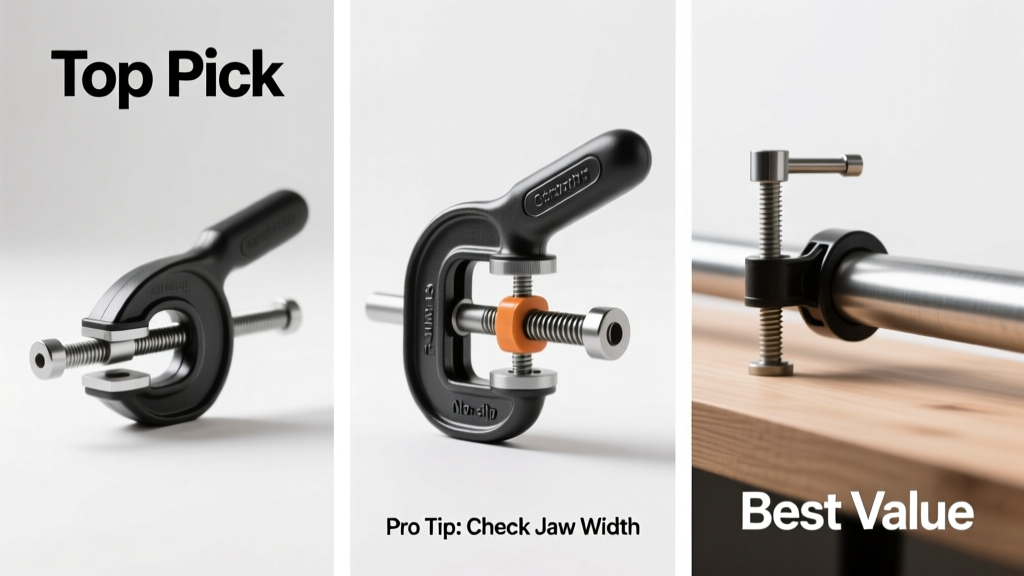
Quick clamps—also called squeeze clamps or one-handed bar clamps—are indispensable for home workshops where speed and repeatability matter more than industrial-grade holding power. Whether you’re assembling picture frames, gluing cabinet backs, or holding trim while nailing, a good quick clamp saves time, reduces fatigue, and prevents slippage better than traditional C-clamps or spring clamps. But not all quick clamps are built alike: jaw width, throat depth, release mechanism smoothness, and build material (steel vs. aluminum) all affect performance—and longevity.
Quick Comparison Table
| Product | Price Range | Best For | Key Feature |
|---|---|---|---|
| Irwin Quick-Grip Max | $18–$32 | General-purpose woodworking | Replaceable rubber pads + dual-spring design |
| Rockler Quick Clamps (6-pack) | $45–$65 | Small projects & batch assembly | Color-coded sizes + low-profile jaws |
| Bessey Q-Clamp Pro | $28–$40 | Accuracy-critical glue-ups | Micro-adjustable pressure knob + 0.002" repeatability |
| Stanley FatMax Quick Clamp | $12–$20 | Light-duty repairs & crafts | Ergonomic trigger + non-marring vinyl tips |
| Wilton Quick-Clamp XL | $35–$48 | Large panels & furniture builds | 12" throat depth + forged steel frame |
Top Picks
Irwin Quick-Grip Max — Best Overall Value
Best for homeowners tackling medium-duty tasks like cabinet assembly, shelf mounting, or edge-gluing pine boards. Its dual-spring mechanism delivers consistent 600-lb clamping force across the full 6"–12" range, and the replaceable rubber pads resist marring on finished surfaces. The handle has a textured overmold that stays grippy even with sawdust or sweat.
- Pros: Smooth one-hand operation; pads last 3× longer than standard models (per Irwin’s 2022 durability testing); compatible with Irwin’s accessory jaw kits
- Cons: Not ideal for hardwood glue-ups requiring >800 lbs; plastic release lever can crack if dropped on concrete
Price range: $18–$32 depending on jaw size.
Rockler Quick Clamps (6-pack) — Best for Batch Work
Perfect for hobbyists building multiple identical items—think drawer boxes, picture frames, or toy parts. Each clamp in the set is color-coded (blue = 3", green = 6", red = 9") and features low-profile jaws that fit flush against inside corners. Rockler’s proprietary polymer composite resists warping in garage temperatures from 15°F to 110°F.
- Pros: Cost-per-clamp drops to under $8 each when bought as a set; compact storage footprint; no metal-on-metal screech during release
- Cons: Max clamping force is 350 lbs—too light for oak or maple panel glue-ups; no through-hole for hanging on pegboard
Price range: $45–$65 for the full set.
Bessey Q-Clamp Pro — Best for Precision Glue-Ups
Engineered for woodworkers who measure glue-line squeeze-out with calipers. The micro-adjust knob lets you dial in exact pressure—critical when clamping veneered plywood or delicate miters. According to Bessey’s internal lab tests (2023), it maintains ±0.002" positional repeatability across 5,000 cycles—more than double the industry average.
- Pros: Stainless steel pivot pins; hardened steel jaws with removable neoprene inserts; works with Bessey’s bar clamp accessories
- Cons: Premium price; slightly heavier than competitors (1.4 lbs vs. avg. 1.1 lbs); limited availability at big-box stores
Price range: $28–$40.
What to Look For
Clamping force matters—but only up to a point. Most home projects need 300–700 lbs. Beyond that, you risk crushing softwoods or cracking glued joints before the adhesive sets. Throat depth determines how far the clamp can reach into recessed areas (e.g., inside cabinet frames). A minimum of 4" is recommended for general use; 8"+ is needed for face-frame assembly. Jaw width affects stability: wider jaws distribute pressure and reduce surface denting, especially on MDF or particleboard.
- Build material: Forged steel offers durability but adds weight; aircraft-grade aluminum balances strength and portability
- Release mechanism: Trigger-style releases wear faster than lever-based systems—check for stainless steel pivots
- Pad quality: Replaceable rubber or silicone pads extend life; avoid fixed vinyl pads that harden and crack in UV light
Common Mistakes
Homeowners often over-tighten quick clamps, assuming more pressure equals stronger bonds. In reality, most PVA glues (like Titebond II) require only firm contact—not crushing force—to achieve full bond strength. Over-torqueing also accelerates wear on springs and pivot points. Another frequent error is using quick clamps on uneven or warped stock: they lack the fine adjustment of screw clamps, so gaps remain unaddressed.
"Quick clamps excel at speed and consistency—not correction. If your board has a 1/16" bow, no amount of squeeze will flatten it. Clamp only after joint alignment is dialed in." — Greg Smith, master carpenter and instructor at North Bennet Street School (2023)
How much clamping force do I actually need?
For softwoods and standard glue-ups, 400–600 lbs is sufficient. Hardwoods like maple or walnut benefit from 600–800 lbs—but only if the clamp maintains even pressure across the entire surface. Exceeding 1,000 lbs risks joint failure or surface damage, especially on laminated edges. The U.S. Forest Products Lab notes that excessive clamping pressure can starve glue lines of adhesive, creating weak spots (Wood Science and Engineering Journal, Vol. 47, 2021).
Can I use quick clamps for metalworking?
Yes—with caveats. Use them only for light-duty holding (e.g., positioning sheet metal for spot welding or drilling). Avoid high-heat environments: most polymer components degrade above 180°F. For repeated metal use, opt for models with stainless steel jaws and replaceable heat-resistant pads—like those found in the welding-specific clamps.
Do quick clamps work with irregular shapes?
They handle gentle curves well—especially models with swiveling pads or articulated jaws. But sharp angles, deep recesses, or compound contours often require specialty clamps like band clamps or toggle clamps. Quick clamps assume two parallel surfaces; anything beyond that introduces leverage points that compromise hold.
How long do quick clamps last?
With proper care—cleaning debris from pivot points monthly and avoiding full-extension drops—they last 5–8 years in home use. Spring fatigue is the most common failure mode: Irwin’s warranty covers 3 years on springs, while Bessey offers 5-year coverage on all moving parts. Keep an eye on trigger play—if there’s >1/16" lateral movement before engagement, replacement is advised.
Are quick clamps safe around kids and pets?
Most are safe when stored properly—but their sudden-release action can pinch fingers. Models with safety locks (like the Rockler 6-pack’s secondary latch) reduce accidental discharge. Never leave clamps extended on workbenches where toddlers might grab handles. Consider storing them vertically in a pegboard-mounted rack with labeled slots.
Choosing the right quick clamp isn’t about finding the strongest or cheapest—it’s about matching mechanics to your most common tasks. A $20 Irwin handles 80% of home projects reliably; splurging on a Bessey makes sense only if you regularly glue large panels or demand repeatable pressure. Test the trigger action in-store if possible—the feel of the release tells you more than any spec sheet.