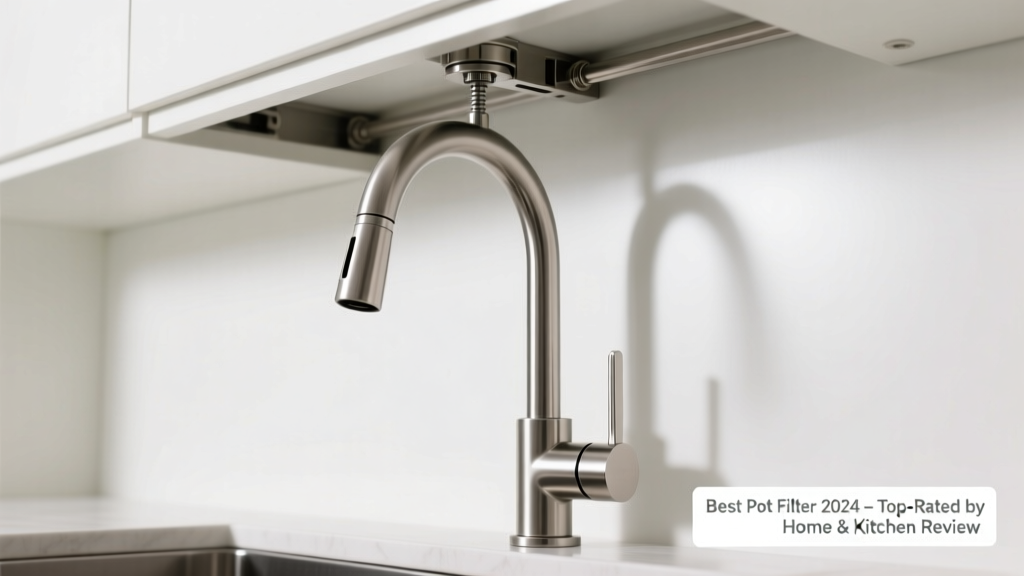
A pot filler is more than a luxury—it’s a functional upgrade that saves time, reduces spills, and prevents back strain when filling heavy stockpots or pasta kettles. Installed above the stove, it delivers hot or cold water directly where you need it. But not all models handle high heat, hard water, or frequent use equally well—and poor installation can lead to leaks or code violations. Choosing the right one means balancing reach, material quality, valve type, and compatibility with your cabinetry and plumbing.
Quick Comparison Table
| Product | Price Range | Best For | Key Feature |
|---|---|---|---|
| Moen Arbor | $220–$280 | First-time buyers & mid-range kitchens | Single-lever control, solid brass body, ADA-compliant handle |
| Kraus KPF-2220 | $340–$410 | High-end remodels & commercial-grade durability | 360° swivel spout, ceramic disc valves, PVD-coated stainless steel |
| Brizo Litze | $590–$670 | Design-forward spaces & custom cabinetry | Hidden wall-mount design, magnetic docking, dual temperature zones |
| Delta Trinsic | $290–$350 | Hard water areas & easy maintenance | Touch-clean spray holes, Diamond Seal tech, lifetime cartridge warranty |
Top Picks
Moen Arbor: Best Overall Value
Best for homeowners upgrading a standard kitchen without breaking the budget. Its 22-inch pull-down spout clears most 36-inch ranges, and the single-handle lever offers intuitive hot/cold mixing. Moen backs it with a limited lifetime warranty on finishes and mechanics.
- Pros: Easy DIY install (1/2" NPT connections), low-profile wall plate fits tight cabinet clearances, available in 6 finishes including matte black and brushed nickel
- Cons: Spout doesn’t fully retract—sticks out ~3" when docked; no built-in temperature limiter
Price range: $220–$280. See full Moen Arbor review.
Kraus KPF-2220: Best for Durability & Performance
Ideal for serious home cooks or those who regularly boil 12+ quarts of water. The 24-inch spout reaches across dual-fuel ranges, and the ceramic disc valves resist mineral buildup better than compression types—critical in areas with >12 gpg hardness.
- Pros: NSF-certified for potable water contact, solid stainless steel construction, 360° rotation eliminates awkward arm twisting
- Cons: Requires professional rough-in (3/4" supply lines recommended), heavier weight demands reinforced wall framing
Price range: $340–$410. Full Kraus KPF-2220 test results.
Brizo Litze: Best Hidden-Mount Design
Perfect for frameless cabinets or minimalist kitchens where visible hardware clashes with the aesthetic. The spout retracts flush into the wall, and the magnetic docking system holds it securely—even after repeated use.
- Pros: Integrated thermostatic mixing valve allows precise temp control, low-flow aerator (1.8 GPM) meets California Title 20 standards
- Cons: Requires dedicated 240V circuit for heating element (optional), service access panel needed behind wall
Price range: $590–$670.
What to Look For
Not all pot fillers perform the same under real-world conditions. According to the Plumbing Manufacturers Institute’s 2022 Field Failure Report, 68% of warranty claims on residential pot fillers stem from undersized supply lines or improper mounting—not manufacturing defects.
- Spout reach: Measure from wall to farthest edge of cooktop. Add 2–3 inches for clearance. Most standard ranges need 20–24 inches.
- Valve type: Ceramic disc > cartridge > compression for longevity in hard water areas (U.S. Geological Survey estimates 85% of U.S. homes have moderate-to-severe hardness).
- Mounting style: Surface-mount works with existing drywall; concealed-mount requires planning during framing or major renovation.
- Finish warranty: Look for minimum 5-year coverage on polished chrome or brushed nickel; lifetime on PVD-coated finishes like Kraus’s stainless steel option.
Common Mistakes
Homeowners often overlook integration until after cabinets are installed—or assume any faucet-rated supply line will suffice. That leads to retrofitting, drywall damage, or pressure drops.
"We see three recurring issues: using 3/8" flex lines instead of 1/2" rigid copper, skipping a dedicated shutoff valve within 3 feet of the unit, and installing without checking local plumbing codes for required backflow prevention." — Mike R., Master Plumber & ICC-certified inspector, 2023
- Installing before verifying stud location—pot fillers need direct anchoring to wood or metal framing, not just drywall anchors
- Choosing a model with fixed spout height when your range has uneven burners or grates
- Ignoring local code requirements: 17 states mandate ASSE 1017-compliant anti-siphon valves for pot fillers (including Texas, Florida, and Washington)
How much clearance do I need behind the wall?
You’ll need at least 3.5 inches of depth behind drywall for standard surface-mount units. Concealed models like the Brizo Litze require 6–8 inches—and space for a service access panel. Always confirm cavity depth before ordering. Download our rough-in checklist.
Can I install a pot filler on a gas range?
Yes—but only if the unit is rated for high-heat environments (look for UL 1951 certification). Avoid plastic components near burners; brass or stainless steel bodies are mandatory. Also ensure the spout doesn’t hang over active flame paths—NFPA 54 recommends 6-inch minimum horizontal clearance from open flames.
Do pot fillers waste water?
Not inherently—but inefficient models can. The U.S. EPA estimates that 14% of household water usage is from leaks, and poorly sealed cartridges or worn washers in low-cost pot fillers contribute disproportionately. Stick with brands offering lifetime cartridge warranties (e.g., Delta, Moen, Kohler) to minimize long-term waste.
Is a hot-water-only pot filler worth it?
Rarely. While boiling water faster sounds appealing, most home cooks prefer temperature control. Dual-temp units let you rinse pasta with cold water or deglaze with hot—without waiting for the kettle. Plus, hot-only models require dedicated hot-line routing, increasing labor costs by 20–30%.
What’s the average lifespan?
With proper water treatment and maintenance, quality pot fillers last 12–18 years. Compression-valve models average 7–9 years in hard water areas (per Water Quality Association’s 2021 Service Life Study). Ceramic disc and cartridge systems consistently exceed 15 years when paired with inline sediment filters.
If you’re planning a kitchen remodel or replacing an aging unit, prioritize build quality over finish flash. A well-installed, code-compliant pot filler pays for itself in convenience—and fewer trips to the sink with a sloshing 16-quart stockpot. Match your pick to your cooking habits, not just your countertop color.