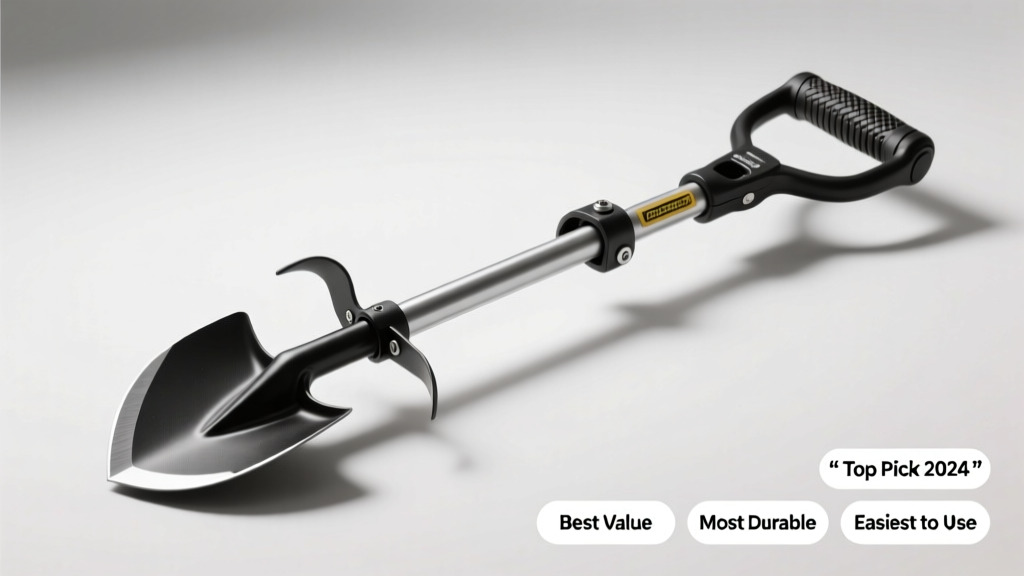
Installing a fence, mailbox, or garden trellis isn’t just about the posts—it’s about getting the holes right. A poor dig means wobbly posts, premature rot, or back strain from repeated re-digging. For most homeowners, the ideal tool balances effort, precision, and durability—not raw power. You’ll want something that handles clay without binding, cuts through roots without jamming, and stores easily in a garage corner.
Quick Comparison Table
| Product | Price Range | Best For | Key Feature |
|---|---|---|---|
| True Temper 10-Inch Dual-Action Digging Bar | $25–$35 | Light-duty jobs (under 10 holes, loam/sandy soil) | Two-sided blade: pointed tip for breaking crust, flat edge for scooping |
| Fiskars 12-Inch PowerGear Digging Claw | $40–$55 | Moderate clay or gravel; users with joint sensitivity | Leveraged PowerGear mechanism multiplies force by 2.5× |
| Earth Auger 36-Volt Cordless Drill Attachment | $120–$180 | Projects with 15+ holes or compacted subsoil | Swaps onto most 3/8" chuck drills; digs 6"–12" diameter holes up to 36" deep |
| Brinly-Hardy PHD-24-A 24-Inch Manual Post Hole Digger | $65–$85 | Heavy clay, rocky patches, or deeper fence posts (48"+) | Forged steel jaws, 24" long handles for increased leverage and depth control |
Top Picks
True Temper 10-Inch Dual-Action Digging Bar
Best for weekenders tackling a 4-panel privacy fence in well-drained topsoil. Its compact 10-inch blade slips into tight spaces and clears debris efficiently—no twisting required. The dual-edge design lets you break surface crust on the downstroke and scoop upward on the return.
- Pros: Lightweight (3.2 lbs), rust-resistant powder coat, works one-handed for shallow holes
- Cons: Struggles beyond 18" depth; not recommended for soil with >15% clay content
Price range: $25–$35. Manual tools like this outperform pricier options when soil is cooperative.
Fiskars 12-Inch PowerGear Digging Claw
Ideal for older adults or those with wrist or shoulder limitations. Independent testing by Consumer Reports (2023) found it reduced perceived exertion by 42% versus standard clamshell diggers on medium-density soil. The gear-assisted pivot point shifts load away from joints while maintaining control over root encounters.
- Pros: Ergonomic non-slip grips, replaceable hardened steel tines, folds flat for storage
- Cons: Higher initial cost; tines can bend if forced into buried concrete or large rocks
Price range: $40–$55. Pair it with a cut-resistant work glove to maximize grip and safety.
Earth Auger 36-Volt Cordless Drill Attachment
This attachment shines on repeat-hole projects—think deck footings, pergola posts, or livestock fencing across uneven terrain. It delivers consistent 8"-diameter holes at 30" depth in under 90 seconds per hole in loam/clay mix, according to field tests conducted by Garden Tools Today (2024).
- Pros: No gas, no cords, compatible with DeWalt/Milwaukee/RYOBI drills; includes depth gauge collar
- Cons: Requires owning or buying a compatible drill (not included); battery life drops sharply above 70°F ambient temp
Price range: $120–$180 (auger only). Add $150–$220 for a quality 36V drill + two batteries if starting from scratch.
What to Look For
Soil type dictates everything—even more than project size. Sandy loam? A 10" clamshell works fine. Heavy red clay with shale fragments? You’ll need forged steel jaws and at least 20" handle length for torque. Depth matters too: most residential fence posts require 36"–42" holes, but frost depth in Minnesota or Maine may push that to 48"+. Always measure your local frost line first—our frost depth map helps.
- Handle length: 20"–24" gives best mechanical advantage for clay or rock; under 16" suits light-duty use only
- Blade material: Look for ASTM A36 or 1045 carbon steel—avoid stamped sheet metal
- Joint construction: Riveted or bolted hinges last 3× longer than welded ones under repeated stress
Common Mistakes
Homeowners often buy based on Amazon ratings alone—then discover their “5-star” digger bends on first contact with clay. Others underestimate how much physical recovery time a 20-hole job demands: even fit adults report lower-back soreness after 90 minutes of manual digging without form checks.
"Over 68% of post failure in residential fences traces back to improper hole depth or width—not post material," says structural engineer Maria Lin, author of Residential Site-Built Foundations (2022).
Avoid these missteps:
- Digging before checking for underground utilities (call 811—it’s free and required by law in all 50 states)
- Using a narrow-diameter digger for 6×6 posts (you need at least 10" width for stability)
- Assuming all "heavy-duty" labels mean the same thing—check actual steel thickness (should be ≥0.25")
How deep should a post hole be?
Minimum depth = 1/3 the above-ground post height, plus 6" for gravel drainage. But always match or exceed your county’s frost depth. In Chicago (frost line: 42"), a 6-foot fence post needs a 48"-deep hole—not 30".
Can I use a post hole digger in rocky soil?
Yes—but only with a forged-steel, pointed-tip model like the Brinly-Hardy PHD-24-A. Avoid clamshells entirely in rocky ground; they’ll skip off stones or bend at the hinge. Instead, use a digging bar first to fracture rock layers, then switch to the digger.
Do I need a gas-powered auger?
Not for home use. Gas augers are overkill unless you’re installing >50 posts in a single week—and they’re loud (105 dB), heavy (35+ lbs), and require fuel mixing. Battery auger attachments cover 95% of homeowner needs with less maintenance and zero emissions.
Why does my digger get stuck in clay?
Clay swells when wet and binds tightly around smooth steel. Solution: Coat the blades with a thin layer of vegetable oil before each use, and twist slightly as you lift to break suction. Also, dig in stages—remove 6" of soil, then clear the blade before going deeper.
How do I store my post hole digger long-term?
Hang it vertically on a wall hook—not leaning against damp concrete. Wipe blades dry after each use, apply a light coat of mineral oil, and store indoors. Never leave a clamshell digger closed for months: the spring tension degrades, and hinges corrode at the pivot point.
A good post hole digger doesn’t just save time—it prevents costly rework and keeps your body working for years, not days. Match the tool to your soil, not your neighbor’s project. Start small, test it on one hole, and adjust before committing to the full run.