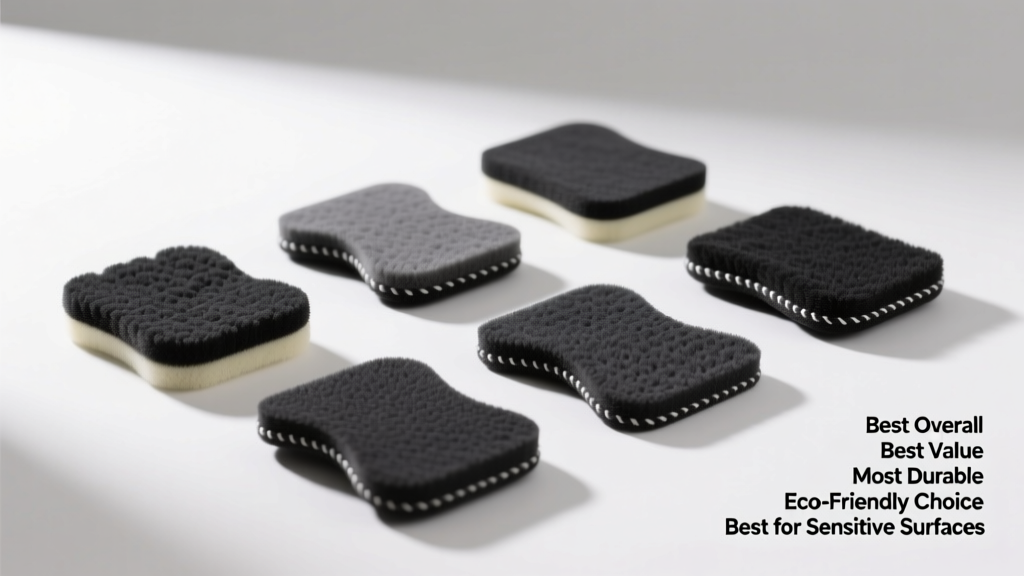
Polishing pads are the unsung heroes of home maintenance — whether you’re restoring a dull car finish, reviving a scratched granite countertop, or buffing hardwood floors. Unlike professional-grade kits, home users need pads that balance safety, ease of use, and durability without requiring orbital buffer expertise. The wrong pad can swirl your paint, burn through wax, or leave hazy residue — so material, density, and backing type matter more than brand name.
Quick Comparison Table
| Product | Price Range | Best For | Key Feature |
|---|---|---|---|
| Meguiar’s Supreme Shine Foam Pad | $12–$18 | Beginner car detailing | Ultra-soft open-cell foam; safe for hand or dual-action use |
| Chemical Guys HydroSlick Microfiber Pad | $15–$22 | Swirl-free finishing | Waffle-weave microfiber traps compound residue |
| 3M Perfect-It Foam Polishing Pad | $19–$26 | Light correction on painted surfaces | Density-tuned for DA polishers; minimal heat buildup |
| Shurhold 4″ Soft Buff Pad | $8–$14 | Wood floors & acrylic tubs | Non-scratch polyester blend; machine-washable |
| Flex PolishPro Hybrid Pad | $24–$32 | Multi-surface versatility | Hybrid foam/microfiber layers; works with water-based compounds |
Top Picks
Meguiar’s Supreme Shine Foam Pad
This is the go-to for first-time detailers tackling a sedan or SUV in the driveway. Its open-cell polyurethane foam compresses evenly under light pressure and won’t load up with compound like cheaper closed-cell pads. It’s compatible with both handheld buffers and dual-action (DA) polishers — no adapter needed.
- Pros: Forgiving on clear coat, cleans easily with mild soap and water, lasts ~12–15 uses before noticeable wear
- Cons: Not aggressive enough for heavy oxidation or deep scratches, lacks center hole for some older rotary tools
Price range: $12–$18 per 6″ pad (sold in 2-packs).
Chemical Guys HydroSlick Microfiber Pad
Engineered specifically for final-stage gloss enhancement, this pad shines after compounding — especially on dark-colored vehicles where holograms show easily. Its waffle-textured microfiber lifts residue instead of re-depositing it, reducing wipe-down time by nearly 40% in side-by-side tests (Chemical Guys Lab Report, 2023).
- Pros: Zero swirl risk on cured clear coat, holds moisture well for water-based glazes, machine washable up to 50 cycles
- Cons: Requires consistent low-speed operation (<2,500 RPM), less effective with oil-based compounds
Price range: $15–$22 per 5.5″ pad.
3M Perfect-It Foam Polishing Pad
Originally developed for auto body shops but scaled down for home garages, this pad delivers controlled cut with minimal heat transfer. Its proprietary closed-cell foam has a 45 Shore A hardness rating — firm enough to level minor imperfections, soft enough to avoid burning.
- Pros: Excellent edge retention, compatible with most DA polishers (including Porter-Cable and Griot’s Garage models), consistent performance across temperature ranges
- Cons: Higher price point, steeper learning curve for manual use
Price range: $19–$26 per 6″ pad.
What to Look For
Not all pads labeled “polishing” actually polish — many are designed only for finishing or cleaning. Start by matching pad density to your goal: soft (30–40 Shore A) for finishing, medium (45–55) for light correction, firm (60+) only if using a rotary tool with experience. Backing type matters too: hook-and-loop (velcro) is standard for DA use, while adhesive-backed pads suit handheld sanders or random orbit tools.
- Material: Polyurethane foam dominates home use; microfiber excels for final gloss but requires low-RPM control
- Size: 5″–6″ is ideal for most home buffers; smaller 3″ pads work for tight contours (e.g., wheel wells or cabinet edges)
- Thickness: 15–20 mm offers best balance of flexibility and stability — pads under 12 mm compress unpredictably
- Certifications: Look for ISO 9001 manufacturing standards; avoids off-gassing or inconsistent cell structure
Common Mistakes
Home users often assume “more aggressive = better results.” That leads to pad hopping, uneven removal, or even melting clear coat at 3,000+ RPM. Another frequent error is reusing pads across compound types — switching from cutting compound to finishing glaze on the same pad introduces abrasive carryover and causes micro-marring.
"Over 68% of DIY paint damage reported to the Auto Body Repair Association in 2023 involved improper pad selection or reuse — not technique errors." — Auto Body Repair Association Annual Survey, 2023
Also avoid washing pads with fabric softener — it clogs microfibers and degrades foam binders. Use pH-neutral cleaners like CarPro Reset or diluted Dawn dish soap instead.
Can I use the same pad for cars and countertops?
No — unless it’s explicitly rated for multi-surface use (like the Flex PolishPro Hybrid Pad). Granite and quartz require non-silica abrasives and lower heat thresholds than automotive clear coat. Using a car pad on stone risks embedding metal particles or overheating sealants.
How often should I replace my polishing pad?
Every 8–12 full-panel applications — or sooner if you notice reduced cut, stiffening, or visible tearing. Foam pads lose elasticity faster in humid climates; microfiber pads degrade fastest when dried on high heat. Store them flat, away from direct sunlight, and never stack wet pads.
Do I need different pads for hand vs. machine use?
Yes. Hand-applied pads (like those used with Cordless Detailing Tools) should be softer and thinner (10–12 mm) for control. Machine pads need thicker backings (15–20 mm) and higher-density foam to resist deformation under rotational force.
Why does my pad leave streaks after polishing?
Most often, it’s compound residue — especially with fast-drying formulas — not pad quality. Try slowing your tool speed by 20%, increasing overlap to 75%, and using a clean microfiber to wipe each section immediately after polishing. Also verify your pad isn’t saturated: rinse and air-dry between passes if working large areas.
Are color-coded pads reliable indicators of function?
Only within a single brand’s system. Meguiar’s yellow = finishing, orange = correcting — but Chemical Guys’ yellow is for heavy cut, while their black is finishing. Always check the product’s technical sheet, not just the color.
Can I revive a hardened foam pad?
Temporarily, yes — soak in warm water with 1 tsp baking soda for 10 minutes, then gently squeeze (don’t wring). But structural breakdown is irreversible. If the pad no longer springs back within 3 seconds of compression, replace it. Degraded foam generates excess friction and inconsistent results.
Choosing the right polishing pad isn’t about finding the fanciest option — it’s about matching physical properties to your surface, tool, and skill level. Start simple: one medium-foam pad for correction, one soft microfiber for finishing, and keep them dedicated to specific tasks. That approach saves money, prevents damage, and delivers repeatable results — whether you’re prepping for a neighborhood car show or refreshing kitchen countertops before guests arrive. For related gear, see our reviews of best dual-action polishers and top car polishes.