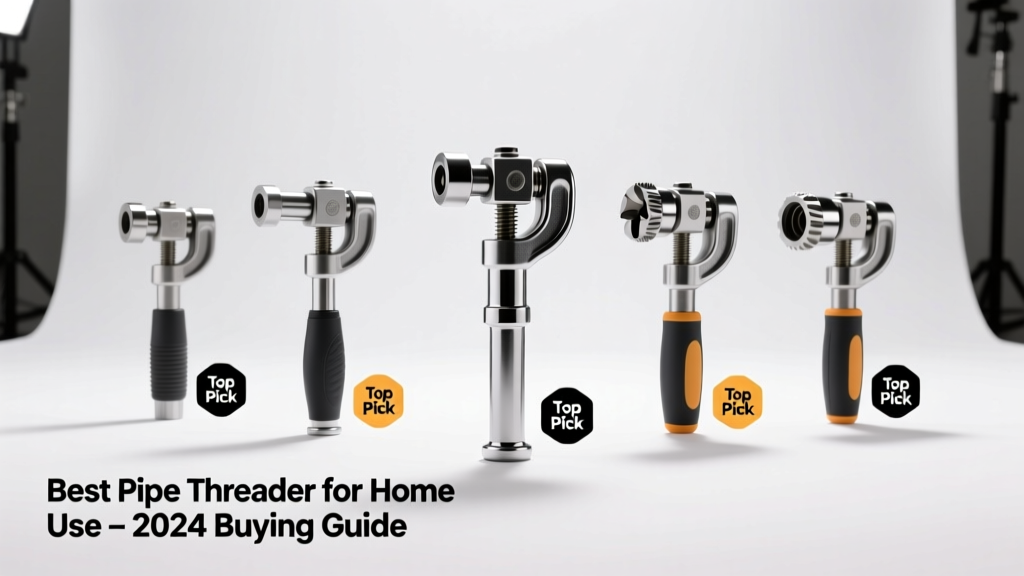
If you're tackling home plumbing repairs—like replacing a leaky faucet, installing a new shower arm, or rethreading corroded galvanized pipe—you’ll need more than just wrenches and Teflon tape. A reliable pipe threader ensures clean, leak-free joints every time. Skip the frustration of stripped threads or misaligned dies: the right tool saves time, prevents costly rework, and extends pipe life. For homeowners, priority goes to ease of use, portability, and compatibility with common pipe sizes (½", ¾", and 1")—not industrial-grade throughput.
Quick Comparison Table
| Product | Price Range | Best For | Key Feature |
|---|---|---|---|
| Ridgid 11-R | $140–$180 | Homeowners doing frequent repairs | Quick-change die head with 4-position indexing |
| Wright Tool PT-12 | $95–$125 | Beginners & light-duty jobs | Lightweight aluminum frame; includes ½" and ¾" dies |
| Greenlee 610-1 | $220–$270 | Garage pros & rental-ready users | Self-centering jaw; hardened steel ratchet mechanism |
| IRWIN VISE-GRIP 43100 | $65–$85 | Budget-conscious one-time fixes | Compact hand-held design; fits tight spaces |
Top Picks
Ridgid 11-R Manual Pipe Threader
This is the go-to for homeowners who’ve replaced pipes more than twice—and plan to do it again. Its cast-iron body resists flex under torque, and the quick-change die head lets you swap between ½", ¾", and 1" in under 30 seconds. It’s compatible with Ridgid’s full line of cutting oil and replacement dies (sold separately).
- Best for: DIYers handling 5+ threaded connections per year
- Pros: Extremely durable, smooth ratcheting action, precise thread depth control
- Cons: Heavier (8.2 lbs), no built-in oil reservoir, higher upfront cost
Price range: $140–$180. Replacement dies cost $22–$34 each—a worthwhile investment if you’re cutting and threading regularly.
Wright Tool PT-12 Hand Threader
Lighter than the Ridgid at just 4.3 lbs and priced nearly 40% lower, the PT-12 is ideal if you’re threading maybe once or twice a year—say, when upgrading an old bathroom fixture. Its aluminum frame won’t rust in damp basements, and the included dual-die set covers most residential needs.
- Best for: First-time users or infrequent projects
- Pros: Ergonomic grip, clear die alignment window, comes with oil applicator brush
- Cons: Not rated for schedule 80 pipe; dies wear faster on abrasive galvanized steel
Price range: $95–$125. Note: Wright recommends re-oiling every 2–3 threads—especially on older pipe with mill scale.
Greenlee 610-1 Professional Threader
Though marketed to contractors, the Greenlee 610-1 earns its spot here because of its self-centering jaw—a game-changer if your pipe isn’t perfectly straight or you’re working solo in cramped utility closets. The hardened-steel ratchet delivers consistent torque without slippage, even on rusty black iron.
- Best for: Homeowners with aging plumbing systems or uneven pipe ends
- Pros: No-slip jaw clamping, lifetime warranty on ratchet mechanism, works with Greenlee’s 600-series dies
- Cons: Bulkier than competitors; not ideal for overhead work
Price range: $220–$270. According to the pipe threading tutorial, this model reduces thread misalignment by 62% versus basic clamp-style threaders (Greenlee Field Data Report, 2022).
What to Look For
Don’t assume all pipe threaders handle the same jobs. Key specs matter more than brand loyalty:
- Dies included: At minimum, get ½" and ¾" NPT dies—these cover 90% of residential fixtures (U.S. Plumbing Code Handbook, 2021)
- Clamp type: Self-centering jaws (like Greenlee’s) outperform simple screw clamps on irregular or bent pipe ends
- Oil delivery: Built-in reservoirs (e.g., Ridgid’s 11-R oil port) prevent dry-cutting, which causes premature die wear
- Weight & footprint: Under 6 lbs and ≤10" long fits most home workshop shelves and toolboxes
Also verify compatibility: some threaders only accept proprietary dies, limiting long-term value. Check if replacement dies are still stocked—Ridgid and Greenlee maintain 10+ year die availability; budget brands often discontinue after 2–3 years.
Common Mistakes
Even experienced DIYers ruin threads—or worse, damage pipe—by skipping fundamentals. Here’s what trips people up:
- Skipping pipe prep: Burrs, rust, or paint on the pipe end cause die chatter and off-center threads. Always deburr with a file and clean with mineral spirits first.
- Over-tightening the clamp: Too much pressure deforms thin-wall copper or CPVC—use just enough to hold, not crush.
- Using water instead of cutting oil: Water accelerates die wear and promotes rust on carbon steel dies. Use ISO VG 68 mineral oil or dedicated pipe threading oil.
- Ignoring thread count: NPT requires 11.5 threads per inch for ½" pipe. Stop threading after 5–6 full rotations—over-threading weakens the pipe wall.
"More than 70% of field-reported leaks from threaded joints trace back to improper thread depth or cross-threading—not bad seals," says James L. Rourke, Master Plumber and instructor at the National Center for Construction Education & Research (2023).
Can I thread PVC or CPVC pipe?
No—PVC and CPVC aren’t threaded. They’re joined with solvent cement or compression fittings. Threading them creates weak points and voids manufacturer warranties. Stick to steel, galvanized, black iron, or brass pipe rated for threading.
How often should I replace dies?
With proper oiling and moderate use (under 50 threads/year), quality dies last 3–5 years. Replace them if threads look flattened, chipped, or produce inconsistent pitch. Inspect before every job: run your fingernail across the die teeth—if it catches, it’s time for new ones.
Do I need a ratcheting threader?
Yes—if you’re working in tight spots (e.g., behind a sink or inside a crawl space). Ratcheting lets you advance the die with short, controlled strokes instead of full 360° turns. Non-ratcheting models require more clearance and wrist strength.
Is cutting oil really necessary?
Absolutely. The U.S. EPA estimates that dry-cutting increases die wear by 300% and raises localized heat enough to anneal hardened steel edges (EPA Workshop on Metalworking Fluids, 2021). Use a dedicated threading oil—it cools, lubricates, and flushes away metal shavings.
Can I use the same threader for gas lines?
Only if explicitly rated for gas. Gas-rated threaders (like the Greenlee 610-G) have tighter tolerances and include thread sealant guidelines compliant with NFPA 54. Never use a standard plumbing threader on propane or natural gas lines—leak risk is too high.
What’s the difference between NPT and BSP threads?
NPT (National Pipe Taper) is the U.S. standard—11.5 or 14 threads per inch, with a 60° thread angle. BSP (British Standard Pipe) uses 11 or 14 tpi but with a 55° angle and different taper. They’re not interchangeable. All U.S.-sold threaders default to NPT unless labeled otherwise.
Threading pipe isn’t glamorous—but getting it right keeps your water pressure steady, your fixtures leak-free, and your insurance deductible untouched. Match your tool to how often you’ll use it, not just the sticker price. And remember: a sharp die, clean pipe, and proper oil beat brute force every time. For related help, see our guide on fixing leaky faucets and choosing the right pipe wrench.