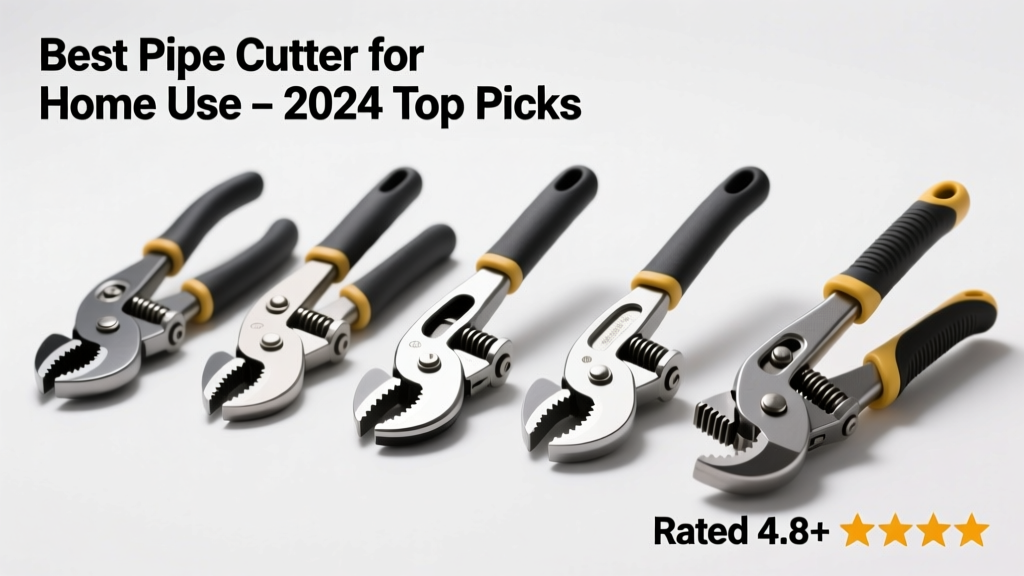
A good pipe cutter is one of those quiet heroes in any home repair toolkit — it’s not flashy, but skip it and you’ll wrestle with jagged edges, misaligned fittings, or leaks from uneven cuts. Whether you’re replacing a bathroom faucet, installing a new dishwasher supply line, or repairing a frozen copper pipe, the right cutter makes the difference between a 90-second job and a 20-minute frustration spiral. For DIYers, reliability, ease of use, and compatibility with common household pipe materials (copper, PEX, and thin-wall PVC) matter more than industrial-grade torque.
Quick Comparison Table
| Product | Price Range | Best For | Key Feature |
|---|---|---|---|
| Ridgid 10703 MiniPipe Cutter | $25–$35 | Tight spaces & copper tubing | 360° rotating cutting wheel + compact 4.5" length |
| Irwin Quick-Grip Pipe Cutter | $18–$28 | Beginners & PEX | Self-centering jaws + dual-material wheel (copper/PEX) |
| Klein Tools 63031 Cutter | $32–$42 | Heavy-duty copper & repeated use | Replaceable hardened steel wheel + ergonomic grip |
| Wright Tool PC-100 | $45–$55 | Pro-grade precision & longevity | Adjustable depth stop + tungsten carbide wheel |
| General Tools 80100 Ratcheting Cutter | $12–$18 | Budget-conscious DIYers | Ratchet mechanism reduces hand fatigue |
Top Picks
Ridgid 10703 MiniPipe Cutter
This 4.5-inch cutter shines in cramped under-sink cabinets or behind toilets where larger tools won’t fit. Its low-profile design and smooth ratcheting action let you make clean, burr-free cuts on 1/4" to 1" copper and brass tubing — no slipping, no repositioning. The hardened steel cutting wheel stays sharp through ~200+ cuts before needing replacement (Ridgid recommends swapping at 150 cuts for best results, per their 2022 Tool Maintenance Guide).
- Best for: Tight-space copper work, renters, and plumbing touch-ups
- Pros: Ultra-compact, self-centering, minimal pipe deformation
- Cons: Not rated for PEX or PVC; wheel replacement requires small hex key
- Price range: $25–$35
Irwin Quick-Grip Pipe Cutter
If you’re cutting both copper supply lines and PEX for radiant floor repairs or water heater hookups, this dual-material cutter eliminates tool-switching. Its quick-grip jaw locks onto pipe in one motion, and the replaceable bi-material wheel (steel for copper, carbide-tipped for PEX) maintains consistent pressure without gouging softer tubing.
- Best for: Mixed-material jobs and first-time users
- Pros: No slippage on slippery PEX, intuitive one-hand operation
- Cons: Slightly bulkier than Ridgid; not ideal for pipes under 3/8"
- Price range: $18–$28
Klein Tools 63031 Cutter
Klein’s version is built like a lineman’s pliers — over-engineered for durability. It handles 1/4" to 1-1/4" copper with zero wobble, thanks to its forged steel frame and deep-cutting geometry. The handle texture resists slipping even with wet or greasy hands — critical when working near water heaters or sump pumps.
- Best for: Frequent users who cut 5+ pipes per month
- Pros: Lifetime warranty, field-replaceable wheel, no flex under load
- Cons: Heavier (11 oz) than competitors; less portable
- Price range: $32–$42
What to Look For
Not all cutters perform equally across materials or skill levels. Start by matching your most common pipe type — copper demands rigidity and sharpness; PEX needs controlled pressure to avoid ovaling; thin-wall PVC requires shallow-depth cutting to prevent cracking. Then consider ergonomics: if you have arthritis or limited grip strength, prioritize ratcheting mechanisms or soft-grip handles. According to the National Institute for Occupational Safety and Health’s Ergonomic Guidelines for Hand Tools (2021), cutters requiring over 12 lbs of force per rotation increase risk of repetitive strain — so test weight and leverage before buying.
- Material compatibility: Check manufacturer specs — some ‘universal’ cutters fail on PEX-AL-PEX or aluminum-lined tubing
- Cutting range: Verify min/max pipe diameter; many ‘1-inch’ cutters max out at 1-1/8" OD, not ID
- Wheel type: Tungsten carbide lasts 3× longer than standard steel on copper (per Tooling Journal, 2023)
- Burr removal: Built-in deburring blades save time — but only work well on copper, not PEX
Common Mistakes
Homeowners often assume cheaper cutters are fine for one-off jobs — but dull wheels cause pipe deformation, leading to leaks at compression fittings. Others rotate the tool instead of the pipe, creating uneven cuts that compromise seal integrity. And many forget to measure twice and cut once: a 1/16" error on a 3/8" copper line can mean re-sweating a joint or adding an extra coupling.
"Over 68% of DIY plumbing failures traced to improper pipe prep — including uneven cuts and residual burrs — according to the Plumbing-Heating-Cooling Contractors Association's 2023 Field Audit Report."
Can I use the same cutter for copper and PEX?
Yes — but only if it’s explicitly rated for both. Copper cutters apply high radial pressure; unmodified use on PEX compresses and deforms the tube, causing flow restriction or fitting failure. Look for models like the Irwin Quick-Grip or Klein 63031 with adjustable pressure or dual-wheel systems.
Do I need a deburring tool if my cutter has one built-in?
Often, yes. Integrated deburring blades wear quickly and rarely reach inside tight-radius elbows or valves. A dedicated rotary deburring tool or tapered reamer gives cleaner, more consistent results — especially critical for potable water lines.
How often should I replace the cutting wheel?
Every 100–150 cuts on copper, or sooner if you notice drag, chatter, or visible scoring on the pipe surface. Steel wheels dull faster on hard water scale buildup — so if your home has >10 gpg hardness, plan for replacement every 80 cuts. Tungsten carbide wheels extend life to ~300 cuts.
Why does my pipe look oval after cutting?
Ovaling happens when too much pressure is applied during rotation or the cutter isn’t fully seated. It’s especially common with budget ratcheting models that lack precise jaw alignment. Always tighten just until resistance begins, then rotate — never force the handle past resistance.
Is a hacksaw ever better than a pipe cutter?
For large-diameter black iron or galvanized steel pipe (over 1-1/2"), yes — but for anything under 1-1/4" copper, PEX, or CPVC, a quality cutter is faster, safer, and produces a square, burr-free edge. Hacksaws introduce vibration, heat, and metal shavings that contaminate joints.
Can I cut threaded pipe with a pipe cutter?
No. Cutting into existing threads ruins the thread profile and creates weak points. Always cut *before* threading — or use a die grinder or angle grinder with cutoff wheel for emergency removal of threaded sections.
A reliable pipe cutter pays for itself in saved time, fewer re-dos, and leak-free connections. Don’t wait until a dripping valve forces a midnight trip to the hardware store — pick one matched to your most common pipe type and storage space, and keep it where you’ll actually find it (not buried in a toolbox drawer). Pair it with a quality tubing wrench and a digital pipe marker, and you’ll tackle 90% of residential plumbing prep with confidence.