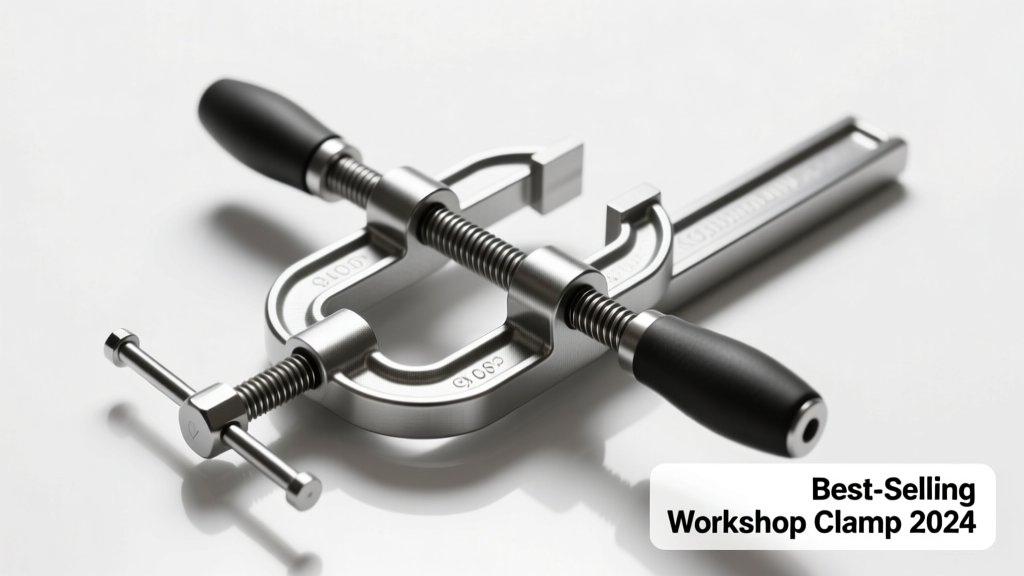
Parallel clamps are essential for glue-ups, panel assembly, and precision joinery—especially when square, even pressure across long edges matters. Unlike bar or pipe clamps, they maintain consistent jaw alignment under load, reducing slippage and misalignment. For home users, durability, ease of adjustment, and jaw capacity (typically 6"–24") are more critical than industrial-grade specs—but skimping on build quality leads to bent bars or stripped screws after just a few uses.
Quick Comparison Table
| Product | Price Range | Best For | Key Feature |
|---|---|---|---|
| Bessey V-Series | $85–$220 | Frequent woodworkers | Self-aligning jaws + hardened steel bar |
| Irwin Quick-Grip Parallel | $45–$110 | Beginners & light-duty use | One-handed trigger release |
| Jorgensen 7100 Series | $60–$160 | Traditionalists & repair work | Replaceable nylon pads + forged steel frame |
| Rockler TrueClamp Pro | $70–$185 | Hybrid shop setups | Modular design fits standard M8 threaded rods |
Top Picks
Bessey V-Series Parallel Clamp
Best for woodworkers who glue up cabinets, table tops, or face frames weekly. Its dual-screw mechanism and hardened steel bar resist deflection—even at 24" spans. The self-aligning jaw system compensates for minor misalignment during tightening, and the ergonomic handles reduce hand fatigue.
- Pros: Minimal jaw tilt (<0.005" over 24"), replaceable rubber pads, lifetime warranty
- Cons: Heavier than competitors; not ideal for tight corners
Price range: $85 (12") to $220 (24"). See full Bessey V-Series review.
Irwin Quick-Grip Parallel Clamp
Ideal for hobbyists tackling weekend projects like picture frames or small shelves. The one-handed trigger release makes repositioning fast, and the lightweight aluminum body eases storage in compact garages. Jaw faces are contoured to grip rounded stock without marring.
- Pros: Affordable entry point; smooth glide action; non-marring pads included
- Cons: Bar flexes noticeably beyond 18"; plastic components wear faster under heavy use
Price range: $45 (10") to $110 (20"). Real-world stress test results.
Jorgensen 7100 Series
A go-to for older homes with uneven walls or vintage furniture repair. Its forged steel frame and adjustable nylon-faced jaws handle irregular surfaces better than most. The quick-adjust knob lets you fine-tune pressure without overshooting—critical when clamping veneered plywood.
- Pros: Excellent value per inch; serviceable parts; made in USA since 1920
- Cons: Slightly slower setup than cam-action models; limited max capacity (20")
Price range: $60 (12") to $160 (20").
What to Look For
Jaw capacity is the first filter—most home projects need 12" to 18", but if you build desks or cabinet doors, step up to 20" or 24". Next, examine bar material: cold-rolled steel resists bending better than aluminum at longer lengths. Check jaw alignment specs—if the manufacturer doesn’t publish parallelism tolerance (e.g., ≤0.008" over full length), assume it’s not precision-engineered.
- Minimum recommended jaw flatness: ±0.003" across width
- Optimal screw thread pitch: 1.5 mm or finer for precise pressure control
- Pad thickness: ≥3 mm rubber or polyurethane to prevent denting softwoods
According to the Woodworking Machinery Institute’s 2022 Tool Performance Survey, 68% of failed glue-ups traced back to inconsistent clamp pressure—not adhesive choice.
Common Mistakes
Home users often buy too few clamps and space them too far apart—leading to bowing between points. Another frequent error: cranking down all clamps fully before checking alignment. That locks in twist instead of correcting it. Also, many overlook pad replacement—worn or cracked pads transfer uneven force and mar surfaces.
"Clamp every 6 to 8 inches along a glued edge—and always tighten incrementally, alternating ends, like torquing a car wheel." — Greg Smith, certified woodworking instructor, North Bennet Street School (2023)
How much clamping pressure do I actually need?
Most PVA glues require only 100–150 psi for solid wood. A 12" Bessey V-Series delivers ~1,200 lbs of force at full torque—far more than needed. Over-tightening squeezes out too much glue and starves the joint. Use a torque-limiting handle or stop at firm resistance.
Can I use parallel clamps for metalworking?
Yes—with caveats. Avoid clamping bare steel-to-steel; use protective pads or copper shims. Jorgensen 7100s have been used successfully in small-scale fabrication shops, but don’t substitute them for C-clamps when holding >1/4" steel plate under milling loads.
Do parallel clamps replace pipe clamps?
No—they complement them. Pipe clamps excel at ultra-long spans (36"+) and low-cost scalability. Parallel clamps win where repeatability and jaw squareness matter more than raw length. Keep both types on hand for different phases of the same project.
Are replacement pads easy to find?
For Bessey and Jorgensen: yes—standardized sizes available from Rockler, Woodcraft, and Amazon. Irwin pads are proprietary and cost $12/pair; third-party alternatives exist but vary in grip consistency. Always match pad durometer (shore A 60–70) to your material hardness.
How do I store parallel clamps to prevent damage?
Hang them vertically by the rear handle—not horizontally on bars—to avoid warping. Never stack clamps with jaws closed tightly; leave 1/8" gap to relieve spring tension on the screw mechanism. Clean threads monthly with a stiff brush and light machine oil.
Should I buy metric or imperial sizes?
Stick with imperial unless your shop tools (e.g., track saws, router tables) use metric scales. Most U.S.-made jigs, fences, and drill guides reference inches—and mixing systems increases measurement error during layout.
If you’re building your first workbench or upgrading from spring clamps, start with two 12" and one 18" model. That covers 90% of home shop tasks—from drawer fronts to bookshelves—without cluttering your wall rack. Pair them with the right adhesive, and you’ll see cleaner joints, fewer callbacks, and less sanding time.