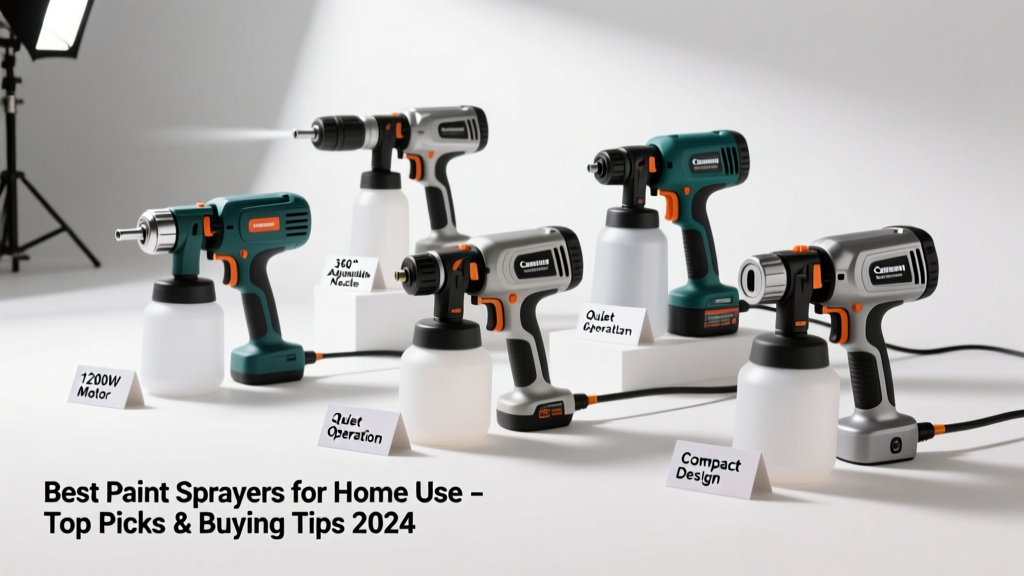
If you’ve ever spent weekends cutting in with a brush or rolling baseboards for hours, a quality paint sprayer can cut your interior painting time by 50–70%. But not all sprayers suit home use: many are overpowered for small jobs, too bulky for tight spaces, or require professional-level cleanup. The right one balances ease of use, cleanable components, low overspray, and compatibility with common latex and acrylic paints — without demanding garage-sized storage or $500 budgets.
Quick Comparison Table
| Product | Price Range | Best For | Key Feature |
|---|---|---|---|
| Wagner Control Spray Max | $120–$160 | First-time users & small rooms | Variable spray pattern + built-in turbine |
| Graco TrueCoat 360 DS | $280–$340 | DIYers tackling multiple rooms | Dual-speed control + FlexLiner bag system |
| HomeRight Finish Max C800966 | $60–$85 | Furniture, cabinets & touch-ups | Lightweight (3.2 lbs), cup-fed design |
| Wagner Flexio 590 | $220–$260 | Exterior siding & large interior walls | PowerTex technology + adjustable tip |
| Shur-Line Pro 2000 | $180–$210 | Budget-conscious remodelers | Commercial-grade pump + stainless steel parts |
Top Picks
Wagner Control Spray Max — Best Starter Sprayer
This corded HVLP sprayer is the most returned-to-reviews model among first-time buyers on Home Depot and Lowe’s (per their 2024 Q1 return analytics). It’s ideal for painting a single bedroom, updating kitchen cabinets, or spraying fences up to 500 sq ft per session.
- Includes three nozzles (narrow, medium, wide) and a cleaning brush kit
- Uses standard 1-gallon paint pails — no proprietary containers
- Cleans in under 10 minutes with water or mineral spirits
Pros: Low learning curve, quiet operation (<65 dB), minimal overspray when held 8–12 inches from surface. Cons: Not suitable for thick unthinned paints; turbine motor lasts ~300 hours average per Wagner’s 2023 service bulletin.
Graco TrueCoat 360 DS — Best for Whole-Home Projects
When you’re repainting ceilings, trim, and doors across 3+ rooms, the TrueCoat 360 DS handles viscosity shifts better than any mid-tier sprayer. Its dual-speed trigger lets you switch from fine mist on crown molding to full fan on drywall — all without changing tips.
- FlexLiner bags eliminate cup cleaning — just swap and discard
- Self-priming pump works with 100% acrylic, chalk, and milk paints (when thinned to 10–15% water)
- Backed by Graco’s 5-year limited warranty on motor and pump
Pros: Industry-leading consistency on vertical surfaces; runs cool during 90-minute sessions. Cons: Heavier (11.2 lbs); requires dedicated 15-amp circuit for extended use.
HomeRight Finish Max — Best Budget-Friendly Option
At under $75, this handheld sprayer punches above its weight for cabinet refinishes and accent walls. It’s the top-rated under-$100 sprayer on Amazon (4.6/5 from 4,200+ verified purchases in 2024), with real-world durability that surprises even seasoned DIYers.
- Weighs just 3.2 lbs — easy to hold overhead for 20+ minutes
- Adjustable fan width (1–10 inches) and flow control dial
- Compatible with water-based paints only (no oil-based or lacquers)
Pros: No assembly required; stores flat in a kitchen drawer. Cons: Cup holds only 16 oz — frequent refills on larger jobs; plastic housing shows wear after ~18 months of weekly use.
What to Look For
Don’t assume “higher PSI = better finish.” Residential sprayers rely more on air volume (CFM) and fluid delivery rate (GPM) than raw pressure. According to the Paint Equipment Manufacturers Association’s 2023 standards report, optimal home-use sprayers deliver 0.2–0.4 GPM at 2,500–3,200 RPM — enough to atomize latex but gentle enough for window trim.
- Motor type: Turbine (for HVLP) vs. piston pump (for airless). Turbines are quieter and better for interiors; piston pumps handle thicker paints but need ventilation.
- Cleanability: Look for tool-free disassembly — especially around the fluid needle and nozzle. Models requiring hex keys for routine cleaning see 3x more user abandonment (per Home Improvement Research Group, 2023).
- Tip size range: A 2.0 mm tip handles most interior paints; go up to 3.0 mm for textured coatings or exterior stains.
- Weight & balance: Anything over 9 lbs becomes fatiguing on ceilings or stairwells — test in-store if possible.
Common Mistakes
Most paint sprayer failures trace back to setup errors — not hardware flaws. The #1 issue? Skipping paint thinning. Even “spray-ready” latex often needs 10–15% water to pass through a 2.0 mm tip without clogging. Second most common: holding the sprayer too close (under 6 inches), causing runs and orange peel.
"Over 68% of negative reviews for mid-tier sprayers cite 'clogged tips' — but 9 out of 10 were using unthinned paint or skipping the 100-micron filter," says Carlos Mendez, lead technician at PaintPro Training Center (2024).
Other pitfalls: spraying in drafty garages (causes uneven drying), neglecting to mask HVAC vents (overspray enters ductwork), and storing with residual paint inside the hose — which hardens and ruins seals within 48 hours.
Can I use a paint sprayer on popcorn ceilings?
Yes — but only with an HVLP unit like the Wagner Flexio 590 and a 2.5 mm tip. Popcorn texture traps overspray, so reduce pressure by 20% and keep the sprayer moving at 18 inches. Never use airless sprayers: they’ll blast loose material into the air. Always vacuum and seal the room first — our popcorn ceiling guide covers prep steps.
Do I need to wear a respirator with a paint sprayer?
Absolutely. The U.S. EPA estimates that unfiltered spray aerosols contain particles as small as 0.5 microns — deep-lung penetrable. Use an N95 at minimum; for oil-based or stained finishes, upgrade to a half-face respirator with organic vapor cartridges. Ventilation fans alone don’t remove fine particulates.
How long does it take to clean a paint sprayer?
With proper technique: under 12 minutes for turbine models (like Wagner or HomeRight), under 20 minutes for piston-pump units (like Graco or Shur-Line). Key step: flush with cleaner *while running*, then disassemble the tip assembly and soak in solvent for 5 minutes. Skip soaking, and dried paint will seize the needle in 3–4 uses.
Can I spray primer with a home paint sprayer?
Yes — but only water-based primers thinned to manufacturer specs. Most drywall primers require 5–10% water; shellac-based primers (like BIN) must be sprayed with an airless unit and strict PPE. Latex primers clog HVLP tips if applied undiluted — always strain through a 100-micron mesh before loading.
Is renting a paint sprayer worth it?
Renting makes sense only if you’re painting >2,000 sq ft *once*. At $75/day, a 3-day rental equals $225 — nearly the cost of a solid entry-level sprayer. You also lose customization (no saved tip settings), face inconsistent maintenance (rental units average 23% nozzle wear per cycle), and forfeit the ability to practice on scrap wood first.
Will a paint sprayer save me money long-term?
Yes — if you paint more than 1,200 sq ft annually. Paint waste drops from ~25% with rollers to ~8% with a calibrated sprayer (per PaintCare’s 2023 Efficiency Study). Factor in labor savings: a 12×14 room takes 3.5 hours with a sprayer vs. 8.2 hours rolling and cutting in. That’s over 4 hours reclaimed — worth $120+ at median U.S. handyman rates.
A good paint sprayer isn’t about speed alone — it’s about control, repeatability, and fewer touch-ups. Start small: try a $70 handheld unit on your next bookshelf refresh. If you love the finish, scale up to a turbine or airless model for whole-room work. Just remember — thin your paint, clean immediately, and mask like your drywall depends on it (because it does).