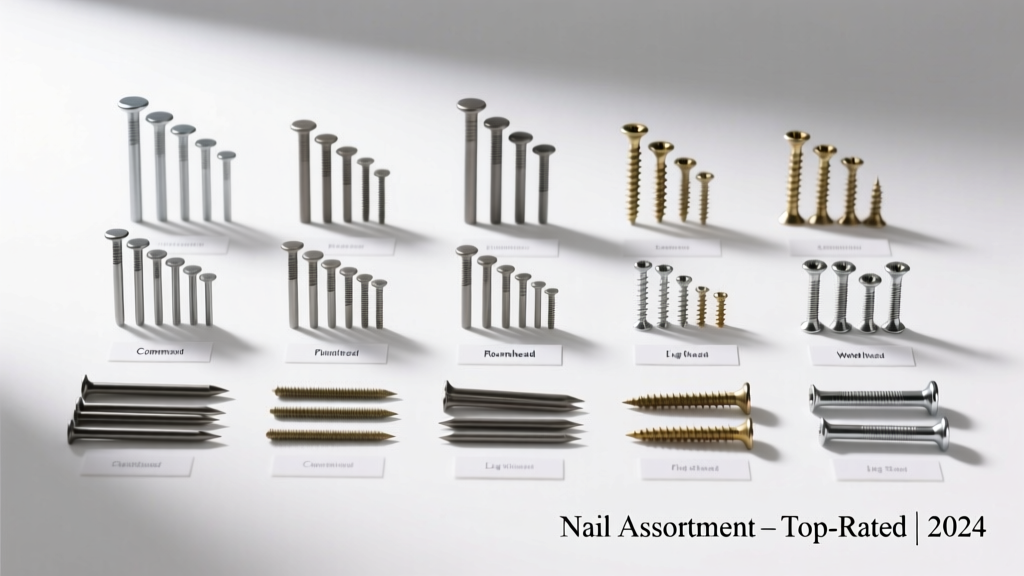
Most homeowners underestimate how much time—and frustration—goes into digging through mismatched nails in a junk drawer or buying single boxes for every minor repair. A well-chosen nail assortment saves trips to the hardware store, prevents bent nails from wrong material matches, and handles everything from hanging picture frames to securing fence pickets. Look for variety in length (1″ to 3″), shank type (smooth, ring, spiral), head style (common, finish, brad), and corrosion resistance—especially if you’ll use them outdoors or in humid areas like basements or garages.
Quick Comparison Table
| Product | Price Range | Best For | Key Feature |
|---|---|---|---|
| Stanley FatMax 1,000-Piece Kit | $22–$28 | General home repairs & light carpentry | Organized plastic tray with labeled compartments |
| DEWALT DWMT73906 1,200-Piece Set | $34–$42 | DIYers needing outdoor & interior versatility | Galvanized + vinyl-coated nails; includes roofing & masonry options |
| Irwin 500-Piece Finish & Brad Nail Pack | $18–$24 | Trim, molding, and furniture assembly | 18-gauge brads + 16-gauge finish nails; all in collated strips |
| Grip-Rite Multi-Use Assortment (800 pcs) | $26–$31 | Basement, garage, and workshop use | Mixed steel + electro-galvanized; heavy-duty common nails included |
Top Picks
Stanley FatMax 1,000-Piece Kit
Best for beginners and moderate DIYers who want reliable variety without overcomplicating their toolbox. Includes 12 nail types—from 16d common nails to 1″ brads—with smooth and ring-shank variants. All are hardened steel with bright finish (not galvanized), so avoid prolonged outdoor exposure.
- Pros: Clear compartment labeling, durable molded case, excellent value per nail (under $0.03 each)
- Cons: No corrosion-resistant options; brads are limited to 18-gauge only
Price range: $22–$28
DEWALT DWMT73906 1,200-Piece Set
Ideal for homeowners tackling decks, sheds, or basement framing where moisture resistance matters. Contains 300 galvanized common nails, 200 vinyl-coated sinkers, plus specialty fasteners like concrete nails and roofing spikes. The storage box has a hinged lid and nested trays—no loose bags to lose track of.
- Pros: Real outdoor-rated options, broad size range (1″ to 3½″), includes masonry-rated nails
- Cons: Slightly bulkier case; no finish nails for trim work
Price range: $34–$42
Irwin 500-Piece Finish & Brad Nail Pack
Perfect for anyone installing baseboards, crown molding, or assembling flat-pack furniture. All nails are collated in 100-nail strips compatible with most pneumatic brad and finish nailers (18-gauge brads, 16-gauge finish). Heads are polished and low-profile for minimal filling and sanding.
- Pros: Ready-to-load strips save time, high consistency across batches, ideal for clean indoor work
- Cons: Not suited for structural framing or exterior use; no common or roofing nails
Price range: $18–$24
What to Look For
A smart nail assortment balances breadth with intentionality—not just quantity. Start by auditing your most common tasks: hanging drywall? You’ll need drywall nails or screws (see our drywall screw guide). Building a garden box? Prioritize galvanized or stainless steel. Installing trim? Focus on finish and brad variety. Check for clear labeling on size (e.g., “2d” = 1″, “16d” = 3½″) and gauge (lower number = thicker shank).
- Material: Bright steel for indoor dry areas; electro-galvanized or hot-dipped galvanized for damp or exterior use
- Shank type: Smooth for general use; ring or spiral for higher withdrawal resistance (e.g., decking)
- Head style: Common for framing; finish for concealed work; clipped head for pneumatic tools
- Storage: Trays with dividers beat bulk bags—lost nails cost more long-term than organized packaging
Common Mistakes
Homeowners often buy assortments based solely on piece count, then discover half the nails don’t match their projects—or worse, they’re using bright steel nails in an unvented crawl space. Another frequent error is assuming all ‘16d’ nails are interchangeable: a 16d common nail (0.165″ diameter) differs significantly from a 16d sinker (0.148″) or a 16d box nail (0.135″), affecting holding power and splitting risk.
"Over 60% of framing nail failures in residential retrofits stem from using undersized or non-galvanized nails in moisture-prone zones—especially rim joists and ledger boards." — NAHB Remodeling Technical Guide, 2022
How many different nail types do I really need?
For most homes, four categories cover 90% of needs: common nails (framing), finish nails (trim), brads (light assembly), and roofing nails (shingles or underlayment). Add masonry nails only if you’re anchoring to concrete or brick. Skip specialty nails like upholstery or carpet tacks unless you have a dedicated project lined up.
Are coated nails worth the extra cost?
Yes—if moisture is present. Vinyl-coated nails resist rust longer than bright steel and drive smoother than galvanized, but they’re not rated for direct soil contact. Hot-dipped galvanized nails cost ~25% more but last 3–5× longer in wet conditions, per the Galvanized Fastener Institute’s 2023 field study.
Can I mix nail brands in the same project?
You can—but don’t mix shank types or coatings in load-bearing connections. For example, pairing smooth-shank common nails with ring-shank nails in the same ledger board attachment creates uneven stress distribution. Stick to one brand and spec for critical structural work.
Do I need both 16-gauge and 18-gauge finish nails?
Yes, if you’re doing varied trim work. Use 16-gauge (0.0625″) for baseboards and door casings where holding power matters; reserve 18-gauge (0.0475″) for delicate moldings, picture frames, or thin veneers where splitting is a concern.
Why do some assortments include ‘sinkers’ instead of ‘common’ nails?
Sinkers have thinner shanks and textured coatings that reduce bending and improve grip in softwood—making them easier to drive by hand or with lower-powered tools. They’re standard for interior framing today, while common nails remain preferred for heavy timber or shear-wall applications.
Is it better to buy pre-sorted assortments or bulk bins?
Pre-sorted wins for home use. Bulk bins tempt with volume, but without labeling or organization, you’ll waste time measuring, sorting, and second-guessing. A $25 tray-based kit pays for itself after three avoided hardware store trips—and prevents misfires from using a 3″ nail where a 1¼″ was needed.
Ultimately, the right nail assortment isn’t about owning every size—it’s about having the right ones, ready when you need them. Match your kit to your actual workload, prioritize corrosion resistance where it counts, and keep it in a dry, accessible spot near your other hand tools. That way, the next time a shelf sags or a hinge loosens, you’ll grab what works—not what’s left over.