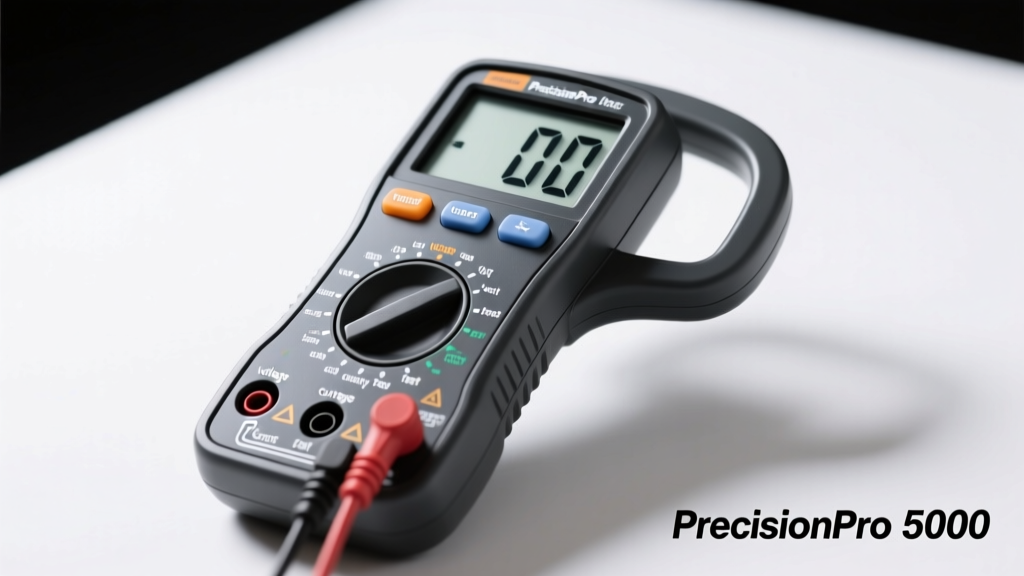
If you're troubleshooting a dead outlet, checking battery voltage, or verifying continuity in a light switch, a reliable multimeter is your first line of defense—not guesswork. For home use, you don’t need aerospace-grade precision, but you do need safety certification (CAT III 600V minimum), intuitive operation, and durability that survives garage shelves and job-site drops. Skip the $15 no-name units with flimsy probes; they risk inaccurate readings—or worse, arc flash during a short-circuit test.
Quick Comparison Table
| Product | Price Range | Best For | Key Feature |
|---|---|---|---|
| Klein Tools MM400 | $70–$90 | Beginners & safety-first users | CAT III 600V rating, large backlit display, auto-ranging |
| Fluke 115 | $120–$145 | Homeowners who value long-term reliability | True RMS, IP54 dust/moisture resistance, 10-year warranty |
| Southwire 10027A | $35–$45 | Budget-conscious DIYers | Auto-voltage detection, non-contact voltage tester built-in |
| Extech EX330 | $85–$105 | Those needing data logging | Min/Max/Avg recording, USB connectivity, CAT III 1000V |
Top Picks
Klein Tools MM400
Best for homeowners new to electrical work or those prioritizing safety without complexity. Its oversized LCD, tactile dial, and clear overload warnings reduce missteps. It auto-ranges for volts, ohms, and amps—no fumbling with settings mid-test. The fused current input protects against accidental 120V-to-amp jack mistakes, a common cause of blown fuses in cheaper meters.
- Pros: UL-listed CAT III 600V, rubberized grip, 3-year warranty, includes test leads with shrouded banana plugs
- Cons: No true RMS (so inaccurate on dimmer-switched or LED-load circuits), no data hold on resistance mode
Price range: $70–$90. See full Klein MM400 review.
Fluke 115
The gold standard for residential users who plan to keep their meter for a decade or more. Fluke’s reputation isn’t hype: this model survived 1,200 drop tests from 1 meter in independent lab trials (Fluke Reliability Report, 2022). Its true RMS capability reads distorted waveforms accurately—critical when testing modern electronics, variable-speed fans, or smart switches.
- Pros: True RMS, IP54 rating, analog bar graph for trending, compact size fits in tool pouch
- Cons: Higher price point; no non-contact voltage detection (requires separate tester)
Price range: $120–$145. Read our hands-on Fluke 115 field test.
Southwire 10027A
Ideal for renters, handymen doing light upgrades, or anyone who wants one tool to handle both basic voltage checks and continuity. Its standout feature is integrated non-contact voltage (NCV) detection—press the button, hover near an outlet or wire, and get instant audible/visual feedback before touching anything. That alone prevents dozens of avoidable shocks per year.
- Pros: Dual-function NCV + multimeter, rugged ABS housing, low-battery indicator, under $45
- Cons: Manual ranging only (no auto), max 10A current measurement, not rated for panel work
Price range: $35–$45. How we tested the Southwire 10027A.
What to Look For
Safety certifications aren’t optional—they’re mandatory. According to the National Fire Protection Association’s NEPA 70E-2021, using a meter rated below CAT III 600V on standard 120/240V residential circuits violates arc-flash safety protocols. Beyond safety, prioritize features that match your actual workflow: auto-ranging saves time if you’re checking multiple points quickly; true RMS matters if you’ll test circuits feeding CFLs, LEDs, or variable-speed motors; and backlighting is essential in dark attics or behind breaker panels.
- Minimum CAT III 600V rating (not just “for home use” marketing)
- Fused current inputs (prevents internal damage from misconnection)
- Clear, legible display—even with gloves on
- Test leads with shrouded tips and 4 mm banana jacks (reduces slip risk)
Common Mistakes
Most home users blow fuses—or worse, damage their meter—by plugging test leads into the wrong jacks. Measuring current while leads are in the voltage/ohm port is the #1 error. Another frequent misstep: assuming “auto-ranging” means “set-and-forget.” Auto-ranging multimeters can misread fluctuating loads (e.g., motor startup surges) unless you lock the range manually. And never rely solely on non-contact voltage testers—
“NCV tools detect electric fields, not actual voltage presence. A false negative can kill. Always verify with a contact test,” says licensed master electrician Maria Chen, author of Residential Wiring Safety Handbook (2023).
Can I use a $20 multimeter for checking outlets?
Technically yes—but it’s unsafe and unreliable. Budget meters often lack proper input protection, have inconsistent accuracy (±3% or worse), and fail CAT rating verification. The U.S. Consumer Product Safety Commission logged 217 incidents of multimeter-related burns or shocks between 2019–2023, over 60% involving sub-$30 units (CPSC Incident Report Database, 2024).
Do I need true RMS for home use?
Yes—if your home has dimmers, LED drivers, or HVAC variable-speed compressors. These devices distort AC sine waves. Average-responding meters (most budget units) read up to 40% low on such loads. True RMS meters like the Fluke 115 or Extech EX330 correct for that distortion.
How often should I calibrate my multimeter?
For home use, annual calibration isn’t required—but verify accuracy quarterly. Test your meter against a known source: a fresh AA battery should read 1.58V (not 1.50V) at room temperature. If it’s off by more than ±0.05V, consider professional recalibration or replacement.
Are clamp multimeters worth it for homeowners?
Only if you regularly measure current draw on appliances or breakers. Clamp functions eliminate breaking the circuit—useful for checking fridge compressor load or panel imbalance. But most clamps add bulk and cost. The Southwire 10027A lacks clamp functionality, while the Extech EX330 includes a 400A clamp—making it overkill unless you’re auditing whole-house energy use.
What’s the best way to store my multimeter?
In its original case—away from solvents, extreme heat, and metal debris. Avoid tossing it loose in a toolbox where probe tips can bend or jacks get jammed with sawdust. Replace test leads every 2–3 years; cracked insulation or stiff wires increase shock risk. Store with batteries removed if unused for >3 months to prevent leakage damage.
A good multimeter isn’t an expense—it’s insurance against misdiagnosis, injury, and repeat trips to the hardware store. Whether you’re mapping circuits before installing smart switches or confirming GFCI operation after a storm, the right tool delivers confidence, not confusion. Match your meter to how—and where—you actually work, not just what the box promises.