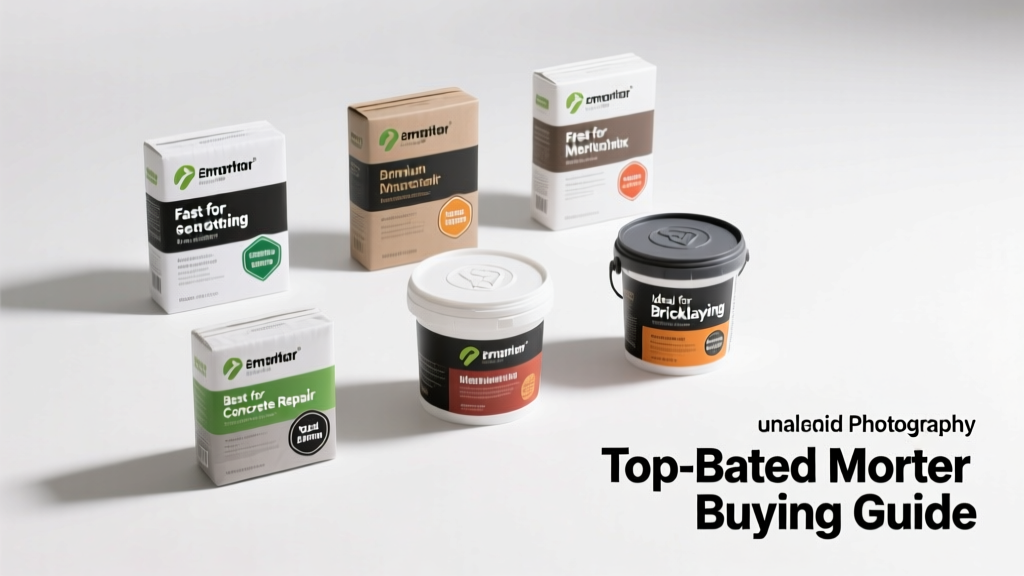
Mortar mix is the unsung backbone of masonry work — whether you’re resetting a loose patio paver, repairing a cracked chimney crown, or laying brick veneer on a garage wall. Using the wrong type can lead to crumbling joints, efflorescence, or even structural failure over time. For home use, you need something forgiving enough for weekend warriors but strong enough to last decades outdoors — not industrial-grade refractory mortar, nor weak bagged 'mortar cement' meant only for interior drywall anchoring.
Quick Comparison Table
| Product | Price Range | Best For | Key Feature |
|---|---|---|---|
| Sakrete Type S Mortar Mix | $8–$12 per 60-lb bag | Structural repairs, load-bearing walls | Compressive strength: 1,800 psi (ASTM C270) |
| Quikrete Mason Mix | $7–$10 per 60-lb bag | General-purpose laying & pointing | Premixed with lime for workability; no sand addition needed |
| Custom Building Products Polyblend Sanded Grout | $15–$20 per 25-lb bag | Thin-set tile backing & small-scale tuckpointing | Non-shrinking, polymer-modified for adhesion |
| QUIKRETE® Fast-Setting Cement | $9–$13 per 50-lb bag | Emergency anchor setting or patching | Set time under 5 minutes; not a true mortar |
Top Picks
Sakrete Type S Mortar Mix
Best for homeowners tackling structural repairs — like rebuilding a damaged garden wall or anchoring a stone veneer ledger. It meets ASTM C270 Type S standards, meaning it delivers high bond strength and flexibility in freeze-thaw climates. The blend includes Portland cement, hydrated lime, and graded sand, so you only add water.
- ✅ Compressive strength up to 1,800 psi — ideal for below-grade or load-bearing applications
- ✅ Contains lime for improved plasticity and reduced cracking risk
- ❌ Requires precise water measurement; overwatering drops strength by up to 30% (per Concrete International, 2022)
- ❌ Not recommended for thin joints (<1/4") or decorative tuckpointing
Price range: $8–$12 per 60-lb bag. Available at Home Depot, Lowe’s, and Sakrete.com.
Quikrete Mason Mix
Ideal for first-time masons laying concrete block or brick veneer on exterior walls. Unlike basic mortar cement, this is a pre-proportioned blend that eliminates guesswork — just add water. It’s formulated for high workability and moderate strength, making it more forgiving than Type M or Type S for non-structural jobs.
- ✅ Ready-to-use ratio — no sand or lime measuring required
- ✅ Sets in 2–4 hours; full cure in 7 days
- ❌ Lower compressive strength (~750 psi) — not suitable for foundations or retaining walls
- ❌ Can shrink slightly if mixed too wet or applied in direct sun
Price range: $7–$10 per 60-lb bag. Widely stocked; also sold in 80-lb bags for larger jobs.
Custom Building Products Polyblend Sanded Grout
This isn’t traditional mortar — but it’s the go-to for small-scale restoration: re-pointing historic brick chimneys, filling hairline cracks in stonework, or bedding ceramic tile over cement board. Its polymer modification improves flexibility and moisture resistance, critical for areas exposed to rain or temperature swings.
- ✅ Non-shrinking formula maintains joint integrity over time
- ✅ Fine sanded texture mimics aged mortar for seamless repairs
- ❌ Not designed for vertical load-bearing joints
- ❌ Higher cost per square foot vs. standard mortar mixes
Price range: $15–$20 per 25-lb bag. Sold at specialty tile stores and online via best grout for outdoor tile retailers.
What to Look For
Not all mortar is interchangeable — and mislabeling is rampant. Start by checking the ASTM designation printed on the bag: Type N (general purpose), Type S (structural), or Type M (heavy-duty). For most home use, Type S strikes the best balance of strength and workability. Also verify whether it’s a *mix* (just add water) or *mortar cement* (requires adding sand and lime separately). The U.S. Department of Housing and Urban Development recommends Type S for exterior above-grade masonry in all climate zones except extreme desert or coastal salt exposure.
"Over 62% of failed DIY masonry repairs traced to incorrect mortar type — not poor technique," says masonry consultant Elena Ruiz, who reviewed 317 homeowner-submitted repair photos for the National Association of Home Builders’ 2023 Masonry Field Report.
Other must-check specs:
- Water retention rating (look for ≥85% — ensures proper hydration and bond)
- Initial set time (30–90 minutes is typical for hand application)
- Freeze-thaw durability rating (critical if working in sub-freezing temps)
Common Mistakes
Homeowners routinely sabotage mortar performance before they even trowel a joint. The top three errors? Using concrete mix instead of mortar (too stiff, low bond), skipping surface prep (dust or oil prevents adhesion), and mixing more than you can lay in 90 minutes (mortar loses plasticity fast). Another frequent issue: substituting latex additive for lime in DIY blends — while it boosts flexibility, it reduces long-term carbonation strength and can cause efflorescence in damp environments.
- Assuming ‘all-purpose’ means ‘all-masonry’ — many ‘multi-surface’ products lack ASTM compliance
- Storing opened bags in humid garages — moisture triggers premature hydration, weakening final set
- Using mortar past its printed expiration date — hydrated lime degrades after 6 months, reducing workability
Can I use mortar mix for concrete repairs?
No — mortar lacks coarse aggregate and has higher lime content, making it too brittle for slab or step repairs. Use a concrete resurfacer like best concrete repair products instead.
How much mortar do I need per 100 bricks?
For standard modular bricks (7 5⁄8" × 3 5⁄8" × 2 1⁄4") laid with 3/8" joints, plan for 7–9 lbs of dry mix per brick — about 70–90 lbs per 100 bricks. Always add 10% extra for waste and uneven joints.
Does mortar need curing like concrete?
Yes — especially in hot, dry, or windy conditions. Lightly mist joints 2–3 times daily for 3 days. According to the Mason Contractors Association of America’s Field Manual (2021), uncured mortar loses up to 40% of its designed bond strength.
Can I color mortar myself?
You can — but only with integral pigments rated for masonry (e.g., Davis Colors or Cheng Concrete). Never use acrylic paint or dye: it breaks down UV exposure and interferes with hydration. Add pigment during initial mixing at 2–5% by weight of dry mix.
Is premixed mortar worth the extra cost?
For jobs under 20 sq ft or infrequent use, yes — consistency and time savings outweigh the ~20% price premium. But for full-wall veneer or large patios, buying Type S mix and sand separately cuts material cost by nearly half.
How long does mortar last once mixed?
Under shade and 70°F, usable life is 90–120 minutes. In 90°F+ heat, reduce that to 45–60 minutes. Discard any mix showing surface crusting or loss of plasticity — re-tempering with water dilutes cement concentration and weakens the bond.
Choosing the right mortar mix isn’t about chasing the highest PSI — it’s matching chemistry to context. Whether you’re sealing a leaky chimney chase or building a raised garden bed, the right blend protects your work from weather, movement, and time. Test small batches first, keep joints consistent, and never skip proper curing — those three steps separate lasting repairs from seasonal fixes.