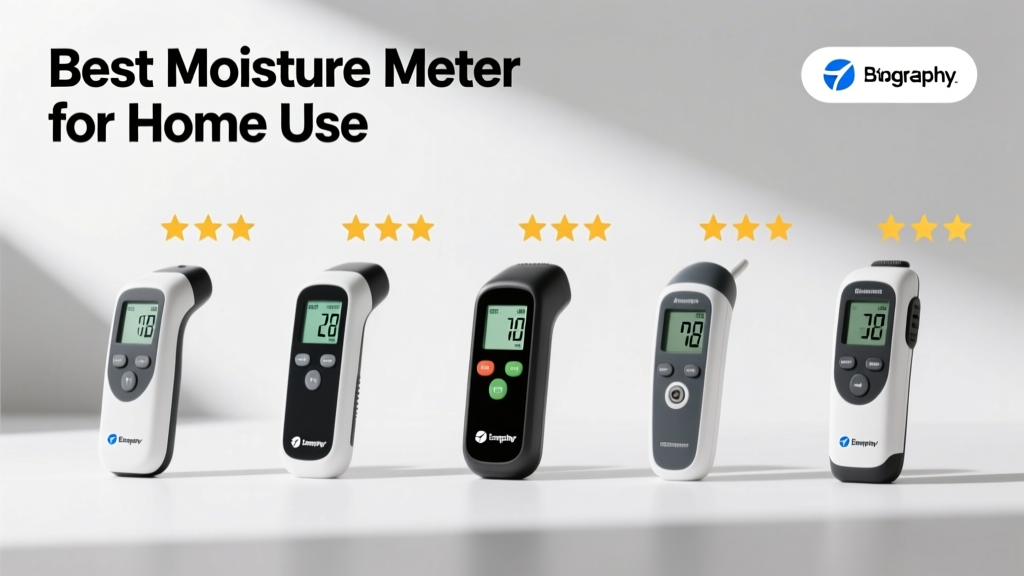
Moisture meters aren’t just for contractors — they’re essential for homeowners spotting early water damage, checking insulation integrity, or verifying drywall is safe to paint after a leak. A false reading can mean missing mold growth behind baseboards or over-drying hardwood before refinishing. The right tool gives you confidence before you cut into drywall or call a plumber.
Quick Comparison Table
| Product | Price Range | Best For | Key Feature |
|---|---|---|---|
| Protimeter Surveymaster | $250–$320 | Home inspectors & serious DIYers | Dual-mode (pin + pinless) with depth-adjustable scanning |
| General Tools MM100 | $45–$65 | First-time buyers & basic wall checks | Pin-type with wood/drywall calibration modes |
| Extech MO250 | $120–$150 | Renovators working with subfloors & framing | Pinless mode up to 3/4" depth; built-in temperature compensation |
| Delmhorst BD-2100 | $180–$220 | Hardwood floor installers & restorers | Calibrated for 30+ wood species; replaceable pins |
Top Picks
Protimeter Surveymaster SM250
This dual-mode meter combines pin-depth measurement with non-invasive scanning — ideal when you need to verify whether a ceiling stain is surface condensation or active roof leak intrusion. It’s calibrated to BS 8221-1 standards and includes a built-in hygrometer to calculate dew point on-site.
- Pros: Accurate across drywall, plaster, and OSB; data logging via Bluetooth app; rugged IP54 rating
- Cons: Steeper learning curve; requires regular electrode cleaning
Price range: $250–$320. Best for homeowners managing recurring moisture issues or pre-purchase home inspections. How to calibrate a moisture meter matters most with this model.
General Tools MM100
A no-frills pin-type meter that delivers reliable readings in wood studs and drywall — without confusing menus or app dependencies. Its two preset scales (wood and drywall/concrete) reduce user error, and the bright LED backlight works in dim basements or attics.
- Pros: Under $50; battery life exceeds 200 hours; simple zero-adjust dial
- Cons: No depth control; not suitable for finished hardwood or tile
Price range: $45–$65. Best for renters checking for hidden leaks before lease renewal or first-time homeowners assessing basement walls.
Extech MO250
If your project involves subfloor moisture checks before installing engineered wood or LVP, the MO250’s 3/4-inch pinless scan depth and automatic temperature compensation prevent false lows in cold garages or crawlspaces. Its auto-hold function freezes readings mid-scan — useful when reaching behind toilets or cabinets.
- Pros: Reads through thin vinyl or carpet underlayment; NIST-traceable calibration certificate included
- Cons: Pinless mode less accurate on uneven surfaces; no species-specific wood settings
Price range: $120–$150. Ideal for DIYers replacing flooring or evaluating attic insulation moisture retention. See our guide on how to test subfloor moisture for proper technique.
What to Look For
Not all moisture meters measure the same thing — or measure it accurately in your home’s materials. Start by identifying your primary use case: Is it checking stud cavities behind drywall? Verifying kiln-dried lumber before building a shed? Or confirming concrete slab readiness before tiling?
- Measurement range: Drywall reads 0–25% MC (moisture content); concrete needs 0–4% RH (relative humidity) or %W/W scale — don’t rely on wood-only meters for slabs
- Calibration options: Look for units with user-accessible calibration checks — like the Delmhorst BD-2100’s built-in verification block
- Material-specific settings: Meters with >10 wood species presets (e.g., oak vs. pine) reduce errors of up to 7% in dense hardwoods (Wood Science and Engineering Lab, Oregon State University, 2022)
Common Mistakes
Homeowners often misinterpret readings because they skip basic prep. One frequent error is testing painted or sealed drywall — the coating blocks pin penetration and skews pinless scans. Another is assuming “safe” means “zero”: According to the U.S. EPA, wood at 15–19% MC is still structurally sound but supports mold spore germination within 48 hours if unchecked.
“A reading above 16% in framing lumber isn’t automatically a repair trigger — but it *is* a signal to investigate source, airflow, and thermal bridging. Context matters more than the number.” — Dr. Lena Cho, Building Science Advisor, IBHS, 2023
Can I use a moisture meter on tile or vinyl flooring?
Yes — but only with a true pinless meter (like the Extech MO250) set to the correct density mode. Pin-type meters will scratch grout lines or puncture luxury vinyl. Always scan multiple points: Tile adhesive failures often show as localized hotspots, not uniform readings.
Why does my meter give different readings on the same spot?
Temperature, surface dust, and battery level all affect accuracy. Low batteries can cause drift of ±3% MC. Let the meter acclimate for 15 minutes in the room before use, and wipe sensor plates with isopropyl alcohol between readings — especially after testing dusty crawlspaces.
Do I need separate meters for wood and concrete?
Not necessarily — but you do need a meter with appropriate scales. Dual-scale models like the Protimeter Surveymaster include both %MC (wood/drywall) and %RH (concrete) modes. Using a wood-only meter on a slab risks false negatives: Concrete at 85% RH may read “dry” on a wood scale, yet still cause adhesive failure.
How deep can pinless meters really scan?
Most consumer-grade pinless meters max out at 3/4 inch — enough for 1/2" drywall or 3/4" subfloor, but not for double-stud walls or thick stucco. Depth claims assume uniform density; embedded wires, pipes, or lath reduce effective depth by 30–50%. Always cross-check with pin mode where accessible.
Is there a moisture meter that detects mold directly?
No — and any product claiming to “detect mold” is misleading. Moisture meters identify conditions favorable for mold (≥16% MC in organic material), but lab testing or visual inspection confirms presence. As the CDC states in its 2021 Guidelines for Mold Remediation, “Moisture is necessary but not sufficient evidence of active growth.”
How often should I recalibrate my moisture meter?
Before each use if working on critical projects (e.g., post-flood assessment). For routine checks, verify calibration weekly using the manufacturer’s reference block or known-dry sample. Pin-type meters lose accuracy fastest — replace pins every 6–12 months if used daily. Moisture meter maintenance tips extend usable life by 3+ years.
Choosing the right moisture meter isn’t about chasing specs — it’s about matching capability to your home’s materials and your tolerance for uncertainty. A $45 pin meter stops guesswork behind bathroom walls; a $300 dual-mode unit helps you avoid costly callbacks during a whole-house renovation. Either way, catching moisture early saves far more than the meter costs — in repairs, health, and peace of mind.