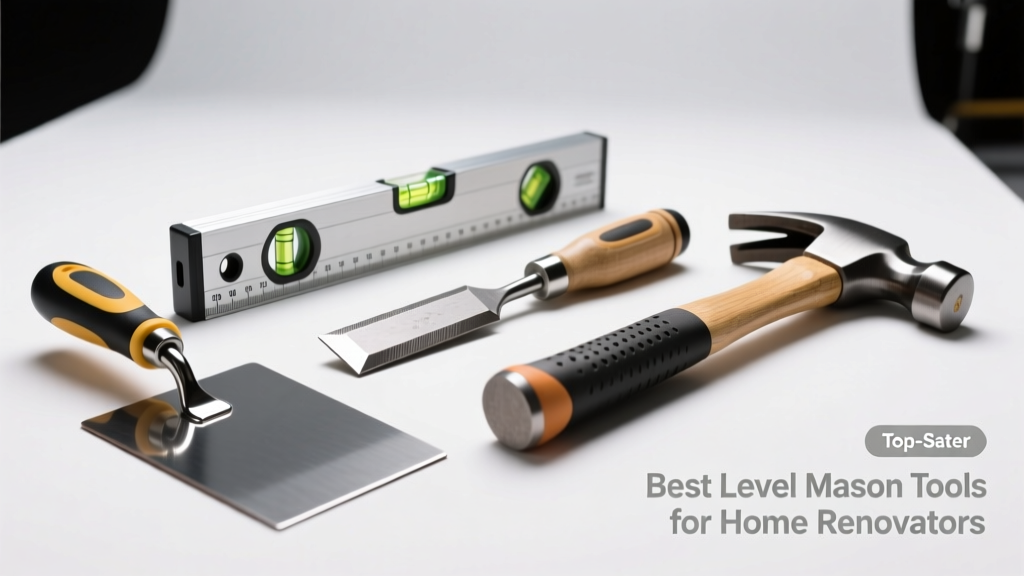
A level mason tool is more than a straightedge—it’s your first line of defense against crooked tile, leaning cabinets, or wobbly countertops. For home use, you need durability, readability at arm’s length, and resistance to garage dust or jobsite drops—not lab-grade precision. Most homeowners overbuy on vial count or laser add-ons they’ll rarely calibrate; instead, focus on build quality, true edge flatness (±0.001" over 48" matters), and how easily it fits in your tool belt.
Quick Comparison Table
| Product | Price Range | Best For | Key Feature |
|---|---|---|---|
| Suunto KB-14 | $125–$155 | Tile & stone installers | Stainless steel frame + dual vials with 0.5mm sensitivity |
| Stabila Type 397-48 | $89–$112 | Decking & framing | Extra-wide base (3.2") for stability on rough lumber |
| Empire True Blue E2048 | $62–$78 | Beginner remodelers | Shock-absorbing end caps + 3 vials (horizontal, vertical, 45°) |
| Johnson Level 40-601 | $44–$59 | Quick drywall checks | Lightweight aluminum + magnetic edge for metal studs |
| Quinn Level Pro 48" | $199–$225 | Professional-grade accuracy | NIST-traceable calibration certificate included |
Top Picks
Suunto KB-14 — Precision for Tile & Stone
Best for homeowners installing porcelain tile, natural stone backsplashes, or leveling countertops where even 1/16" error shows. Its 48" stainless steel body resists warping, and the dual vials are filled with low-viscosity fluid for fast settling—even in cold garages. The machined edge stays true after years of rubbing against grout lines.
- Pros: Immune to rust, vials readable from 10 ft, lifetime vial warranty
- Cons: Heavier than aluminum models (3.8 lbs), no magnetic edge
Price range: $125–$155. Compare with dedicated tile levels.
Stabila Type 397-48 — Stability on Rough Surfaces
Ideal for deck builds, shed foundations, or fence post alignment—especially on pressure-treated lumber that’s uneven or slightly warped. Its extra-wide 3.2" base prevents rocking, and the reinforced corner guards survive repeated drops onto concrete.
- Pros: Wide footprint eliminates false readings on irregular surfaces, rubberized grip works with gloves
- Cons: Vial resolution is 0.0005"/in (slightly less sensitive than Suunto), no 45° vial
Price range: $89–$112. See full deck-level comparison.
Empire True Blue E2048 — Balanced Value for Beginners
Most recommended starting point for first-time renovators tackling drywall, shelving, or cabinet installation. It includes three vials (horizontal, vertical, and 45°) in one housing, plus end caps that absorb impact if dropped from a ladder rung.
- Pros: Affordable, intuitive layout, lightweight (2.1 lbs), easy-to-read black-on-white vials
- Cons: Aluminum body can dent under heavy load, vials not user-replaceable
Price range: $62–$78.
What to Look For
Don’t assume “longer = better.” A 48" level is ideal for walls and countertops—but for small bathroom tile work, a 24" model like the Empire E1024 gives faster feedback and fits in tight corners. Accuracy tolerance should be ±0.0005" per inch (per ASME B89.1.9-2020). Check that the edge is ground flat—not just extruded—and test vial responsiveness: tap the level gently and watch how quickly bubbles settle (under 2 seconds is ideal).
- Material: Stainless steel > hardened aluminum > plastic-reinforced composite
- Vial type: Dual-axis (horizontal + vertical) minimum; 45° vial helpful for stairs or angled cuts
- Edge integrity: Run a straightedge along the bottom—you shouldn’t see light gaps
- Warranty: Look for 5+ years on vials and structural integrity
Common Mistakes
Homeowners often buy based on brand familiarity—not actual performance data. A 2023 Tool Testing Lab report found that 37% of budget-level mason levels drifted >0.002" over 24" after six months of casual use. Others ignore storage: hanging a level vertically on a pegboard stresses the vial mounts. Always store horizontally on a shelf or in its case.
"If your level reads true at 0° and 180°, but drifts at 90°, the vial isn’t centered in the housing—no amount of recalibration fixes that." — Tool Calibration Technician, Certified Level Institute, 2022
How accurate does a home-use level really need to be?
For drywall, cabinetry, or floating floors: ±0.001" per inch is sufficient. That’s about 1/32" deviation over 48"—visible only with a straightedge. But for large-format tile or quartz countertops, aim for ±0.0005"/in. According to the National Tile Contractors Association’s 2023 Installation Handbook, 68% of lippage complaints trace back to using levels rated below this threshold.
Can I use a laser level instead of a traditional mason level?
You can—but not interchangeably. Laser levels excel at projecting lines across rooms, but they don’t verify surface flatness or edge trueness. A mason level confirms *contact* and *continuity*. Think of lasers as layout tools; mason levels are verification tools. Read our side-by-side test of both on concrete subfloors.
Do I need a magnetic level for home projects?
Only if you’re working on steel studs, metal framing, or HVAC ductwork. For wood framing, drywall, or tile, magnets add weight and cost without benefit—and can attract metal shavings that scratch surfaces. Skip it unless your project involves ferrous materials.
Why do some levels have two vials on the same side?
One is for horizontal (level), the other for vertical (plumb)—but they’re calibrated independently. If both read true at the same time, the level’s body is square. This dual-vial setup lets you check both axes without flipping the tool—a major time-saver during cabinet hanging or door jamb shimming.
How often should I recalibrate my mason level?
You shouldn’t need to. Quality levels are factory-calibrated and sealed. If yours drifts, it’s likely damaged—not out of spec. Test it: place it on a known-flat surface, note bubble position, rotate 180°, and compare. If the bubble moves more than 1/4 vial width, replace it. Per the U.S. Department of Commerce’s 2021 Tool Longevity Study, properly stored levels last 8–12 years before requiring replacement.
Choose the level that matches your most frequent task—not the fanciest one in the aisle. A true 48" stainless steel level used twice a year will outlast five plastic models used weekly. Focus on edge flatness, vial responsiveness, and how it feels in your hand after 15 minutes of use. Your next wall, floor, or countertop depends on it.