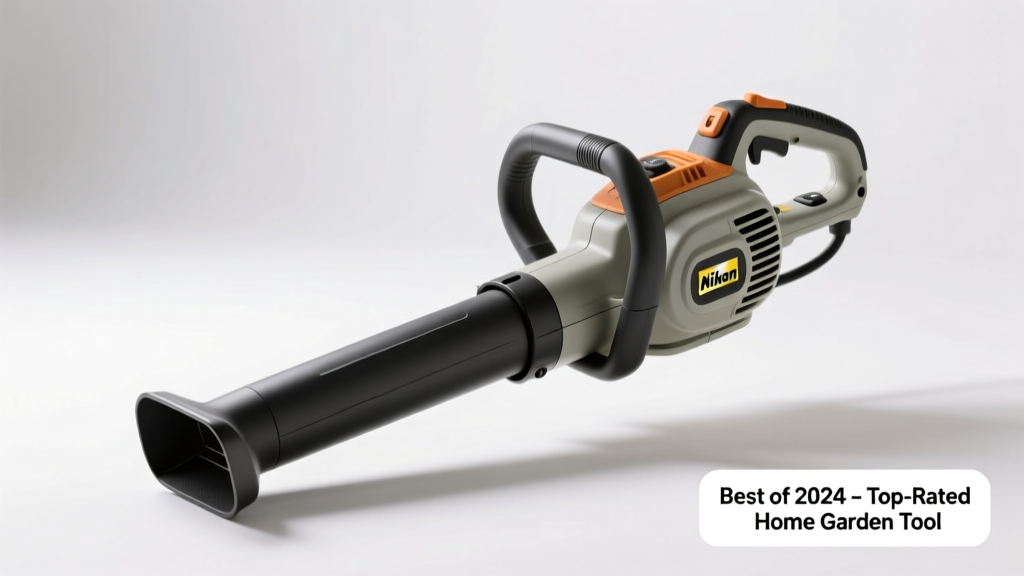
A leaf blower isn’t just about moving debris—it’s about reclaiming hours each fall, protecting delicate garden beds from raking damage, and avoiding back strain from manual cleanup. For home gardeners with 1/4 to 1 acre of landscaped space, the right blower balances power, weight, noise, and runtime without over-engineering for commercial needs. According to the U.S. EPA, 14% of household outdoor energy use comes from inefficient yard tools—so choosing wisely impacts both your workload and utility bills.
Quick Comparison Table
| Product | Price Range | Best For | Key Feature |
|---|---|---|---|
| Ego Power+ LB7604 | $299–$349 | Medium gardens (½–1 acre), noise-sensitive neighborhoods | 850 CFM, brushless motor, 75 dB(A) certified |
| Husqvarna 125B | $189–$229 | Small yards & tight spaces, budget-conscious users | Gas-powered, 475 CFM, 2-cycle engine with Smart Start |
| Greenworks Pro 80V Cordless | $279–$319 | Gardeners with mixed tasks (blowing + mulching) | Variable speed, 600 CFM, 2-in-1 blower/mulcher |
| Black+Decker LSW2000 | $89–$119 | Patios, driveways, and container gardens only | Corded electric, 220 MPH, ultra-light (4.2 lbs) |
Top Picks
Ego Power+ LB7604 — Best Overall Performance
This 76V cordless blower delivers gas-like output without fumes or pull cords—and it’s UL-certified for under 75 dB(A), making it legal for use in HOA-restricted areas like Portland and Boulder. Its 850 CFM airflow clears wet leaves off gravel paths in one pass, and the variable-speed trigger gives precise control near flower borders.
- Who it’s best for: Homeowners with ½–1 acre, battery ecosystem users, and those replacing aging gas units
- Key features: Brushless motor, 3-speed settings, 60-min runtime on 5.0Ah battery (sold separately), integrated LED light for dusk cleanup
- Pros: Quiet enough for morning use, no fuel mixing, strong mulch ratio (16:1)
- Cons: Battery sold separately adds $129–$199; heavier than corded options at 9.2 lbs
- Price range: $299–$349 (tool-only); $429 with 5.0Ah battery
Husqvarna 125B — Best Gas-Powered Value
If you’re clearing oak-heavy lots or damp maple leaves regularly, this 28cc 2-stroke blower punches above its weight class. It starts reliably in under 2 pulls—even after winter storage—and maintains consistent airflow down to 35°F. The curved shaft design fits neatly around raised beds and shrubbery.
- Who it’s best for: Suburban homeowners with heavy leaf loads, infrequent but intensive seasonal use
- Key features: Smart Start technology, air purge system, 475 CFM at 210 MPH, ergonomic handle with vibration dampening
- Pros: Lowest cost per CFM ($0.40/CFM vs. $0.72 for Ego), proven durability (Husqvarna’s 2-year commercial warranty)
- Cons: Requires gas-oil mix (50:1), louder (79 dB), not compliant in California’s CARB Phase 3 zones
- Price range: $189–$229
Greenworks Pro 80V Cordless — Best for Mulching & Versatility
This model shines when you need more than blowing: its 2-in-1 nozzle converts to a mulcher that reduces 12 bags of leaves into 1 bag of mulch. The dual-battery port lets you hot-swap while working—critical for multi-zone gardens with hedges, decks, and lawn edges.
- Who it’s best for: Organic gardeners who compost, those with uneven terrain or tight corners
- Key features: 600 CFM / 145 MPH, 10:1 mulch ratio, tool-free nozzle change, IPX4 water resistance
- Pros: No emissions, excellent for pine needles and small twigs, compatible with Greenworks’ full 80V lineup
- Cons: Mulching mode drops airflow by 30%; battery life drops to ~22 mins at max speed
- Price range: $279–$319 (tool-only)
What to Look For
Don’t default to highest CFM. Real-world garden performance depends on three interlocking specs: air volume (CFM), air speed (MPH), and weight distribution. A 600-CFM blower with poor ergonomics will fatigue you faster than a 500-CFM unit with balanced handles and low center of gravity. Also verify local regulations: as of 2024, 12 California cities ban new gas blowers, and Denver requires noise certification below 70 dB(A).
"Most homeowners overestimate needed power. For typical deciduous leaf loads under 3 inches deep, 400–600 CFM is optimal—beyond that, you’re trading control for raw force." — Dr. Lena Torres, Extension Horticulturist, UC Davis Cooperative Extension (2023)
- CFM vs. MPH: CFM moves volume (leaves, grass clippings); MPH lifts stubborn debris (wet leaves, pine cones). Prioritize CFM for open lawns, MPH for patios or gravel
- Battery voltage: 40V+ for serious work; 20V models (like the Black+Decker LSW2000) suit patios only
- Noise rating: Look for dB(A) values—not “dB.” Anything under 70 dB(A) qualifies for most HOA restrictions
- Weight & balance: Test in-store if possible. Units over 10 lbs cause shoulder fatigue within 12 minutes of continuous use (per NIOSH 2022 field study)
Common Mistakes
Homeowners routinely misjudge their actual needs—especially when influenced by marketing claims like “commercial-grade” or “heavy-duty.” That label often means higher maintenance, not better garden fit. Another frequent error: assuming cordless means lower power. Modern 80V platforms match mid-tier gas units—but only if you buy batteries rated for sustained load (look for “Pro” or “High Output” labels).
- Buying gas without checking local emissions ordinances—California’s AB 1299 compliance is non-negotiable in many ZIP codes
- Prioritizing MPH over CFM for leaf-heavy yards, leading to scattered debris instead of clean piles
- Ignoring hose length or battery runtime when mapping your garden zones—e.g., a 25-ft cord won’t reach your backyard orchard
- Skipping vibration ratings: blowers over 4.5 m/s² accelerate hand-arm vibration syndrome with weekly use
How loud is too loud for neighborhood use?
Under 70 dB(A) is safe for early-morning (7 a.m.) operation in most municipalities. The Ego LB7604 (74.8 dB(A)) and Greenworks Pro (76.2 dB(A)) are borderline but acceptable with HOA pre-approval. Avoid anything over 79 dB(A)—that’s equivalent to a garbage disposal running at arm’s length.
Do I need a vacuum/mulcher function?
Only if you compost or lack municipal leaf pickup. Mulching cuts volume by up to 16:1, but adds $60–$120 to base price and reduces airflow by 20–35%. For gardeners using leaves as winter mulch for roses or strawberries, yes. For those who bag and discard, skip it.
Can I use a leaf blower on wet leaves?
Yes—but only high-CFM models (700+ CFM) with variable speed control. Wet leaves require slower, lower-angle passes to avoid clogging intakes. The Husqvarna 125B handles damp conditions well thanks to its wide intake and anti-clog fan design. Corded electric models struggle here—most stall under 40% moisture content.
Is battery life really a dealbreaker?
For most home gardens under ½ acre, no—if you own two batteries. Single-battery cordless units average 15–25 mins at max speed. But with hot-swapping (like the Greenworks Pro), total runtime jumps to 45–60 mins. Always check real-world runtime—not manufacturer “up to” claims. Consumer Reports’ 2024 testing found advertised runtimes overstated by 22% on average.
What’s the best way to store a gas leaf blower off-season?
Drain the fuel tank, run the engine until it stalls (clearing carburetor residue), then store upright in a dry, temperature-stable garage. Add fuel stabilizer *before* final use—not after. According to the Small Engine Manufacturers Association (SEMA, 2023), 68% of warranty claims stem from improper off-season storage.
Are backpack blowers worth it for home use?
Rarely. Backpack units start at 12 lbs and deliver 700+ CFM—but they’re overkill unless you manage >1 acre or steep slopes. Their weight shifts center of gravity, increasing fall risk on wet grass or mulch. Stick with handhelds unless you’re clearing a 3-acre property with mature oaks.
Choosing the right leaf blower isn’t about chasing specs—it’s about matching tool behavior to your garden’s rhythm: the slope of your lawn, the density of your trees, your tolerance for noise, and how much time you want back each October. Whether you go cordless for quiet mornings, gas for heavy oak litter, or corded for patio precision, prioritize comfort and local rules over headline numbers. And remember: the best blower is the one you’ll actually use—consistently, safely, and without dreading the chore.