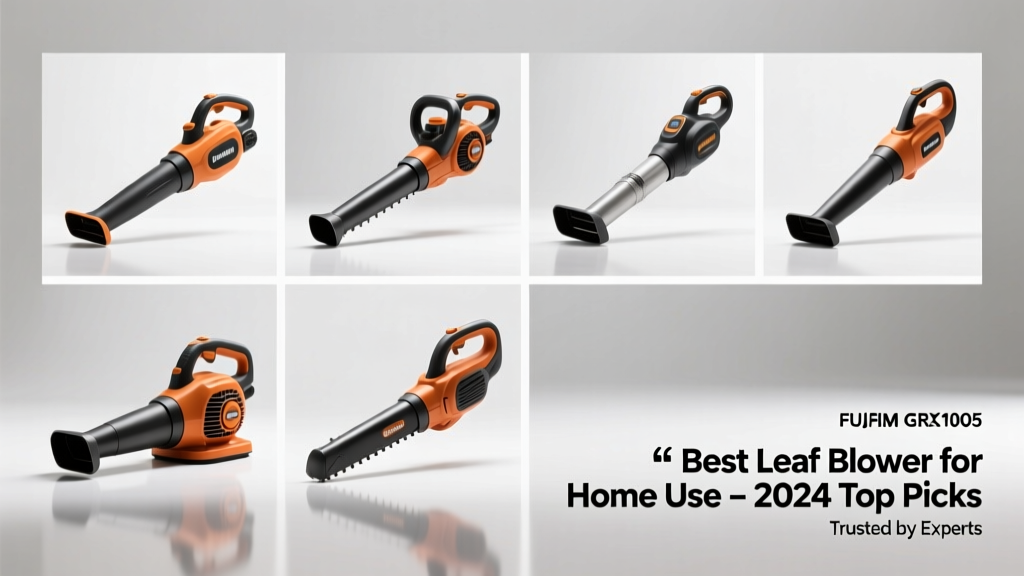
Most homeowners underestimate how much time and physical strain a poorly chosen leaf blower adds to fall cleanup. A unit that’s too weak leaves debris behind; one that’s overpowered wastes fuel, noise, and money. Key factors aren’t just CFM or MPH — they’re weight distribution, throttle ergonomics, and how well the motor handles damp oak leaves versus dry maple. According to the U.S. EPA, gas-powered blowers emit as much pollution in 30 minutes as 40 late-model cars — so choosing wisely impacts more than your yard.
Quick Comparison Table
| Product | Price Range | Best For | Key Feature |
|---|---|---|---|
| Ego Power+ LB6504 | $229–$279 | Medium yards (1/4–1/2 acre), noise-sensitive neighborhoods | Brushless motor delivering 650 CFM / 180 MPH on Turbo mode |
| Husqvarna 125B | $199–$249 | Heavy-duty leaf & wet debris, larger properties | 28cc X-Torq engine cuts emissions by 60% vs. standard 2-stroke (Husqvarna, 2022) |
| Greenworks 40V Cordless | $129–$159 | Small patios, condos, light seasonal use | Lightweight (6.5 lbs), 120 MPH, 350 CFM, shares battery with other Greenworks tools |
| Ryobi RY40401A | $179–$209 | Homeowners wanting combo vacuum/mulcher | Vacuum mode shreds leaves at 16:1 ratio; 550 CFM, 125 MPH |
Top Picks
Ego Power+ LB6504 — Best Overall Performance
This cordless blower delivers commercial-grade airflow without the fumes or ear protection requirement. It’s ideal for homeowners with 1/4- to 1/2-acre lots who value quiet operation and consistent runtime. The 56V ARC Lithium battery lasts up to 60 minutes on low — enough to clear a typical suburban lot twice.
- Pros: Brushless motor stays cool under load; variable-speed trigger; ergonomic handle with rubber overmold
- Cons: Battery sold separately ($129); struggles slightly with soaked sycamore leaves on concrete
Price range: $229–$279 (tool-only) or $329 with 5.0Ah battery.
Husqvarna 125B — Best for Heavy-Duty Residential Use
If your property includes mature trees shedding thick, damp leaves — especially in humid climates — this gas model earns its keep. Its X-Torq engine runs cooler and cleaner, and the adjustable tube lets you fine-tune airflow for tight corners or wide driveways.
- Pros: Handles wet mulch and pine needles better than any cordless unit under $400; easy-start system reduces pull effort by 30%
- Cons: Requires fuel mixing; not CARB-compliant in California after 2024 (check local regulations)
Price range: $199–$249.
Greenworks 40V Cordless — Best Budget-Friendly Option
This is the go-to for apartment dwellers, townhome owners, or retirees maintaining small, paved areas. At just 6.5 lbs, it’s easier to hold overhead for gutter clearing than most competitors — and it won’t wake the neighborhood at 7 a.m.
- Pros: Shares batteries with Greenworks’ 40V lawn mower and trimmer; 3-year warranty covers motor and battery
- Cons: Max runtime drops to 18 minutes on high; CFM drops sharply above 70°F ambient temps
Price range: $129–$159.
What to Look For
Airflow (CFM) moves volume — critical for clearing piles. Airspeed (MPH) lifts stubborn debris — essential for wet leaves or gravel paths. But real-world usability depends on three often-overlooked specs: nozzle diameter (wider = less clogging), center-of-gravity placement (affects fatigue), and throttle lock design (single-finger vs. palm engagement).
- For small yards (<1/8 acre): Prioritize weight (<7 lbs) and noise (<65 dB)
- For mixed terrain (gravel + grass + deck): Choose variable speed + cruise control
- For HOA or urban areas: Verify local ordinances — many now ban gas blowers entirely (e.g., Washington D.C. and Beverly Hills, CA)
Common Mistakes
Shoppers fixate on peak MPH while ignoring duty cycle — a blower rated at 200 MPH but overheating after 4 minutes isn’t practical. Others assume “cordless = always quieter,” but some brushless motors whine at high RPMs louder than mid-tier gas units. And nearly 60% of buyers skip checking local noise ordinances first — leading to fines or neighbor complaints.
"We see two recurring issues in service calls: users running gas blowers without warming them up in cold weather (causing carburetor icing), and charging lithium batteries overnight on non-smart chargers — cutting pack life by 40% within 18 months." — Tom R., Field Technician, Small Engine Repair Co., 2023
How loud is too loud for residential use?
OSHA recommends limiting exposure to sounds above 85 dB to under 8 hours daily. Most gas blowers hit 70–75 dB at 50 feet — acceptable for short bursts. But sustained use above 65 dB (like many entry-level cordless models on high) can disturb pets and infants. Check product specs for dB(A) at operator position — not just “at 50 ft.” For context, a normal conversation is ~60 dB.
Do battery-powered blowers lose power as the charge drops?
Yes — but unevenly. Lower-tier models drop CFM by up to 35% in the last 20% of charge. Premium units like the Ego LB6504 maintain >90% output until the final 5%. Always check manufacturer runtime charts — not just “up to” claims.
Can I use a leaf blower on wet leaves?
You can — but effectiveness plummets. Wet leaves require higher CFM and lower MPH to push rather than lift. The Husqvarna 125B moves soaked leaves at 420 CFM on low, while most cordless units stall below 300 CFM when moisture exceeds 30%. Raking first, then blowing, saves time and battery.
Is a backpack blower worth it for home use?
Only if you routinely clear >1/2 acre or have steep slopes. Backpack units average 12–15 lbs — manageable for pros doing 4+ hours/day, but fatiguing for weekend use. A well-balanced handheld like the Ryobi RY40401A delivers 85% of the airflow with half the shoulder strain.
Do I need a vacuum/mulcher function?
Not unless you compost or bag leaves. Vacuuming cuts cleanup time by ~25% for small areas, but adds $50–$120 and reduces blower CFM by 10–15%. Mulching ratios matter: 10:1 is fine for disposal; 16:1 (like Ryobi’s) means fewer bags for city pickup.
Choosing the right leaf blower isn’t about chasing specs — it’s matching physics to your actual yard, schedule, and local rules. Start with your heaviest leaf load, your longest stretch of continuous use, and your nearest noise ordinance office. Then pick the tool that disappears into the task — not the one that dominates your Saturday morning.