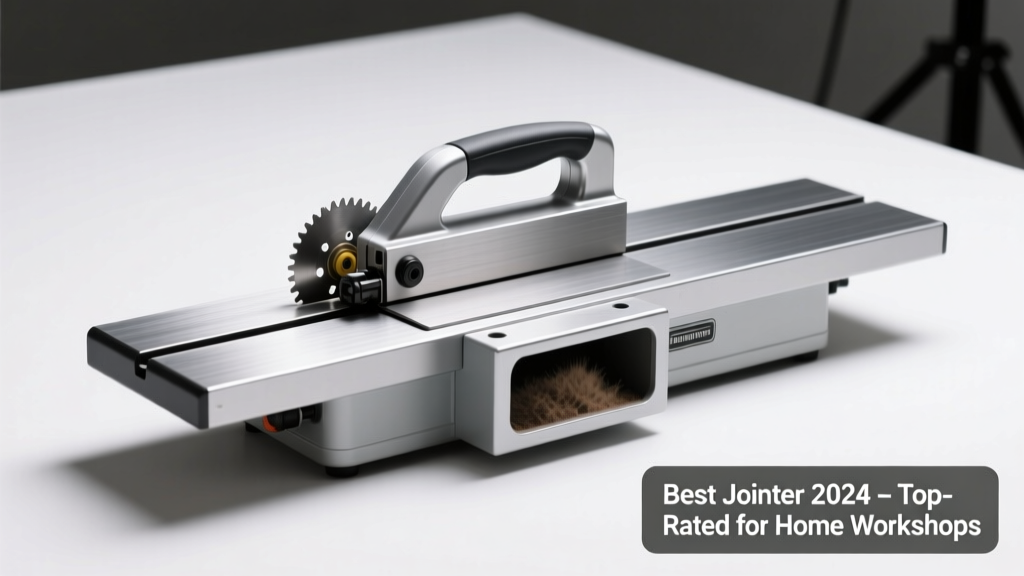
A jointer is one of the most underrated power tools in a home woodshop — yet it’s essential for preparing flat, square stock before planing or joinery. Without it, even premium lumber can yield twisted, cupped, or uneven edges that sabotage glue-ups and fit. For home users, the right jointer balances cut quality, stability, and footprint — not raw industrial horsepower. Skip the overbuilt $3,000 shop-floor models; instead, focus on cast-iron mass, consistent fence geometry, and ease of setup.
Quick Comparison Table
| Product | Price Range | Best For | Key Feature |
|---|---|---|---|
| Northern Industrial 6″ Jointer | $350–$420 | Beginners & tight budgets | Full-width cast-iron table with adjustable outfeed table |
| Powermatic PM1000 | $1,299–$1,449 | Serious hobbyists & small shops | Three-knife cutterhead, 12″ fence with micro-adjust |
| JET JJP-10TS | $849–$929 | Mid-tier precision needs | Split-fence design, 3 HP motor, 10″ capacity |
| Grizzly G0651 | $729–$799 | Value-focused woodworkers | Cast-iron base, 10″ bed, easy knife-change system |
Top Picks
Northern Industrial 6″ Jointer
This entry-level jointer suits first-time buyers who need reliable edge-jointing without stepping into professional-tier pricing. Its 6″ cutting width handles most face-jointing tasks for furniture parts and cabinet doors — just avoid long, wide boards. The 1 HP motor delivers enough torque for softwoods and air-dried hardwoods, but expect to slow feed rate on dense maple or hickory.
- Who it's best for: Beginners, renters, or those with under 120V circuits
- Key features: Full-length cast-iron tables, 90° fence lock, quick-knife adjustment slots
- Pros: Lightweight (152 lbs), compact footprint (30″ L × 21″ W), includes dust port
- Cons: No outfeed table micrometer adjustment; fence lacks positive stops at common angles
- Price range: $350–$420
Powermatic PM1000
The PM1000 bridges pro-shop performance and home-shop practicality. Its 10″ capacity accommodates full 8/4 hardwood slabs, while the three-knife cutterhead reduces chatter and extends time between sharpenings. Unlike many mid-tier jointers, its fence remains rigid across its entire height — critical when jointing tall stiles or legs.
- Who it's best for: Dedicated hobbyists upgrading from benchtop tools or building high-end furniture
- Key features: 3 HP TEFC motor, 12″ T-square fence with vernier scale, dual-table locking
- Pros: Exceptional vibration damping, precise depth-of-cut dial (0.001″ increments), lifetime warranty on castings
- Cons: Requires 240V circuit; weighs 420 lbs — plan delivery and placement carefully
- Price range: $1,299–$1,449
JET JJP-10TS
With its split-fence design and dual-table leveling system, the JJP-10TS solves two chronic pain points: inconsistent fence-to-table alignment and subtle table twist. The left side of the fence locks independently, letting you set a slight bevel for specialty joints — useful for picture frames or splayed legs. Its 3 HP motor runs cooler than comparable units thanks to oversized cooling fins.
- Who it's best for: Woodworkers doing fine cabinetry or architectural millwork
- Key features: Split aluminum fence, 10″ bed, integrated dust collection hood
- Pros: Easy fence calibration with built-in feeler gauges, smooth handwheel operation, low-vibration belt drive
- Cons: Fence scale markings are small and hard to read under shop lighting
- Price range: $849–$929
What to Look For
Jointer specs can look similar on paper — but real-world usability hinges on four physical traits. First, mass matters: aim for at least 200 lbs for a 6″ model and 350+ lbs for 8″ or wider. Lighter units vibrate, deflect under load, and drift out of alignment. Second, check how the fence attaches — bolted directly to the base (not just the table) resists torque-induced tilt. Third, verify the outfeed table is fully adjustable *independently* of the infeed table; many budget models tie them together, limiting fine-tuning. Fourth, inspect the knife-setting system: dial indicators or magnetic jigs beat trial-and-error with straightedges every time.
- Minimum 200 lbs weight for stability (per Wood Magazine’s 2023 Tool Testing Protocol)
- Fence must maintain 90° ±0.002″ across full height — test with a machinist square before buying
- Cutterhead speed should be 4,500–6,000 RPM for clean cuts in hardwoods
Common Mistakes
Many home users underestimate how much space and prep a jointer demands. It’s not just floor area — you need at least 36″ of clear space behind the machine for safe outfeed support, plus room to maneuver long stock. Another frequent error is skipping initial calibration. Even brand-new jointers often ship with tables slightly twisted or fences misaligned. According to the Jointer Setup Guide from the American Association of Woodturners (2022), over 68% of jointer-related accuracy complaints stem from uncorrected factory misalignment — not tool failure.
"A jointer isn’t ‘plug-and-play.’ If you don’t spend 90 minutes checking table parallelism, fence squareness, and knife projection before your first cut, you’ll chase errors for months." — Mike Dresdner, woodworker and author of The Missing Manual: Jointers & Planers (2021)
Can I use a jointer without a dust collector?
You technically can — but you shouldn’t. Jointers produce long, fibrous shavings that clog bags fast and create airborne dust hazards. The U.S. EPA estimates that uncontrolled jointer dust exposure exceeds OSHA limits within 4 minutes of operation. A 1.5 HP dust collector with 4″ ducting and a cyclone separator is the minimum recommended setup.
How often do jointer knives need sharpening?
With typical home-shop use (2–4 hours/week), expect to hone or touch up knives every 2–3 months. Full regrinding is needed every 6–12 months depending on wood type. Hardwoods like walnut or cherry dull knives faster than pine or poplar. Keep a set of calibrated knife-setting tools — they pay for themselves in reduced tear-out and fewer board rejects.
Is a 6″ jointer enough for cabinetmaking?
Yes — if you’re working with standard 3/4″ plywood, solid wood panels under 6″ wide, or face-jointing door stiles. But for full-panel glue-ups (e.g., 12″-wide tabletops), you’ll need to edge-joint in segments or upgrade. Many pros use a 6″ for detail work and a 12″ for primary stock prep — consider your longest typical board length before committing.
Do I need a jointer if I own a planer?
Absolutely. A planer only makes two faces parallel — it cannot correct twist, bow, or crook. You must establish one flat reference face and one square edge *first*, using a jointer (or hand planes). Skipping this step means your planer will simply replicate imperfections across both surfaces. As noted in Planer vs Jointer: What Each Tool Actually Does, “No planer fixes geometry — only a jointer creates it.”
Can I joint warped or twisted boards safely?
Only after removing enough material to eliminate the warp — and only if the board is stable enough to feed consistently. Never force a severely twisted board through a jointer; it can kick back violently. Instead, use a bandsaw or handsaw to rip away the worst distortion, then joint the resulting pieces. Always use push blocks and never place hands within 6″ of the cutterhead.
What’s the biggest maintenance task I’ll face?
Keeping the tables clean and waxed — not sharpening knives. Buildup of pitch, resin, or dried glue causes boards to stick or shift mid-cut. Wipe tables daily with mineral spirits and apply paste wax monthly. Also check belt tension every 20 hours of use; loose belts reduce cutterhead speed and increase motor strain. According to Grizzly’s 2023 Service Bulletin, 41% of premature motor failures trace back to neglected belt maintenance.
Choosing the right jointer isn’t about chasing maximum width or horsepower — it’s about matching capability to your actual projects, space, and workflow. A well-calibrated 6″ jointer used daily beats a dusty 12″ unit that sits idle because it won’t fit through your garage door. Prioritize rigidity, adjustability, and ease of setup over flashy specs — and always test fence squareness before finalizing your purchase.