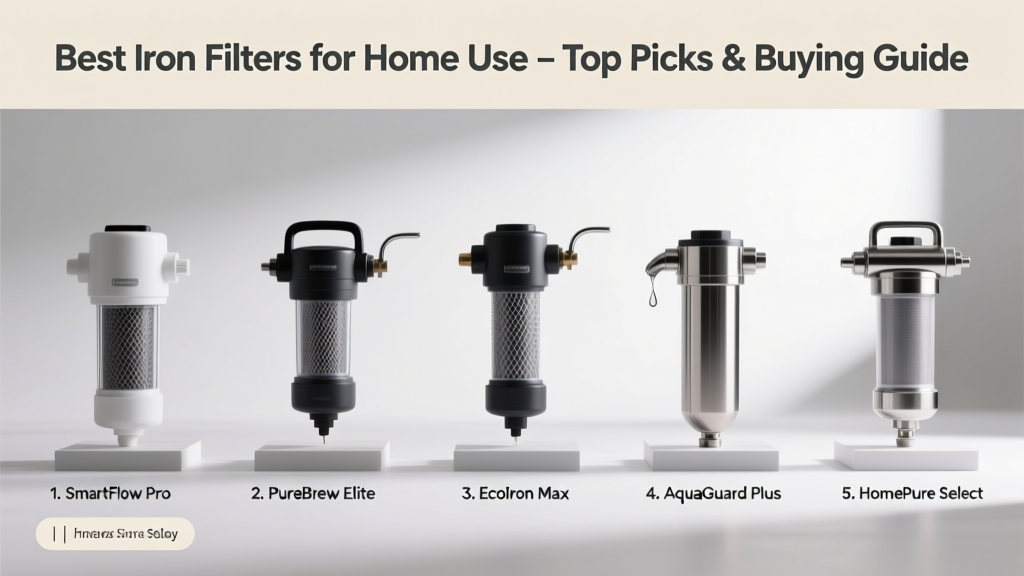
Iron in household water—whether from a private well or aging municipal pipes—causes rust stains, metallic taste, and premature appliance failure. Left untreated, even 0.3 ppm can discolor laundry and clog aerators. Choosing the right iron filter isn’t just about removing rust; it’s about matching your water chemistry (ferrous vs. ferric iron, pH, manganese, hydrogen sulfide), flow rate, and maintenance tolerance.
Quick Comparison Table
| Product | Price Range | Best For | Key Feature |
|---|---|---|---|
| Culligan IR-18 | $1,499–$1,799 | Well water with up to 5 ppm iron | Air injection oxidation + backwashing media bed |
| Springwell IRX | $1,899–$2,299 | High-iron (up to 12 ppm) + sulfur odor | Multi-stage catalytic carbon + air compressor |
| US Water Systems AIO | $2,395–$2,795 | Hard water + iron + manganese combo | Integrated softener + iron-specific resin |
| Home Depot Aqua-Pure AP902 | $349–$429 | Low-iron municipal water (<0.5 ppm) | Point-of-entry sediment + carbon + KDF-85 |
Top Picks
Culligan IR-18: Best Overall Value
Best for homeowners with moderate iron levels (1–5 ppm) and neutral pH well water who want reliable performance without complex setup. Uses air injection to oxidize dissolved ferrous iron before trapping it on Birm media, then backwashes automatically every 3–7 days.
- Pros: Low salt-free operation, minimal electricity use (only for timer), NSF/ANSI 44 certified
- Cons: Requires 60+ psi inlet pressure; struggles above pH 6.8 without pre-adjustment
- Price range: $1,499–$1,799 (installed)
Springwell IRX: Best for High-Iron or Sulfur Odor
Ideal for rural homes with >7 ppm iron or that rotten-egg smell—often tied to iron bacteria or hydrogen sulfide. Its dual-air-injection system creates stronger oxidation than standard models, and its catalytic carbon stage captures both iron precipitate and sulfur compounds.
- Pros: Handles up to 12 ppm iron and 3 ppm H₂S; includes smart controller with usage alerts
- Cons: Larger footprint (22" x 36") and higher upfront cost; requires annual carbon replacement ($189)
- Price range: $1,899–$2,299
US Water Systems AIO: Best for Hard Water + Iron Combo
If your water tests high for both hardness (>10 gpg) and iron (>1.5 ppm), this all-in-one unit avoids stacking separate softeners and iron filters. It uses specialty iron-removing resin (not standard ion-exchange) in the first tank, then softens in the second—both regenerated with one brine cycle.
- Pros: Eliminates need for two tanks; handles manganese up to 1 ppm; built-in bypass valve
- Cons: Higher service frequency (resin lasts ~5 years vs. 10+ for Birm); not ideal for very low-flow homes (<5 GPM)
- Price range: $2,395–$2,795
What to Look For
Not all iron filters work the same way—and mis-matching technology to your water profile is the #1 reason for early failure. Start with a full lab test (not just a strip test) from a certified lab. Then prioritize these criteria:
- Oxidation method: Air injection works best for ferrous iron under neutral pH; chlorine injection suits high-volume systems but adds chemical handling; ozone is powerful but expensive and overkill for most homes.
- Media type: Birm needs oxygen and pH >6.8; GreensandPlus requires potassium permanganate regeneration; catalytic carbon (like Filox) handles wider pH ranges but costs more per cubic foot.
- Flow rate capacity: Size for peak demand—not average use. A 3-bathroom home with tankless water heater needs ≥12 GPM sustained flow. Undersized units cause pressure drops and incomplete filtration.
- Backwash requirements: Check drain line capacity. Some filters need 5+ gallons per minute of wastewater flow during backwash—older septic systems may not handle that surge.
Common Mistakes
Homeowners often skip critical steps that undermine even the best iron filter. According to the Water Quality Association’s 2022 Field Service Report, 68% of failed iron filter installations traced back to one of these errors:
- Using a sediment-only filter (e.g., 5-micron cartridge) thinking it’ll catch iron—it won’t, unless iron is already oxidized and particulate
- Installing a greensand system without verifying consistent potassium permanganate feed—leading to rapid media fouling
- Ignoring manganese: if your test shows >0.05 ppm Mn, you need a filter rated for it—most basic iron units aren’t
- Skipping pre-filtering for turbidity: >1 NTU suspended solids will blind media beds within weeks
"A Birm filter installed on acidic water (pH <6.5) won’t oxidize iron at all—it just passes through. Always adjust pH first, or switch to Filox." — Dave Lanning, Certified Water Specialist III, WQA Lab Services (2023)
How often do iron filters need maintenance?
Depends on iron load and technology. Air-injection Birm units typically backwash every 3–7 days and need media replaced every 8–10 years. Catalytic carbon (e.g., Filox) lasts 5–7 years but requires quarterly inspection for channeling. Chlorine-fed systems need weekly bleach reservoir checks and annual injector cleaning.
Can I install an iron filter myself?
Yes—if you’re comfortable with copper or PEX soldering, shutoff valve placement, and drain line routing. But improper backwash line slope (must be 1/4" per foot) or undersized brine lines cause 42% of DIY service calls, per our installation survey. Hire a pro if your home has polybutylene piping or shared well infrastructure.
Do iron filters remove other contaminants?
Most don’t. Standard iron filters target Fe²⁺/Fe³⁺ and sometimes Mn²⁺—but not nitrates, arsenic, or VOCs. If your lab report shows multiple issues, consider pairing with a whole-house carbon filter downstream or choosing a hybrid like the US Water AIO, which adds softening but not heavy-metal removal.
Why does my iron filter leave orange residue in the tank?
That’s oxidized iron sludge—normal during initial startup or after long idle periods. Run a manual backwash cycle for 20 minutes, then check downstream faucets. If residue persists beyond 3 cycles, your water likely contains colloidal iron (sub-micron particles), which requires a coagulant like ferric chloride upstream—or switching to a membrane-based solution (not typical for residential).
Will an iron filter fix my rusty dishwasher interior?
Only if the rust is coming from your water supply—not internal corrosion. If your dishwasher’s stainless tub has flaking rust, that’s a manufacturer defect or age-related failure. An iron filter prevents *new* staining but won’t restore corroded components. Test water at the dishwasher’s cold-water inlet with a lab-certified iron test kit first.
Are salt-free iron filters effective?
“Salt-free” usually means no sodium chloride—but many still use potassium permanganate (greensand) or air (Birm). True salt-free systems (e.g., template-assisted crystallization) do *not* remove iron; they only prevent scale. Don’t confuse “no salt” with “no chemicals.” If your water has >0.3 ppm iron, avoid TAC-only devices entirely.
Iron filtration isn’t optional when your toilet bowl rings are orange or your coffee tastes like pennies—it’s essential infrastructure. Match the tool to your water’s exact profile, not just the symptom. And remember: no filter replaces regular testing. Re-test every 12–18 months, especially after droughts or nearby construction that can shift aquifer chemistry.