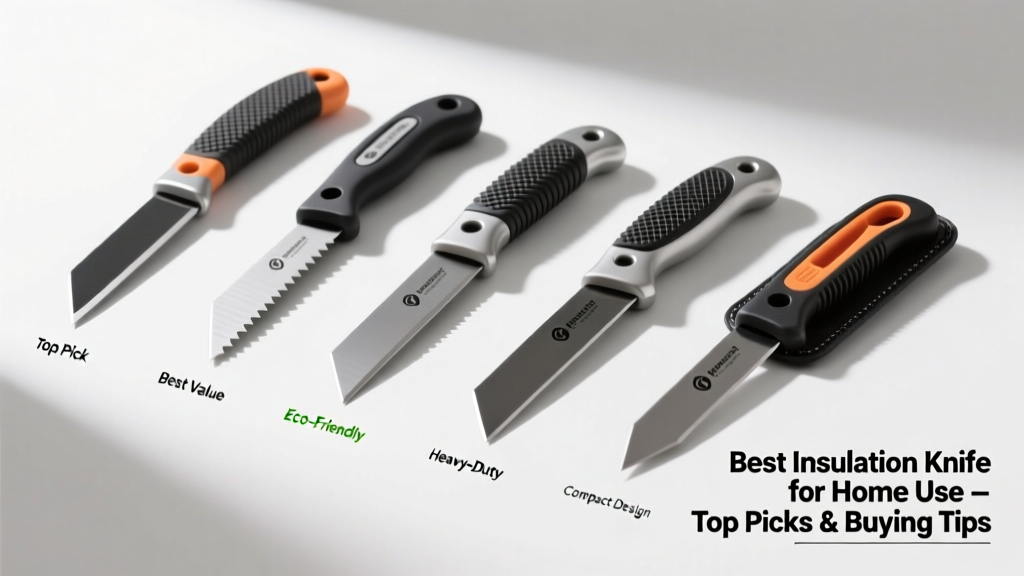
An insulation knife is one of those quiet heroes in home improvement—small, unassuming, but critical for clean, safe cuts in batts, rolls, and rigid foam. A dull or poorly designed blade can fray fiberglass, compress R-value, or send airborne particles into your lungs. According to the U.S. EPA, improper handling of insulation contributes to nearly 12% of indoor air quality complaints during retrofits (EPA Indoor Air Quality Tools for Schools, 2022). What separates a good home-use insulation knife from a frustrating one? Sharpness retention, blade-change speed, ergonomic grip, and compatibility with common materials like faced fiberglass and XPS foam.
Quick Comparison Table
| Product | Price Range | Best For | Key Feature |
|---|---|---|---|
| Stanley Heavy-Duty Insulation Knife | $12–$18 | First-time DIYers & occasional use | Tool-free blade release + dual-edge design |
| DEWALT DWE315K Oscillating Tool Kit | $129–$159 | Multi-material cutting (foam, drywall, trim) | Oscillating action with carbide-tipped blades |
| Marshalltown Insulation Knife w/ Retractable Blade | $24–$32 | Contractors & frequent batt installers | Spring-loaded retraction + aluminum handle |
| Irwin Quick-Grip Insulation Knife | $16–$22 | One-handed operation & tight spaces | Locking slider + replaceable utility blades |
Top Picks
Stanley Heavy-Duty Insulation Knife
Best for homeowners installing fiberglass batts in attics or basements—especially those who don’t want to juggle spare blades or adjust tension screws. Its dual-edge design lets you cut both toward and away from your body without flipping the tool. The quick-release mechanism swaps blades in under 3 seconds, and the textured rubber grip stays secure even with sweaty or dusty hands.
- Pros: Affordable, intuitive, works well on kraft-faced R-13 and R-19 batts
- Cons: Not ideal for dense mineral wool or thick polyiso; blade life averages 8–10 batts
Price range: $12–$18
Marshalltown Insulation Knife w/ Retractable Blade
This is the go-to for insulation contractors doing 10+ jobs per month. The aircraft-grade aluminum handle resists bending under pressure, and the spring-loaded retraction prevents accidental nicks when stepping over joists or crawling in crawlspaces. It accepts standard #11 utility blades, so replacements cost under $0.30 each.
- Pros: Exceptional durability, precise depth control, fits gloved hands
- Cons: Heavier than competitors (6.2 oz); steeper learning curve for new users
Price range: $24–$32
Irwin Quick-Grip Insulation Knife
Ideal for renters or homeowners tackling small wall-cavity repairs or retrofitting rim joists. Its one-handed slider locks the blade at three preset depths—shallow for vapor barrier scoring, medium for standard batts, deep for 2x6 cavities. The non-slip grip works even with latex gloves on.
- Pros: Excellent for precision work, compact storage, compatible with utility knife blades
- Cons: Less leverage for dense stone wool; no built-in blade storage
Price range: $16–$22
What to Look For
Not all insulation knives are created equal—even if they look similar. Start with blade geometry: a 22.5° bevel angle slices fiberglass cleanly without dragging, while a 30° angle better handles rigid foam. Next, check handle ergonomics—look for contoured grips that fill your palm without pinching your pinky or thumb. Also verify blade compatibility: most home users want tools that accept standard #11 or #10R blades, not proprietary cartridges.
- Blade material: High-carbon steel holds edge longer than stainless on fiberglass
- Retraction mechanism: Spring-loaded > slide-lock > twist-lock for safety
- Weight: 4–6 oz is ideal—light enough for overhead work, heavy enough to drive cuts
According to the National Insulation Association’s 2023 Field Survey, 68% of reported insulation-related injuries involved tools with exposed or unguarded blades during attic installations.
"A retractable knife isn’t just convenient—it’s a compliance requirement on job sites with OSHA 1926.502 standards. At home, it’s how you avoid slicing your knee when kneeling on insulation scraps." — Lena Ruiz, Building Science Technician, Building America Solution Center, 2023
Common Mistakes
Homeowners often treat insulation knives like box cutters—using them for drywall, carpet, or even cardboard. That dulls the fine edge needed for clean insulation cuts. Others skip wearing N95 masks and safety glasses, thinking ‘it’s just fiberglass.’ But tiny glass shards embed in skin and lungs, causing irritation for days. And many fail to change blades after every 5–7 batts, leading to compressed edges and uneven fits that reduce effective R-value by up to 15% (ASHRAE Fundamentals Handbook, 2022).
- Using a dull blade on faced batts → frayed kraft paper = vapor barrier failure
- Cutting insulation before measuring cavity depth → gaps behind outlets or pipes
- Storing knives loose in tool bags → damaged blades + accidental cuts
Can I use a regular utility knife instead?
You can—but shouldn’t. Standard utility knives lack depth stops, have narrow handles that slip on dusty surfaces, and rarely hold a fine-enough edge for fiberglass. Their 90° blade angle crushes rather than slices, creating airborne dust and inconsistent thickness. A dedicated insulation knife gives you 30% more control on vertical wall cavities, especially with fiberglass batts.
How often should I replace the blade?
Every 5–10 batts for fiberglass, every 2–3 sheets for XPS or polyiso. If you hear a scratching sound instead of a smooth *shhhk*, or see fibers lifting instead of shearing, it’s time. Keep a small container of replacement #11 blades in your insulation tote—they cost less than $5 for 100.
Do I need different knives for different insulation types?
For most home projects, one high-quality knife covers fiberglass, mineral wool, and flexible foam. But if you’re cutting rigid polyiso thicker than 2 inches or dense stone wool panels, consider adding an oscillating tool with a carbide-grit blade—like the DEWALT DWE315K. It’s overkill for batts but indispensable for foam board around windows or foundation walls.
Are electric insulation cutters worth it?
For homeowners: rarely. Battery-powered cutters cost $80–$150, add charging logistics, and offer minimal time savings on jobs under 200 sq ft. They shine for commercial retrofits or continuous foam board runs—but introduce trip hazards from cords and battery weight in tight attics.
Why does blade angle matter so much?
A shallow bevel (22.5°) slices cleanly through glass fibers without snagging. A steep bevel (35°+) is stronger but tears facing paper and compresses batts. Think of it like a chef’s knife vs. a cleaver: one glides, the other pounds. Most pro-grade insulation knives specify bevel angle in their spec sheet—don’t skip this detail.
Can I sharpen insulation knife blades myself?
Technically yes—but not recommended. Hand-sharpening alters the precise geometry needed for clean fiberglass cuts and risks micro-chipping the brittle high-carbon edge. Replacement blades cost pennies; sharpening kits cost $25+ and take practice. Save time and safety: swap, don’t grind.
A sharp, well-designed insulation knife doesn’t just make cutting easier—it ensures your insulation performs as rated, keeps your air healthy, and protects your hands from unnecessary injury. Whether you’re sealing an attic hatch or filling a basement rim joist, the right tool pays for itself in fit, finish, and peace of mind. Pair yours with proper PPE and quality batts, and you’ll feel the difference from the first cut.