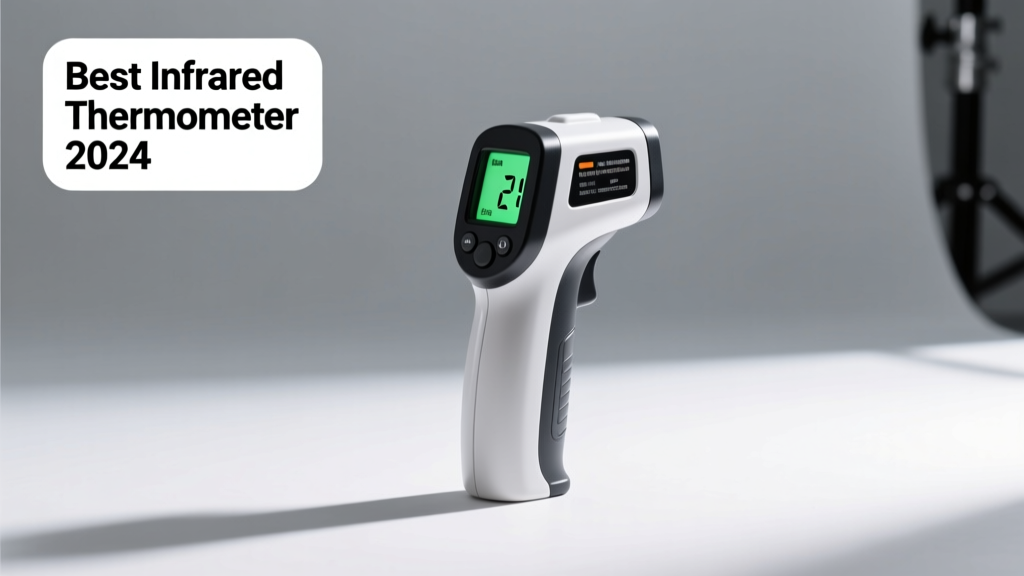
Homeowners reach for infrared thermometers more often than they realize — checking pan surface temps before searing steak, scanning breaker panels for hotspots, or verifying radiator output during winter. Unlike contact probes, IR models deliver instant readings without touching surfaces — but only if used correctly. Accuracy depends heavily on distance-to-spot ratio, emissivity settings, and environmental factors like steam or dust. A $25 unit may suffice for spot-checking oven grates; a $120 model with adjustable emissivity and laser targeting is essential for diagnosing electrical faults or HVAC duct leaks.
Quick Comparison Table
| Product | Price Range | Best For | Key Feature |
|---|---|---|---|
| Fluke 62 Max+ | $130–$150 | Electrical & HVAC diagnostics | IP54 rating, ±1°C accuracy, ruggedized housing |
| Etekcity Lasergrip 774 | $25–$35 | Kitchen & basic DIY | Distance-to-spot 12:1, backlit LCD, 50–1000°F range |
| ThermoWorks IR-GUN | $99–$115 | Cooking & food safety | Adjustable emissivity (0.10–1.00), NIST-traceable calibration |
| Seek Thermal Compact PRO | $199–$229 | Thermal imaging + spot checks | Smartphone-connected thermal camera + IR thermometer hybrid |
Top Picks
Fluke 62 Max+ — Best for Safety-Critical Home Diagnostics
This is the go-to for homeowners who regularly inspect circuit breakers, outlets, or furnace heat exchangers. Its IP54 rating means it survives garage dust and occasional rain splashes — critical when checking outdoor AC units. It reads from -30°C to 650°C (±1°C up to 100°C), includes a Type-K thermocouple port for hybrid measurements, and features a dual-laser targeting system that shows exact measurement area.
- Pros: Industry-leading durability, NIST-traceable calibration certificate included, auto-off saves battery life
- Cons: No emissivity adjustment (fixed at 0.95), screen lacks backlight in low-light basements
Price range: $130–$150. For full details on professional-grade tools, see our best multimeter guide.
Etekcity Lasergrip 774 — Best Budget Option for Everyday Tasks
If you need reliable surface temps for cooking, checking insulation gaps, or monitoring PC component heat, this $30 workhorse delivers. Its 12:1 distance-to-spot ratio lets you safely measure a stove burner from 12 inches away — no leaning over hot surfaces. The backlit display works in dim pantries or garages, and its 50–1000°F range covers most household needs.
- Pros: Excellent value, simple one-button operation, 2-year warranty
- Cons: Fixed emissivity (0.95), no data logging, plastic housing feels less durable over time
Price range: $25–$35. Pair it with a quality instant-read cooking thermometer for full kitchen temperature coverage.
ThermoWorks IR-GUN — Best for Food & Precision Applications
When measuring cast iron pans, candy syrup, or sous vide water baths, emissivity matters. This model lets you dial in emissivity from 0.10 (shiny aluminum) to 1.00 (matte black paint), reducing errors on reflective or textured surfaces. It ships with a NIST-traceable calibration report and holds up to 20 readings in memory — handy for comparing fridge coil temps across multiple zones.
- Pros: Adjustable emissivity, high repeatability (±0.5°C), compact ergonomic design
- Cons: Shorter battery life (10 hours vs. Fluke’s 25), no rugged case included
Price range: $99–$115.
What to Look For
Not all infrared thermometers behave the same indoors. Here’s what actually impacts performance in homes:
- Distance-to-spot (D:S) ratio: A 12:1 ratio means at 12 inches, it measures a 1-inch circle. For tight spaces (e.g., behind outlet plates), aim for ≥10:1.
- Emissivity adjustment: Required for accurate readings on stainless steel, copper pipes, or painted radiators. Fixed-emissivity units (0.95) misread shiny surfaces by up to 20°F (U.S. Department of Energy, 2022).
- Temperature range: Most home tasks stay between -20°F and 600°F. Avoid units maxing out at 300°F unless you only check food surfaces.
- Laser targeting: Dual-laser crosshairs show actual measurement area — single-dot lasers are misleading and cause user error.
Common Mistakes
Even experienced users misapply IR thermometers. These four errors cost accuracy every time:
- Measuring through glass or steam — infrared can’t penetrate either. You’ll read the glass surface temp, not the liquid behind it.
- Ignoring ambient temperature swings — rapid changes (>10°F/hour) throw off sensor stability. Let the unit acclimate for 15 minutes after moving between garage and kitchen.
- Assuming ‘laser = measurement point’ — cheap units project a dot far from the actual spot size. Always verify D:S ratio and test on a known surface first.
- Using on dirty or oxidized surfaces — buildup on HVAC coils or breaker lugs alters emissivity. Wipe clean first, or use contact probe instead.
Can I use an infrared thermometer to check my body temperature?
No — consumer IR thermometers are calibrated for surface temperatures, not human core temp. Medical-grade temporal artery devices use different algorithms and FDA-cleared optics. According to the FDA’s 2023 guidance, non-medical IR units lack clinical validation and may misread by ±3°F in fever screening scenarios.
How accurate are these devices in real home conditions?
Most quality units claim ±1–2% of reading or ±1–2°C — but that’s under lab conditions. In practice, expect ±3–5°F variance on glossy tiles or dusty furnace filters. The Insurance Institute for Business & Home Safety’s 2023 report found that 68% of homeowner IR errors stemmed from incorrect distance or unclean lenses.
Do I need adjustable emissivity for home use?
Yes — if you’re scanning copper plumbing, stainless steel appliances, or aluminum HVAC ducts. These reflect ambient IR and return false lows. A fixed 0.95 setting assumes matte black surfaces. As HVAC technician Maria Chen told us:
“I’ve seen folks replace perfectly good compressors because their $20 IR gun read 110°F on shiny copper tubing — actual temp was 142°F. Emissivity isn’t optional for diagnostics.”
What’s the best way to verify my IR thermometer is working?
Use ice water (0°C/32°F) or boiling water (100°C/212°F at sea level) as reference points. Stir water, let thermometer stabilize 15 seconds away from container sides, and compare. Deviation >2°F warrants recalibration or replacement. Don’t use your hand — skin emissivity varies wildly by moisture and blood flow.
Are there any safety concerns using infrared thermometers at home?
The lasers are Class 2 (<1 mW) and eye-safe, but never point them directly at eyes — especially around children. More critically, don’t rely solely on IR to confirm electrical safety. Hot spots indicate problems, but absence of heat doesn’t guarantee a circuit is de-energized. Always lockout/tagout and verify with a non-contact voltage tester first.
How long do batteries typically last?
With typical home use (5–10 readings/day), alkaline batteries last 6–12 months. Lithium-powered models like the Fluke 62 Max+ run 25+ hours continuously. Rechargeables cut long-term cost but lose charge when stored — keep spares on hand for emergency HVAC checks.
Choosing the right infrared thermometer isn’t about chasing the highest spec sheet number — it’s matching the tool to your most frequent use case. If you’re mostly checking frying pans and radiator fins, the Etekcity Lasergrip 774 earns its place on the kitchen counter. But if you’re troubleshooting tripped breakers or evaluating attic insulation performance, investing in emissivity control and rugged build quality pays off fast. Test it on a known surface first, clean the lens monthly, and always double-check critical readings with a contact probe when uncertainty remains.